
Senior Research Engineer at DeepMind Currently working on Gemini Omni Previously Veo 3, Veo 2
Joined October 2021
- Tweets74
- Following386
- Followers217
- Likes2.4K



Andrew Marmon retweeted

I did say we'd be releasing our models periodically...introducing Gemini 4 Carbon, our next frontier model.
Following Argon's release just two weeks ago, Carbon shows the pace at which we’re pushing the frontier, it ranks #1 on the recently updated v5.0 of @ArtificialAnlys Intelligence Index at 59. It also leads across key cybersecurity evaluations scoring 88.2% on SEC-bench Pro for finding vulnerabilities, 54.8% on ExploitGym for exploitation, and 71.0% on CWE-bench for patching.
We’re seeing significant improvements in long-horizon tasks even compared to Argon, and we’ve strengthened frontier safeguards.
As we did with Argon, we’re going to roll it out gradually + responsibly. Some trusted cyber defenders will get access starting this week. We'll be expanding it to more partners through our Fairwind Program, ahead of wider availability soon, so hang tight!

Andrew Marmon retweeted

AI will not automate radiologists like you think
We have been talking for years now about AI automating jobs. Radiology has been a prime target, with Geoff Hinton once claiming, “people should stop training radiologists now, it’s just completely obvious that within five years, deep learning is going to do better than radiologists”, which is funny since he said that in 2016. There is now more demand for radiologists than ever, so clearly things did not turn out the way many thought. Here I will make a prediction that while radiology will change in the coming decade, radiologists will not be automated away any time soon. I will use radiology as an example but I think these principles will broadly apply to any field where demand can be elastic and quality can scale with increased intelligence.
First of all, we have seen in the short history of language models that there is a “jagged edge of intelligence”, where AI excels at verifiable tasks with a lot of data but is underwhelming on less common tasks. One thing most AI researchers underestimate about radiology is that it is actually extremely multi-task. There are at least a hundred conditions that can be diagnosed from x-rays alone, and thousands using CT and MRI. AI will first master common and easy-to-see conditions and it will not be as good as experts at less-common diseases just because there is less data for that. This jagged edge will certainly improve over time but this means that AI will certainly be used as a triage tool at first, rather than full automation in one go. I would guess that this process from solid triage tool to full automation would take 3-5 years in the best case scenario, because training AI to get all the edge cases right will be bottlenecked by data collection of rare diseases, and also because radiology isn’t currently a focus for frontier labs.
Second, there will be elastic demand for radiology as it gets cheaper per unit. I think elastic demand (“Jevons paradox”) is the most underrated phenomenon when people think about AI automation. In software, it is obvious that I have way more demand than before because Claude Code makes it so easy. These days I ask Claude Code to build a custom three-thousand line html viewer to help me visualize every little RL run that I do. The same thing will happen in radiology. If there is essentially no cost or latency of interpreting an MRI, a physician can order many scans preemptively to better diagnose a case. So with AI tools, a radiologist might have to read only 20% of inbound scans, but there might be 5x more scans inbound. Many developing countries have fewer than one radiologist per million people and they will also want to send a lot of radiology to be interpreted.
Longer term, cheap and fast radiology interpretation will also drive incentives to build cheaper radiology scanners. If an MRI had essentially no latency for interpretation, medical devices companies will want to build much cheaper MRI machines that can be used more frequently, perhaps even in the middle of a surgery. AI will accelerate the development of scanning technology, too. If a full body MRI was only $100 dollars I would totally want to get one every month instead of every two years. I can imagine a world where people get 10 or 100x the number of scans they do today, largely for preventative care, if radiology were 10-100x cheaper.
Third, even if we did have a model that could outperform the world’s best radiologists today, that would not be the end of all work on radiology. Medicine is a field of change. We may develop new treatment protocols that require reading radiology images in a way that radiologists currently aren’t used to. New scanners may reveal diseases that we cannot currently diagnose today with radiology alone. Some radiologists will change their work from reading scans to doing frontier research to advance our understanding of radiology and translate new knowledge into updated models.
Moreover, I am sure that we will ask for more out of our AI models than ever before. With a good flywheel, we may one day train AI models that can use radiology images to predict disease probabilities far into the future. With good prediction algorithms, cancer may be detected months earlier than we can detect it now. Society will invest a lot into this research and this will contribute even more to increased demand for radiology and the best AI around it.
On top of all of this, the medical system is typically slower to adopt new technology and has more regulation compared to technology companies. There is legacy infrastructure and medical centers need to constantly support patients which makes it hard to integrate new technology. This is even more true in developing countries. Moreover data access tends to be limited due to HIPAA, deidentification, IRBs, etc. So I think radiologists will be in demand for a while.
While some worry about radiology being totally automated, I think there is a more exciting future for radiology than ever before—one where there is more demand and we ask for more predictive power from our intelligence. This is similar to how many of us feel that programming will thrive more than ever before despite drastic change in the field. More generally, any domain where demand can be elastic and quality can scale with increased intelligence will, like radiology, similarly flourish with the development of AI. This is certainly a more exciting and nuanced future than what Hinton described in 2016!
(Finally, to be fair to Hinton, he did acknowledge in a recent podcast that he was wrong and also agrees with the elastic demand argument.)
Thanks @JayRothschild and @engyziedan for feedback on this post.
Andrew Marmon retweeted

Argon can also plan effectively in world models!
Here it went through an iterated loop of 1) writing out plans for how to achieve a goal 2) using an omni world model to simulate consequences of actions 3) reflect on produced rollouts to modify the plan. This is the resulting video plan.
More details in our blog - developers.googleblog.com/ge…
Andrew Marmon retweeted

(1/7) I'd like to provide some additional context for the remarks that can be found in this interview.
(2/7) My discomfort with the attention being paid to existential risk---and with the ongoing dominance of the public discussion of such risks by a few so-called thought leaders---is that there's an elephant in the room that is being missed. That elephant is the effect of all of this discussion on young people, and indeed the effect---beginning with social media a decade ago---of information technology on young lives broadly speaking.
(3/7) I recently read an interview by Jill Lepore in which she reports on discussions that she had recently with a group of college students: "They had just three things to say. One, social media completely destroyed their childhoods. Two, AI is destroying their college education and their likely prospects for employment. And three, what the hell are we all doing?" To add a fourth bullet that I've heard in similar discussions: "I'm not going to have children, because the existential risk is just too high."
(4/7) Please contemplate such a statement, those of you who think that it's OK that the public, widely diffused, discussion coming from seemingly authoritative figures is so adamant about existential risk.
(5/7) Let me add that I have little interest in a debate about what "superintelligence" might mean, or whether we're currently seeing the emergence of superintelligence. For what it's worth, I would certainly agree that the solution of extremely challenging math problems (for example) exhibits a very impressive form of intelligence, although I would want to argue that such intelligence is impossible to dissociate from the collective of humans that provided data to the machine learning system (which itself has become a kind of collective).
(6/7) Such philosophical debates are entertaining and even important, but when they then head in the direction of "when such superintelligence emerges, there's a good chance that it will want to kill all humans", I say "science fiction". Again, I don't think that it's bad to consider such thoughts, but I strongly believe that it's bad for society, and especially young people, for such thoughts, unaccompanied by any serious real-world analysis, to become a dominant form of discourse of the era.
(7/7) We are damaging human lives, and the consequences of that damage will no doubt be a major theme of the next several decades.
Andrew Marmon retweeted

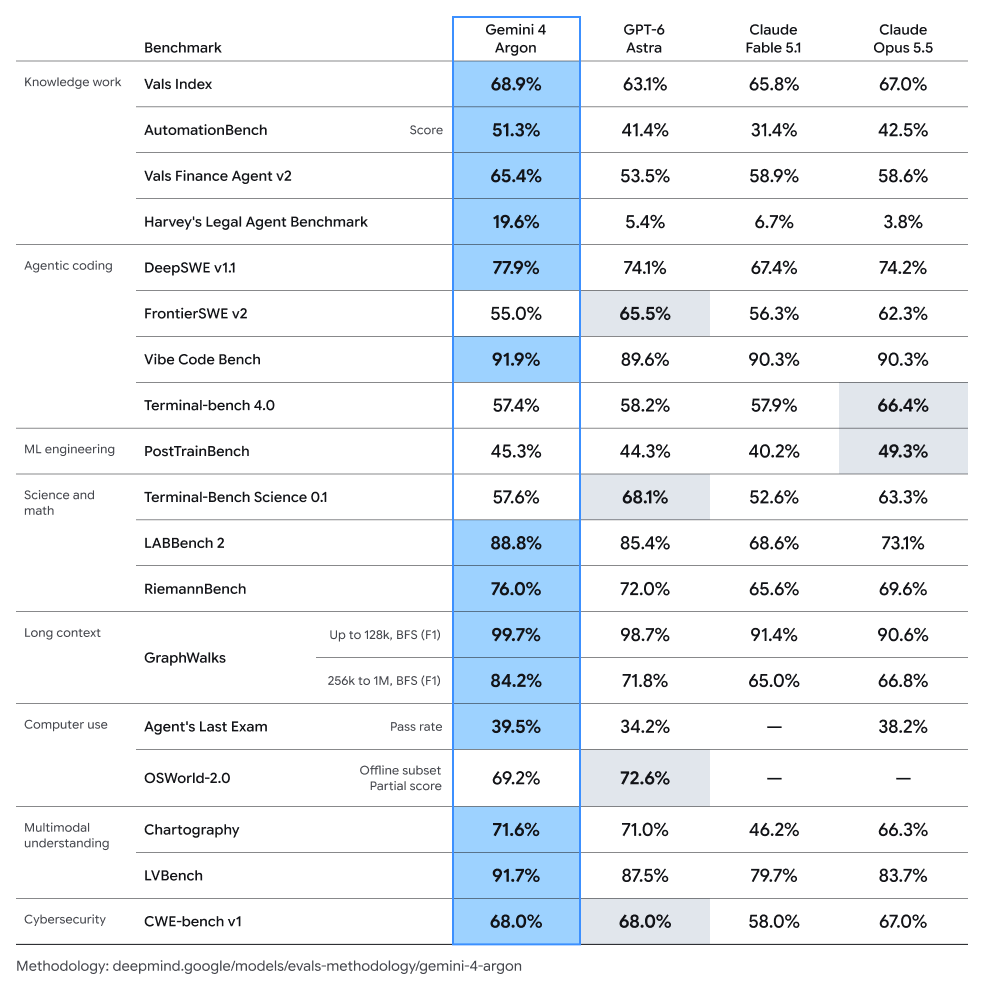
Gemini 4 Argon officially takes the #1 spot on the Text Arena leaderboard with an Elo of 1,525.


Andrew Marmon retweeted

We are hiring research scientists and engineers🧑🔬 on the Gemini Omni team! Both in the US (Mountain View / SF) and Europe (London / Zürich).
Apply here: google.com/about/careers/app…

Andrew Marmon retweeted

We’re hiring! This is a rare opportunity to work with the folks that built Veo, Genie, and Gemini Omni — and advance the frontier of world models.
More details below 👇

Andrew Marmon retweeted

>sam altman: "we tried this because there were rumor on the internet"
>rumor: math professor close to solving navier-stokes
>the professor: using codex for a year
>openai: has all his logs
>checked every codex session tagged to N-S
>found the most promising one
>spun up 10,000 agents to finish the proof where he couldn't
>they got caught
>told the guy if you say anything you'll destroy your own career
>he ruins his career over this
>openai: "we did not see his work"
>also openai: "we cannot rule out that de-identified data from their usage helped improve our models"
they stole it lmao


Andrew Marmon retweeted

Terry Tao is probably the most measured, pro-AI mathematician on the planet - which makes this quote especially concerning to read. 😟
If sharing your hunches means getting scooped ~immediately without acknowledgement, then we're going to see not just math but all other science / engineering disciplines go dark.


Andrew Marmon retweeted

Fun test of Gemini Omni's video editing and location knowledge ✨
I uploaded a video riding in a Waymo in Menlo Park.
Then I asked Omni to re-shoot the video in different locations based on screenshots from Google Maps.
It's seamless, as you can see from the transitions 👇
Andrew Marmon retweeted

Gemini Omni is a major leap in world understanding & multimodal editing! It can take photos, video & audio and build entirely new scenes. Over time it’ll be able to handle any input & any output - starting w/ video
You can even give it your own videos & iterate on your ideas:
It's definitely informative / humbling to reach a plateau, but even more informative when you learn how to break through a rank you've been stuck at for months or even years. The most important and transferrable skills are learned at these points.

Andrew Marmon retweeted

Agreed. Mass surveillance violates the Fourth Amendment and has a chilling effect on freedom of expression. Surveillance systems are prone to misuse for political or discriminatory purposes.

Andrew Marmon retweeted
Today, Veo 3.1 Ingredients to Video is getting more expressive + portrait mode has arrived (we heard you!)
You can now create vertical clips with livelier movement and better control directly in the @Geminiapp, @YouTube & Google Vids.
All this plus state-of-the-art upscaling to 1080p and 4K also coming to @flowbygoogle, the Gemini API and Vertex AI.

Veo is not just a video generation model, it's a zero-shot reasoner (arxiv.org/abs/2509.20328) and we've now shown it's also a capable world model.
We evaluated Gemini robotics policies in an action-conditioned Veo model and found that the results directly correlate to real-world performance. We can test rollouts entirely in simulation and expect that the most successful policies will also transfer to reality. Crazy.


Generalist robots need a generalist evaluator. But how do you test safety without breaking things? 💥
🌎 Introducing our new work from @GoogleDeepMind:
Evaluating Gemini Robotics Policies in a Veo World Simulator
veo-robotics.github.io
🧵👇
Thanks to the incredible collaborators from the Gemini Robotics team @SeanKirmani, @AllanZhou17, @Majumdar_Ani, @fangchenliu_, @sherryyangML, @xf1280, @debidatta, @Stacormed, @xiao_ted, @vikassindhwani, @shahdhruv_, @du_yilun and to the amazing colleagues on the Veo side @tkipf, @RuiqiGao, @YuliaRubanova for pushing this forward!