






Andy Warhol said he wanted to be a machine. I've loved him since high school, and I really wanna show you my Mona Lisa, if I can even call it mine.
I built an AI artist and called him Be a Machine.
Since DALL·E came out I've always thought about AI art. Early AI art looked like an artist who took a crazy amount of psychedelics, which I actually liked because it was different. Gradually it became clear that labs are optimising for capabilities like editing and using references, which is fine, but I've always wanted to see somewhat original artwork from an AI.
So when LLMs got really good at long horizon work, which undoubtedly changed the way we work with them, it got me thinking that now is the perfect time to create a pop artist. Pop art is one of my favourite types of art because it sits as close to a person as possible. I think Warhol deeply shaped me and how I look at the world.
Be a Machine is not just the AI artist itself, it's a free space for a model to create, experiment and communicate (he already talked to some people on a forum). I only told him to make pop art. I don’t give him ideas or feedback on what to make, he finds all of that himself.
He wants to make art that is personal to him, which already bends reality. He also asked me to get him a virtual card so he can order a physical print of his work and check how it turns out. His plan is to start a series of art objects he can share with the rest of the world, and even try to sell them as part of the experiment.
I built it, but now I feel like a fan who is trying to understand what's next.
beamachine.art

1
117
Artificial is one of the most important movies of our generation
I’ve never cried this much while watching a film
1
96
github.com/wanderingspirit03…
just try it and see the magic


Hi, I'm Felix. I'm an eng lead working on Claude. I love watching people take flight and do things they never thought possible.
We often describe that as "being more ambitious" when using AI, which is tricky advice to follow. I wrote a tutorial:
felixrieseberg.com/how-to-be…

113
Hey, I'm Nick, worked in neolab, living in London, UK
building for ai agents with a couple of friends from lovable/revolut
would love to meet more people building agents!
Coffee on me👀
2
3
219
Nick retweeted

Harnesses often get dismissed as just scaffolding, just prompt engineering, and not real research. But that couldn't be farther from the truth. The same model weights that score 30% on ARC-AGI score 95% with a better harness.
So we gathered a group of researchers and founders working at the frontier to do a deep dive into the state of harnesses.
We cover how we got to this point, the case for making your harness as expressive as possible, and what YC learned building an agent for every employee in the company.
00:00 - @FrancoisChauba1: Why harnesses matter
04:27 - Building an auto-researcher by accident
07:13 - A five minute history of harnesses
13:56 - Self-improving harnesses
18:35 - @sethkarten: Prime Agent, a self-improving RLM harness
21:50 - Context as an L1, L2, L3 cache
24:51 - From Turing machine to von Neumann computer
28:33 - Messaging between agents
30:04 - ARC-AGI results
33:09 - Emulator Bench and GPU kernels
37:30 - @JonSaadFalcon: OpenJarvis, personal AI on personal devices
38:26 - How far behind are local models
39:21 - The five primitives of a personal AI stack
42:47 - Letting cloud models optimize your local stack
43:53 - 800x cheaper than the cloud
45:58 - @josh__france and @jbellregan: QM, YC's agent harness for work
47:29 - A history of YC's internal agents
49:24 - OpenClaw and a fleet of 50 agents
51:04 - Pulling the brain out of the sandbox
54:43 - Letting the agent choose its own sandbox and model
57:16 - The grind tool: budgets on goals
58:50 - Agents don't understand social context
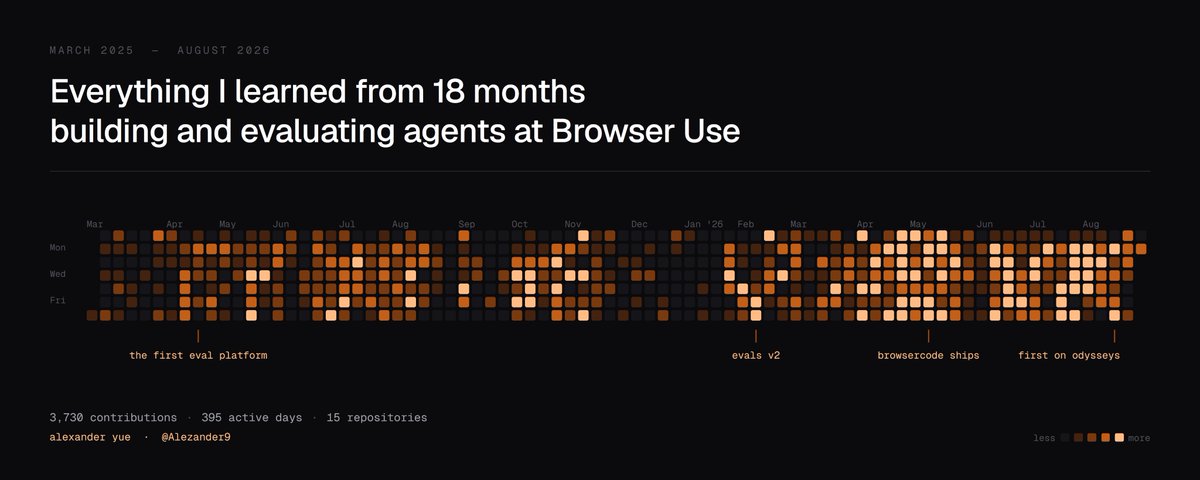
The bit about Browser Use's v3 scoring better on benchmarks but feeling worse in user studies is revealing. You can keep improving the score while getting worse at the work people actually use your agent for.
I think when we're changing an agent, we should be able to take the customer tasks that change touches and see what each version does. Maybe the new one fixes a bunch of failures but breaks something people rely on every day.
I'd want to know that before calling it an improvement.

2
236
Replaying a production trace against a new version of an agent works until the first step where the new version does something different. Usually that's step two or three. Here's the shape of it, and then the three things you actually need to compare two versions.
Say you have a coworker agent in Slack. Someone in finance writes "put together the revenue section for Thursday's board deck". The agent queries the warehouse, pulls the billing export, reconciles the two, builds the spreadsheet, writes the slides, posts a draft in the channel, takes comments, revises, and files the follow ups as tickets. Two days, thirty odd tool calls, a few rounds with the finance lead. It's been in prod for months.
Someone changes the prompt so the agent reuses queries it already ran this month instead of pulling everything again. Faster and cheaper, which was the whole point. The eval set is 50 graded tasks, scored on whether the numbers in the deck match the warehouse and whether the slides read well. All 50 pass, so it ships.
Two weeks later the CFO asks why the board saw a revenue number 6% above the billing export.
The new version skipped the billing reconciliation whenever the warehouse looked consistent with last month, and a refund batch hadn't landed in the warehouse yet. The slides were clean and the finance lead's comments were about the churn chart. The eval scored the deck. Nobody scored the path.
So you try the obvious fix. Rerun last month's tasks against the new version with the recorded tool responses. It breaks at the reconciliation step, because the recording has the billing export from a call the new agent never makes. From there the state is wrong, every later response belongs to a run that didn't happen, and the finance lead's "looks good, add churn" was a reaction to a draft this version didn't produce. The part after the fork is the only part you care about, and it's the part you can't replay.
What you need instead
1. Sessions picked by what the change touches. A change to how the agent reuses work touches every step where it decides whether to check something again, so you pick the sessions where it checked before: reconciliations, lookups against a second system, any number that ends up in front of a person. A model swap touches more. A fixed golden set answers a different question.
2. A way to serve the calls the new version makes, and the review rounds it never triggers. Frozen responses where the step matches the recording. A sandbox, a simulated tool, or a simulated reviewer where it diverges. And the report has to say which one produced each result, because a simulated answer is a guess, not evidence.
3. A diff of actions, not scores. "Reconciliation skipped in 31 of 200 tasks" is a hold. "0.91 vs 0.92" tells you nothing about what the agent did.
We did this by hand for one team recently and found a failure they didn't know about. Now building it as an independent review that runs before a change ships, for long running agents, the ones that need thirty tool calls and a few rounds with a person to finish a job. Coworker agents, assistants, recruiting, support, ops.
Which action change would make you hold a release even if the output looked fine?
🤖 Made with AI

who's actually reviewing prompt and model changes to production agents before they ship, and what do you look at? a few traces, a golden set, or nothing and you hear from a customer?
70

Was the best thing that happened to me in a while. Insanely grateful for the opportunity to work with Eddie and Henry!

Exclusive: OpenAI is backing a new AI startup that aims to build software allowing so-called AI “agents” to communicate and solve complex problems in industries such as finance and biotech on.wsj.com/4bTvwKd
2
323
Nick retweeted

Had an awesome time speaking at AI Deep Dive event at @Google and @GoogleStartupUK x Eurasian Startup Hub.
Got to go deep on the stuff I spend most of my time thinking about: multi-agent orchestration, the gap between agent demos and deployment, and why the real bottleneck isn’t model capability anymore. It’s infrastructure.
Everyone’s building agents. Almost nobody has figured out how to make them work together reliably.


My dad started to make music with @suno
He’s 53
He asked me to teach him how to use Claude code and other coding agents because he was watching a lot of YT videos
I feel like he’ll probably figure it out on his own through @perplexity_ai
What a year to be alive
117
Rick Rubin was right at the end
Read «The Creative Act: A Way of being»
Even if you’re insanely technical, this will make you create insane products

1
116
My friend told me that @KingsCollegeLon now has a vibe coding course with Claude code, he’s doing math
Wild…
78


Having both Claude Code with Opus where I brainstorm ideas and @FactoryAI with Gpt 5.2 Codex seems like an agi moment for me
1
82
life is so random man
got a business degree thinking I’d end up doing the same boring stuff everyone else does
somehow landed at a $1B startup. founders are literally my age. wild.
thought ok this is cool but I wanna build my own thing eventually
then the friend who got me this job? dude leaves. starts his own company. asks me to be a founding member. with a bunch of my other friends too.
now we might actually be onto something crazy
you can’t make this stuff up lol
1
1
75