Researcher in Theoretical Physics

Parigi, Francia
Joined June 2017
Incredibly glad and honoured to be awarded the 𝟐𝟎𝟐𝟑 𝐄𝐏𝐒 𝐄𝐚𝐫𝐥𝐲 𝐂𝐚𝐫𝐞𝐞𝐫 𝐏𝐫𝐢𝐳𝐞, along with distinguished scientists. For the official announcement: eps.org/members/group.aspx?i… @EuroPhysSoc
6
1
37
3,525
📌Conference Announcement📌 We are delighted to announce ECO²STAT in Cagliari (9-11 July 2025), a satellite of statphys29.org/. Abstract submissions: agile-group.org/eco2stat2025… - see attached for Keynote Speakers and Topics. With @ada_altieri @s__bartolucci M. Ortu G. Contu
6
1
13
1,521
A terrific workshop "Physics of Biological Systems" happening in Edinburgh next May! Still room for contributed talks.
🚨🚨Please RT! 📢📢 Following last year’s success, International workshop Physics of Biological Systems is back in May! Free registration! Submit talk or poster abstract. @HiggsCentre @PhysAstroEd @SBSatEd bit.ly/EdinPBS2025
2
1
12
1,317
A fascinating and interdisciplinary workshop in Lausanne next May on StatMech and Inference problems. Don’t miss the opportunity to submit an abstract! 🤓 🏔️
A bit of advertisement for our CECAM workshop «Stochastics processes: Inferences in complex systems» in Lausanne on May 14-16, 2025. Registration deadline for abstracts: Feb 23, 2025. More details on cecam.org/workshop-details/s…
1
10
580
The Aizawa Attractor. A simple equation, but beautiful chaotic pattern. [bityl.co/Nh9d]
40
414
25
2,198
109,515
Amazing news about the 2024 Nobel prize in Physics highlighting works on disordered and complex systems in the new era of AI.
Over time, the boundaries of physics have expanded as new ideas — once seen as outside the discipline — have been embraced by the broader community. Fields like biological physics and quantum information were once met with skepticism, yet today they are integral to physics. Now, with the 2024 Nobel Prize in Physics recognizing artificial neural networks, we're adding artificial intelligence to the list. There’s been questioning online about this year’s physics prize — specifically about whether John Hopfield and Geoffrey Hinton’s work on artificial neural networks is actually physics. Our CEO Jonathan Bagger says it is. Here’s what he said: At its core, physics focuses on understanding how the universe works. Sometimes that comes from studying complex systems, which is exactly what Hopfield and Hinton did. They used tools from statistical physics to create systems that emulate the brain. Both Hinton and Hopfield modeled neural networks as physical systems of interconnected nodes — with each node equivalent to something like an atomic spin. The interactions between the nodes can be adjusted, or trained, so that the network appears to “learn,” in that a specific “memory” is associated with the system’s ground state. Because statistical physics is essential to analyzing such systems, it is fair to say that physics underlies artificial intelligence. So while this year’s prize might not feature black holes, neutrinos, or entangled quantum states — topics most often recognized as physics — the efforts of Hopfield and Hinton are clearly grounded in physics. It’s also the latest in a long history of Nobel Prizes that spotlight impactful tools for physics and many other disciplines, from groundbreaking inventions in laser physics to new methods for discovering quantum particles. These tools are especially important now, as physics moves towards larger, more complex experiments – which will require artificial intelligence to make headway in analyzing the data and unlocking the discoveries.
9
623
seeing differently
47
1,170
91
7,358
411,292
Ada Altieri retweeted
Trying to relax
4
131
12
1,090
119,437
Thanks @PRX_Life, @tobiasgalla and @PhysicsMagazine for such a great press release. 😊
Tools from statistical physics shed light on important ecology problem: how complex ecosystems maintain their stability. Work by @GiulioBiroli, @ada_altieri, and @GiuliaLorenzana. go.aps.org/3WM3ybG
2
17
1,120
It has been a pleasure to join forces and collaborate with you! 😊
Replying to @jcppsqln
In this work, I learned a lot a lot about the data and the rich framework of disordered systems! I want to really thank @ada_altieri and @SamirSuweis for their invaluable help and guidance. Also, I thank the other co-authors for their contributions. [15/n]
3
522
🚨 NEW PREPRINT 🚨 Happy to share our work with @ada_altieri & @SamirSuweis! We inferred the parameters of the Disordered Generalized Lotka-Volterra (dgLV) model to compare healthy and chronically inflamed gut microbiomes. 🧵A thread 🧵 arxiv.org/abs/2406.07465
1
7
19
1,666
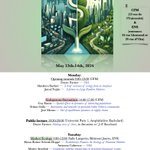
I am pleased to announce a two-day workshop we are organising in May together with @GiulioBiroli, J.-P. Bouchaud, and other young collaborators, at the interface between "Ecology & Economics". For more details, have a look at the flyer👇
4
5
1
32
3,160
**Important change of venue**. If you registered to the event on Monday evening, May 13, for Doyne Farmer's book presentation "Making sense of chaos", please note that the new venue is Amphithéâtre Pierre-Henri Teitgen on the Lourcine centre of Paris 1, 1 rue de la Glacière.
374
Here is the updated flyer of the event happening on May 13th &14th in Paris! Given the limited number of seats, we would kindly invite participants to follow online as much as possible (the two links are attached).
3
368
Great news! 💫 CNRS press release about our recent Science: sub-linear self-regulation mechanism in contrast to a logistic growth model to explain the greater stability as biodiversity increases.
23
938
Extremely glad to share our recent results on spatially extended ecosystems with heterogeneous interactions @CNRSphysique @CNRSingenierie @PRX_Life xitter.cf/CNRSphysique/status/17…
#ResultatScientifique 🔎| Des physiciennes et physiciens ont montré comment l’hétérogénéité spatiale et relationnelle est un ingrédient indispensable au maintien à long terme d’une diversité écologique importante dans les vastes écosystèmes naturels. ➡️inp.cnrs.fr/fr/cnrsinfo/comm…
20
1,306