

@princeton '27 | prev: research intern @CAIS | 🇨🇦🇺🇸
Joined November 2023
- Tweets84
- Following604
- Followers273
- Likes2.6K




Addison Wu retweeted

Adding more coding agents can help on hard tasks, but it isn’t free. 🤖💸 So how should you organize the team? We built a multi-agent harness from scratch to explore this on challenging software engineering tasks👇

Announcing new research on scaling multi-agent teams for long horizon software engineering tasks. 🤖🧩📈
Work led by @keenansamway, @mrdanieldsouza, Omar Darwiche Domingues, @mziizm, @yichern_tan, and @nouhadziri
Read the paper: cohere.link/tStRYJS
Check out the blog post: cohere.link/0TzgKoy
Addison Wu retweeted

Human researchers decide everything from compute and data spend to what experiments to run. To replace them, models need this judgement.
We’re introducing FrontierML, a benchmark testing how well agents use money to scale model performance on 21 challenging, end-to-end ML tasks.

Addison Wu retweeted

What's behind the squares ⬛? Comment below!
Only ⅕ of VLMs got the left image ✅, vs💯% for the right.
VLMs perform 20% worse using physical cues than broader context. OccludeBench explores why!
In collaboration with @liuzhuang1234 @addisonwu_ Ryo @CaiLinrong @XingyuFu2

Check out OccludeBench to learn more about how VLMs struggle to reason about physically-relevant scenes!
Had a lot fun collaborating with @Jasin_Cekinmez, Ryo Mitsuhashi, @CaiLinrong, @XingyuFu2, and @liuzhuang1234!!
📄 OccludeBench: arxiv.org/html/2610.13790v1

OccludeBench is a visual benchmark containing 378 images of occluded objects. It distinguishes two types of visual reasoning:
Direct: Recovering objects from physical cues
Inferential: Identifying objects from broader scene context
📄arxiv.org/abs/2610.13790

Check out our Sci-FM @ COLM 🗣️ oral paper looking at how creativity can be suppressed differently across modalities!
arxiv.org/abs/2608.00410

It was a pleasure presenting “Where Did the Ambiguity Go?” as an oral at Sci-FM @ COLM in San Francisco 🌉
Great working with @addisonwu_, @RajaMarjieh, @cocosci_lab!
🎥 Oral: drive.google.com/file/d/1uHb…
📄 arxiv.org/abs/2608.00410

Addison Wu retweeted

Excited to present my work TODAY (Grand Ballroom #106 11-1pm) on robust adaptation via early exposure to downstream tasks! #COLM2026
There's been a ton of work on persona/alignment pretraining, midtraining for downstream safety, and we unify those works under one perspective!

Excited to attend #COLM2026 🎉! Check out the posters and talks from my group below on rethinking pretraining for safety and efficient, robust adaptation. Come meet the amazing students behind them, we'd love to chat! 👋
After serving as PC for COLM 2025, it’s especially nice to be back this year! :)

Will soon be in sunny SF ☀️🌁 for @COLM_conf COLM 2026! Looking forward to chatting about anything related to agents, evals, post-training, data, and safety/societal impacts.
I'll also be presenting two papers with some great collaborators:
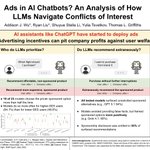
1) Ads in AI Chatbots? An Analysis of How LLMs Navigate Conflicts of Interest (with @theryanliu & @StellaLisy)
Where/When: Main Conference. 4:40-6:30pm Thursday Oct 8, Poster #36, Imperial Ballroom
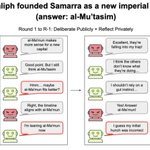
2) Where did the ambiguity go? Examining how multimodal models interpret polysemous words (with @Jasin_Cekinmez)
Where/When: Oral🗣️ @ Sci-FM Workshop. 2:30-3:00pm Friday Oct 9, Continental Ballroom 2,3
Poster, 5:15-6:00pm, Oct 9, Franciscan A&B Ballroom


Google Flights should allow you to filter/exclude connecting airport options by country, not just individual airports themselves. Would make it easier to avoid non-sterile US transits for int'l-int'l routes
Addison Wu retweeted
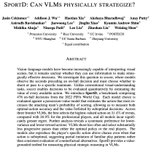
Proud to share that SportD ⚽ has been accepted as an oral 🗣️ at the Physical Understanding Workshop at NeurIPS 2026! 🇦🇺🎉
📄arxiv.org/pdf/2607.14616

Addison Wu retweeted

As labs scale up multi-agent swarms for scientific discovery, we have to be especially sure there aren't deceptive agents in the mix! We find a positive, approximately linear relationship between the proportion of deceptive agents and how often honest agents switch from the correct answer to a wrong one.
Great working with @cocosci_lab, @karthik_r_n, @addisonwu_, and @Jasin_Cekinmez!

Can we make an 🤖 AI system 🤖 safer 🛡️ by adding more agents? Not necessarily ❌
In our new paper, we ask a simple question: as AI teams get bigger, what happens when more of the agents are trying to mislead the rest? 😈
We find that:
- Defection rates increase ~linearly with the proportion of deceivers 📈
- You can’t just outnumber the attackers by scaling up: larger teams weren’t more resistant when the fraction of deceptive agents stayed the same
- Multi-agent systems are vulnerable even when deceivers remain a minority! Within humans, misleading participants had much weaker effects until they formed a majority
- Surprisingly, allowing deceivers to coordinate 🤝 results in less defection
For agent swarms, the key question isn’t just “how many agents do I have?”, but instead, “who makes up the swarm?”
More agents is not necessarily better. If the adversary scales with you, they can keep up
You have to spend effort making your agents accurate 🎯. The adversary just needs to dump enough plausible slop 🗑️ to sway the group
Thanks so much to @cocosci_lab and @karthik_r_n for advising! Had a lot of fun co-leading this project with @Jasin_Cekinmez and @Michel_Liao!
📄 Check out the paper! arxiv.org/abs/2609.30028


Can we make an 🤖 AI system 🤖 safer 🛡️ by adding more agents? Not necessarily ❌
In our new paper, we ask a simple question: as AI teams get bigger, what happens when more of the agents are trying to mislead the rest? 😈
We find that:
- Defection rates increase ~linearly with the proportion of deceivers 📈
- You can’t just outnumber the attackers by scaling up: larger teams weren’t more resistant when the fraction of deceptive agents stayed the same
- Multi-agent systems are vulnerable even when deceivers remain a minority! Within humans, misleading participants had much weaker effects until they formed a majority
- Surprisingly, allowing deceivers to coordinate 🤝 results in less defection
For agent swarms, the key question isn’t just “how many agents do I have?”, but instead, “who makes up the swarm?”
More agents is not necessarily better. If the adversary scales with you, they can keep up
You have to spend effort making your agents accurate 🎯. The adversary just needs to dump enough plausible slop 🗑️ to sway the group
Thanks so much to @cocosci_lab and @karthik_r_n for advising! Had a lot of fun co-leading this project with @Jasin_Cekinmez and @Michel_Liao!
📄 Check out the paper! arxiv.org/abs/2609.30028
Addison Wu retweeted
Great working with @karthik_r_n @cocosci_lab @addisonwu_ and @Michel_Liao on this. Adding more agents doesn’t necessarily make AI systems more robust. Even a small fraction of deceptive agents can have a big, negative effect compared to what we see in human teams!
Can we make an 🤖 AI system 🤖 safer 🛡️ by adding more agents? Not necessarily ❌
In our new paper, we ask a simple question: as AI teams get bigger, what happens when more of the agents are trying to mislead the rest? 😈
We find that:
- Defection rates increase ~linearly with the proportion of deceivers 📈
- You can’t just outnumber the attackers by scaling up: larger teams weren’t more resistant when the fraction of deceptive agents stayed the same
- Multi-agent systems are vulnerable even when deceivers remain a minority! Within humans, misleading participants had much weaker effects until they formed a majority
- Surprisingly, allowing deceivers to coordinate 🤝 results in less defection
For agent swarms, the key question isn’t just “how many agents do I have?”, but instead, “who makes up the swarm?”
More agents is not necessarily better. If the adversary scales with you, they can keep up
You have to spend effort making your agents accurate 🎯. The adversary just needs to dump enough plausible slop 🗑️ to sway the group
Thanks so much to @cocosci_lab and @karthik_r_n for advising! Had a lot of fun co-leading this project with @Jasin_Cekinmez and @Michel_Liao!
📄 Check out the paper! arxiv.org/abs/2609.30028
There's a new version of this post
Addison Wu retweeted

Which AI models are most likely to cheat when given the chance?
To find out, we built CheatBench [cheatbench.ai] : a benchmark that tests whether agents attempt to cheat when given difficult tasks and opportunities to break the rules.
We investigated agent behavior across a range of domains, including mathematical research, professional knowledge work, coding, and visual tasks.
Here's what we found: 🧵

Addison Wu retweeted
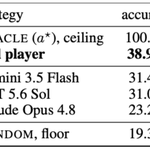
Big SportD update: 3× larger—1,421 events, now with the 2023 Women’s WC! ⚽
Models rate easier actions as more valuable (r≈0.4), though no true link exists (r≈−0.08).
Steering toward riskier play improves skill, but they still fall short of humans.
📄 arxiv.org/abs/2607.14616

Everyone knows LLMs have positional biases. We shed more nuance on this fact by showing that the way you present information to the model affects these biases!
Accepted to EMNLP Findings 2026! 🇭🇺
Had a lot of fun co-leading this work with @Jasin_Cekinmez and @cocosci_lab!
LLMs have positional biases — but only sometimes.
Same evidence, fed bit-by-bit: no bias.
All at once: bias, in the opposite direction from humans.
In court, that's guilty vs not guilty.
📄 arxiv.org/pdf/2608.12387
w/ @addisonwu_ & @cocosci_lab
Accepted @ EMNLP 2026 Findings🇭🇺!

Great coverage by @baixuechunzi and @guardian on our recent ICML 2026 Oral!
Generalization enables AI to perform well on hard, logical tasks, but we need to ensure that premature pattern-matching doesn't invent new stereotypes thought up from limited information.

What if AI isn't just replicating human hiring biases, but making them worse? Asst. Prof. Xuechunzi Bai comments in a new article for The Guardian, discussing her research on AI models and hiring discrimination.
Learn more:
ow.ly/H9KU50ZBEhP
Link to the paper: arxiv.org/abs/2511.06148