

Technical Services and Collections Librarian, Eckerd College, St. Petersburg, FL. 2020 ALA Spectrum Scholar. 2021-2023 ARL Kaleidoscope Diversity Scholar.
- Tweets146
- Following573
- Followers195
- Likes804





ALT PRESS RELEASE 1/2: “APALA recognizes the collective grief that the militarism in Gaza, the West Bank, & Israel has caused our members & loved ones. APALA represents Asian Americans, Native Hawaiians, & Pacific Islanders whose communities have survived the violence of imperialism, colonialism, & displacement, & we stand firmly against the ongoing oppression affecting Jewish, Arabic, Muslim, & West Asian communities. We hope for the continued return of Israeli hostages following the initial violent attacks by Hamas on October 7, 2023, which killed 1,300 Israeli citizens. Since Hamas’ attack on southern Israel, the Israeli army has begun a relentless retaliation campaign, which has killed at least 7,000 Palestinians living in the Gaza strip–the majority of whom are women & children. This campaign has displaced approximately one million Palestinians through continuous airstrikes & artillery, while also denying them basic supplies such as food, water, electricity, & humanitarian aid.”

ALT PRESS RELEASE 2/2: “APALA denounces these violent acts against civilians, and recognizes the ongoing collective punishment as acts of genocide, violating international law. As an organization, we advocate for every individual’s basic right of liberty and peaceful existence, regardless of their ethnic or religious background. We are concerned about the ongoing violence against Palestinians and the Islamaphobic backlash against those racialized as Arab or Muslim across the U.S. We also recognize the rise in antisemitism that stems from this conflict. Additionally, we acknowledge that a system rooted in oppression and white supremacy creates hostility and violence against people of the global majority. We stand firmly against antisemitism, Islamophobia, and the misinformation being spread following these tragic events. We call for an immediate ceasefire and access to critical resources and humanitarian aid restored. Join us in taking action: uscpr.org/StopGazaGenocide.”




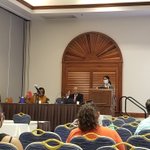
ALT USF Alum and current student at RBMS Conference.



ALT screenshot of linked article: Critiquing the Machine: The Critical Cataloging Database1by B. M. Watson Libraries are [...] desiring machines that seek to collect everything for everyone for all time, making knowl-edge universally accessible through cataloging and classification schemes from which nothing escapes... Knowledge organization structures are also about power, the power to produce both order and excess... our catalogs and classification structures are themselves technologies of power, facilitating some ways of know-ing and not others, representing certain ideological ways of seeing the world, and, crucially, not others. (Drabinski 2019, 49–51).INTRODUCTIONCritical Cataloguing (CritCat) is a descriptor for a variety of critical approaches to the cataloguing, classification, and creation of metadata for resources2 in Galleries, Libraries, Archives, Museums, and Special Collections (GLAMS) and in other information systems. Critical cataloguing places

ALT screenshot of endnotes from article: This article is dedicated to Emily Drabinski. Without Emily’s inspirational scholarship, encouragement of an MLIS student, and her friendship, this article and the work that it discusses would not exist. My title is a riff on Emily’s foundational work Queering the Catalog
