
Head of insights @figma. Former @Forrester analyst. Parenting at https://xitter.gq/t.co/zgIV0NOPJv
San Francisco
Joined June 2008
- Tweets1.2K
- Following1.6K
- Followers682
- Likes878


"I actually don't see agents as our new users. They are intermediary software, like RNA. It's important they are successful in their task, but I'm not willing to sacrifice the importance that the ultimate persona in the matrix is the human.
So in this context, whether you're working on interfaces, or agentic workflows, or model behavior, we're all working in service of the people trying to derive value, efficiency, and meaning out of the things we are creating."

Design in the wilderness
There was a time 10 or so years ago when we got really focused on human centered design. I think it's time to retrieve that earnestness. When we were designing web sites we could perfectly architect every touchpoint.
Then apps, with their algorithms, where we did our best to provide users a map but they ultimately chose their own journeys.
Now, they are in the wilderness, and we can't possibly craft every potential experience or interaction they will encounter. So we have to think differently.
I'm increasingly seeing experience design merge with service design. In the former, we shaped the thing itself. In the latter, we shape the inputs, improve the connections, make it easy to pass data out and make it legible and true when it's received, reduce inefficiencies, improve predictability, always focused on the humans in the center.
I actually don't see agents as our new users. They are intermediary software, like RNA. It's important they are successful in their task, but I'm not willing to sacrifice the importance that the ultimate persona in the matrix is the human.
So in this context, whether you're working on interfaces, or agentic workflows, or model behavior, we're all working in service of the people trying to derive value, efficiency, and meaning out of the things we are creating.
Because honestly, technology sometimes feels like a pretty meaningless industry to work in. Staying centered on what people need, and how I can make their lives easier and better is what drives my engagement and my ambition
“A broader question is whether most tasks in the economy are like chess, where there is a clear performance metric that can be optimized, or whether they’re like writing, where quality is a multidimensional balancing act without clear training signals beyond human mimicry.”
Yes

What would the writing of superintelligent AI sound like? You might expect it to have the characteristics of good human writing — figurative language, high information density, coining new terms, and punchiness — but dialed up to 11. Well, that’s what Claude did, until Anthropic dialed it back recently because of user complaints. It didn’t sound superintelligent to most of us. Instead, the neuralese writing style sounds like a “stupid person’s idea of a smart person”.
Our response to information density and metaphor-laden writing looks something like the cartoon graph I've drawn. Beyond a point, it completely backfires. The reason human writers don’t overdo it isn’t because they aren’t capable, but because they are aware of the reader’s cognitive burden. One of the hardest skills to learn as a writer is to simulate the reader’s experience.
It’s easy to train AI to mimic mediocre human writing. But optimizing it to be (perceived as) good is really hard, and made much harder by the fact that when everyone uses the same few AI models we get tired of their tics very quickly. Most Claudeisms are individually pretty good. I hate that I can’t use “load bearing” in my writing any more. If it weren’t for AI overuse it would be a neat metaphor.
A broader question is whether most tasks in the economy are like chess, where there is a clear performance metric that can be optimized, or whether they’re like writing, where quality is a multidimensional balancing act without clear training signals beyond human mimicry.

30
Everyone’s saying "you can just do things," but I ask, "should you always?"
I boil it down and give a TLDR and analysis for @figma's blog. Thanks to @carlyayres and so many others for their perspectives!


Sometimes it's hard to do your best work. New @figma blog on the forces shaping our work and the barriers to working together that we need to overcome. figma.com/blog/work-has-chan…

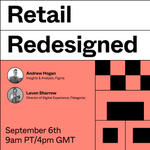
From "don't make me think" to "think before you buy." @patagonia in conversation with me/ @figma and all of you on Sep 6 bit.ly/3spb68A

Life side quest: find overlooked data about design and make it meaningful.
Every year @Figma asks people to submit proposals to talk at Config about the topics they care about most
Let's see what it all says about the state of design, tech, and dev...
figma.com/blog/insights-from…


I wrote something cheeky for @figma about a new @BLS_gov job and what it means figma.com/blog/digital-desig…
2
This essay is a great look at creative work, motivation and inspiration.
This quoted post is unavailable.
1
1
@michellercarney Hi - love MLUXSF. Time to connect about data science + design research? Or know someone who would be interested? Here's a recent blog: go.forrester.com/blogs/data-…
1
After telling us the weather this morning, Alexa added something new. She said “have a good morning”. Attempts at an emotional appeal?
1
I thought we were done blaming people using systems for system failures? "It's not a glitch, it's a user-induced problem that comes from the type of system that we have" thehill.com/policy/technolog…
Continuing my @forrester research about #design services. Hard to benchmark time and costs, but we tried anyway: go.forrester.com/blogs/exper…
2
Collection of recent @forrester research on design services: go.forrester.com/blogs/exper…

2
New @forrester research from @ginabhawalkar about super-sizing #design orgs! go.forrester.com/blogs/with-…