

Collision of random interests
Joined June 2014
- Tweets762
- Following1.3K
- Followers155
- Likes4K




Pinned Tweet
OUR HISTORY
I read and catalogued every major event that happened from 1900 so you don’t have to.
History is a fun rabbit hole to fall into when you can connect the dots, understand how things came to be, and learn some timeless lessons.
Hope you get something useful out of this 🧵

Protectionism and tariffs are bad? Think again.
It was the key to the East Asian countries economic miracles after WWII — for instance, South Korea’s rise from poverty to industrial powerhouse.
What did they get right?
And what lessons does it offer America today?
🧵⬇️

1
54
Fun prompt: Based on all of our chats, what job do you think I work in, and what job do you think I ought to be at, if it is different (although it doesnt have to be)?
1
28

Exactly. Dollar hegemony is the bedrock of American power, it is what allows them to impose their will on others and safeguard their interests.
But it has come at a cost as they’ve gotten addicted to overspending with the bill never coming due. Now a rival power is providing the world with an alternative.
And like any unhinged addict that gets their toys taken away, the first response is not to address the underlying issues that got them into trouble in the first place, but to go on a rampage kicking and screaming, hurting friends, making enemies, and digging an even deeper hole for themselves.

The inability to attract and retain the best Chinese scientists, researchers and students will show up a decade later by the stark difference in the inventiveness of Chinese companies vs U.S.
China will be the one leading the major breakthroughs while U.S. will be copying

Chinese mathematician couple Chen Min and Shen Jie, after decades in the US, left Purdue Univ. to join EIT in Ningbo.
Shen ranked 4th for impact in numerical & computational math in 2021 and 9th for career impact in 2022 Stanford's top 2% scientists global ranking.
WELCOME HOME!

79
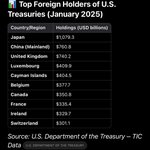
As I mentioned in a previous post, indeed Japan is the largest foreign nation holding treasuries, >$1T
They are currently facing their own domestic issues with 11-year record high bankruptcy rates, >90% for SMEs. This is due to the BOJ normalising rates after two decades of deflation and ultra-loose monetary policy, as well as as the largest wage hikes in the last two Shunto - annual spring wage negotiations.
That it is limited only to SMEs doesn’t mean it’s a trivial problem - about 70% of Japan’s workforce is employed by SMEs, and even the big MNCs also have supply chains that are dependent on these SMEs.
Given how important the administration’s focus is on keeping the 10Y yield down, U.S. / Japan relations are of vital importance and hence why Bessent was tasked to lead negotiations with them.
Key discussions between both countries:
- Japan securing Alaskan LNG imports (the country’s cost base is highly sensitive to energy inputs)
- Japan agreeing not to “manipulate currency” ie dump Treasuries like they did back in 2022-23
- U.S. / Japan trade deficits and tariffs
- Nippon steel investment in U.S. steel (Biden blocked it probably for political reasons)
- Japan / China relations

You may have read that China owns "most of the US debt".
It is completely false.
Most US debt is held by US institutions, public bodies, and pension plans.
China is not even the largest foreign holder. That is Japan.
China has been steadily selling US debt for years.
US debt holders via Bloomberg, total and foreign.


61
Statin drugs inhibit the mevalonate pathway, which affects production of a whole host of other important molecules, especially CoenzymeQ10 (CoQ10)
This can lead to increased risk of heart failure, as CoQ10 plays a crucial role as an electron carrier in the Electron Transport Chain (ETC), without which mitochondria’s ability to produce ATP is impaired.
Lower cholesterol production also affects production of testosterone as its a precursor.
Think there is a fundamental misunderstanding here about LDL being a “bad” cholesterol, which is a widespread but I believe mistaken belief.
The main problem is excessive inflammation and oxidation. HDL/LDL’s job is to shuttle cholesterol, vitamins, anti-inflammatory molecules to and from the site of inflammation to fight and repair. They are so essential to the body that the body makes most of it. Dietary cholesterol doesn’t move the needle at all.
That LDL ends up getting deposited along the coronary arteries, oxidised, and turning into plaques is like blaming firemen for dying at a fire. The original problem is the fire i.e. inflammation. The cause of that inflammation? Smoking, sugar, stress, and (poor) sleep.

In 2018, President Trump had a high LDL cholesterol level of 143. Today, his LDL sits at 51.
Trump is on Rosuvastatin and Ezetimibe now and his risk of a heart attack is much lower as a result.
Statins really are an incredible drug keeping people alive in every social class.
1
95
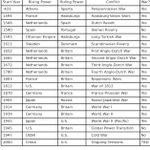
Of the last 16 times the global dominant power was challenged by a rising power, 13 of them resulted in war, 1 was a Cold War, and only 2 were peaceful transitions.
Of those 2 peaceful transitions, 1 was between Spain & Portugal (15th - 17th century Iberian rivalry), and the other was Britain & the U.S (post-WWII). Both involved empires with similar cultural values and economic co-dependence.
Today, U.S. & China don’t have the same cultural values, are trying to economically separate from one another, and both sides view each other with suspicion.
Full-scale war is less likely today given the threat of nuclear war. But history tells us that some form of aggression - cyber warfare, drone wars, proxy wars, trade wars - will probably occur. A tale as old as time.

While Trump is playing Chess (badly), Xi is playing Go (well)

All across Hanoi this morning - from newsstands to cafes - President Xi’s signed article is making headlines.
In it, he talks about building a China-Vietnam community with a shared future, and working together for peace and prosperity across Asia and beyond.
#china #vietnam


1
72
The first trade war taught China to reduce their import dependence from the U.S. and they’ve done so. American farmers have been hurt badly by Trump’s tariffs & USTR Chinese vessel penalty proposal.
Trump likely will seek re-negotiations / firm re-commitment to the U.S. & China Phase 1 deal, but with Brazil’s upcoming bumper soy & corn crop, he will not have strong leverage over them.

The trade war between the US and China has spurred Brazil’s agricultural sector and pummelled American farmers. 'It is a boon for farmers in Brazil and Argentina, and it will help their industry a lot,' points out a lead agriculture analyst on.ft.com/42oB1f2

166
BOJ’s dilemma & their UST holdings
The Bank of Japan faces a dilemma whether to continue normalizing rates or to hold off.
They might resort to dumping a part of their massive Treasury holdings like what they did back in 2022-23, which would be a significant risk for the U.S.
1/7

1
74
Probably the biggest trigger that caused Trump to fold was the move higher in yields, a real Liz Truss type situation
Other countries now know they don’t have to give much in concessions, just watch the bond market and you know the strength of Trump’s hand
And it seems USTR now also walking back on their proposal to penalise Chinese vessels. They finally recognise how much damage they inflicted on American farmers & U.S. export competitiveness in general.
And of course now Trump wants to find a way to provide “financial assistance” to farmers. How on earth does he expect to make up to them the 50cpb drop in corn futs from Feb to March? Basis didn’t move up nearly enough to compensate
It was the best window for marketing their corn then - they only had to compete with Argentina. Soon they will have to compete with the flood of Brazilian corn once its harvested
Two very poorly executed policy decisions imo, but apparently that’s the Art of the Deal!

My X feed tonight is filled with "Trump is a genius...Bessent is the best. This move was all calculated. They are playing 5d chess. China is totally screwed."
Frankly, it seems like media psyops to cover up a major fuckup in the rollout of the tariff policy and effectively and admission that they are taking a loss right here to China in this round of the trade war.
There is no way their strategy was always to blow up their own government bond market in order to snuff out various over levered hedge funds and force them to delever all while also testing the rest of the world to see whether or not they are with us or with China in the new world order that is coming.
This mental gymnastics here is ridiculous.
Just admit you messed up, got spooked by the bond market and are now trying to fix things without blowing up the financial system.
Speaking the truth would improve credibility. This nonsense here only hurts it and all trading partners are seeing through the BS. They know now we need "deals" in order to keep markets afloat so they will offer us very little remedy for adverse trading relationships and we will have to take it. Seems like an own goal here to me.
82
Here are some Chinese companies with low to zero exposure to the U.S and pretty decent fundamentals. Despite that, they’ve fallen in tandem with the rest of the world, declining 7.7% - 14.3% in the last 3 days.
Just simply looking at current vs historical min/max multiples also suggests pretty attractive risk/reward ratios.
With China doubling down their focus on boosting consumption as a key driver to hit GDP growth target, the Chinese consumer will return once again. Remember that China as a nation only has 3% GDP exposure to U.S. These companies individually have even less exposure than that.

The political pressure on Powell to exercise his put will be relentless now
They need an easy monetary runway of at least a few months leading up to the Midterms to recover from the tariff shock
Other countries also know this. So everyday the Fed does not play ball, Trump’s negotiating power is theta decaying
1
113
Biggest risks to Trump admin grand plan
1) Underestimating China’s resilience. Only 3% of GDP exposure to U.S. Diversified exports that can find a home elsewhere besides the U.S.
2) Underestimating how quickly global trade flows will re-route and integrate deeper with China as matter of survival. Trust once broken will be difficult to repair. Probably the most consequential 2nd-order impact.
3) Underestimating speed, cost, and feasibility of re-shoring. Plenty of analysis done already by other experts on X. Tariffs makes sense only if they’re targeted to specific sectors that are critical for securing national security - pharamaceuticals, semiconductor, shipbuilding, but including Nike shoes and iPhones as well is a self-inflicted wound.
Of course tariffs in their current form are probably Art of the Deal type negotiating tactics and real plan is to scale them back
But if above risks are miscalculated by Trump’s advisors, I wonder if the administration is over-confident about the true strength of their hand at the negotiating table
1
41
I used to think U.S. politicians criticisms about other countries democracies and human rights as hypocrisy, holier-than-thou, and simply just none of their business.
But now I realise that perhaps it was all along their intention to promote “democracy” around the world because it’s easier to influence and manipulate elections through covert channels, as opposed to deadling with say, a group of communist leaders who prioritise national interests that may or may not align with U.S. strategic interests.
It’s part of why they get freaked out by Xi Jinping and the CPC - even though they have undeniably achieved massive success in uplifting the standards of living of their own people - because they fear what they cannot control.
There’s conclusive evidence that the CIA has been interfering in foreign nations elections, starting at least from the Italian elections in 1948, Chile in the 1960s, Japan in the 50s and 60s, etc.
Imo, the best long-term outcome for humanity is for the U.S. and China to have friendly relations. Two great powers working jointly together in the age of AI will yield incredible breakthroughs in science, medicine, space exploration, sustainable energy, etc, that would be a net benefit for us all.
That’s why I think discussions around “who will win the AI race, U.S. or China?” reflects entrenched zero-sum thinking. As if AI - particularly at the application layer where there’s still so much value to unlock - is something binary and winner-takes-all. It’s not.
This is the most consequential Stag Hunt of our lifetime and how both U.S. and China chooses to act will determine our collective prosperity
1
28
Dietary added sugar intake is still above the WHO recommended level of 50g, ideal level is <25g.
Meaning reduced sugar intake trends might only slow obesity rates of increase but not reverse increase. NHANES data seems to back that up (though this needs more investigation, I just Grok-ed it).
There is also a lagging effect - dietary intake changes can take years of cumulative impact to see it in outcomes. So you can’t just overlay the two time series directly and draw a conclusion right away.
In addition, while added sugar intake has fallen, the total carb intake, specifically the refined carb component, has remained relatively constant. More importantly, fibre intake has barely budged at all. This is what matters.
The body doesn’t distinguish between natural and added sugars - it’s chemically the same thing. The difference is that the sucrose and fructose from an apple - eaten whole - comes with fibre. Whereas if you drink say apple juice, the insoluble fibres have been destroyed by the shearing action of the blender. Without adequate fibre, excessive sugar levels eventually result in insulin resistance and cause metabolic illness, obesity, Type 2 diabetes, MI, etc.
This is where thinking from first principles - understanding what the science shows about what sugar actually does to the body at a biochemical level and the body’s endocrinological response - matters. It is easy to be fooled by being purely data-driven without balancing it with first principles.

Likewise for SEA and Oceania.
So who holds the cards?
Fgos, this is total trade volume, so it’s not just imports from but also exports to China.


While the United States has been busy burning bridges, China has been building them.
52 out of 54 countries in Africa now trade more with China than the United States.

54