








AVP retweeted

Holy sh*t...I've read a lot about agents. Nothing comes close to this Anthropic harness paper.
Anthropic's Labs team typed one sentence into Claude. Six hours later they had a working app.
Same model as always. The difference was the setup around it.
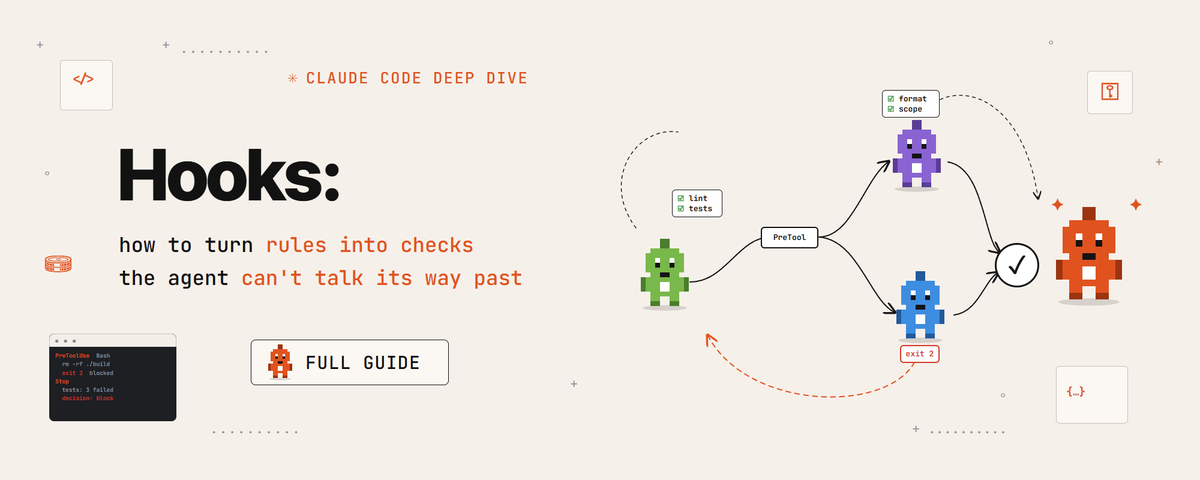
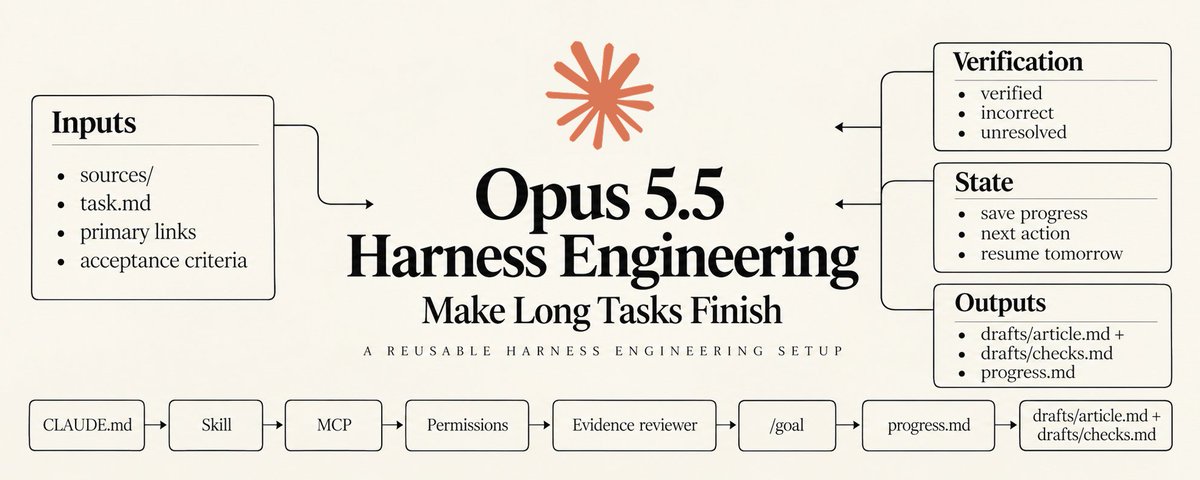
Three agents, and not one of them is allowed to grade its own work. That's harness engineering.
Prompt -> Spec -> Contract -> Build -> QA -> Fix
Here's how the 6 pieces fit together:
1. The planner
Give it 1-4 sentences and it writes a spec with 16 features.
It thinks like a PM. No code talk at all.
2. The sprint contract
Nobody writes code until the generator and the evaluator agree on what "done" means.
They hash it out through files, like two devs arguing in a doc.
3. The generator
It builds one feature per sprint.
Runs its own check, then throws it over to QA.
4. The evaluator
It opens the live app and clicks through everything with Playwright.
Sprint 3 alone had 27 criteria to pass.
5. The hard bars
Depth, functionality, design, code.
Fall short on any one of them and the whole sprint fails.
6. The price tag
One agent alone: 20 minutes, $9, and a game that ignored every input.
Full harness: 6 hours, $200, and a game you could actually play.
The lesson is simple. Let an agent grade itself and it will always pass. A stranger with Playwright won't let it slide.
I turned all 6 pieces into one prompt. Paste it into Claude Code and it sets up the harness for you.
3 agents -> 1 prompt -> Zero self-grading.
Full breakdown in the article below ↓

AVP retweeted

I'm sharing with you one of the best papers I've read on Harness Engineering
it breaks down Claude Code (Fable 5.2), Codex, Gemini CLI and more, and distills all of them into one line:
agent = model + harness
what you take away:
> what a harness is, in plain terms
> how today's coding agents are built under the hood
> the patterns they all share
> the direction the entire field is moving
> a checklist for building your own
the model collects the applause
the harness decides whether the agent actually works
then read the article below ↓
AVP retweeted

Happy kaarthigai Deepam to all! तमसो मा ज्योतिर्गमय | Let the deepam be lit on top of Thirupparangunram!
AVP retweeted
this is pure f*cking treasure
Andrej Karpathy has been inside Anthropic since May, and the two pieces you need to build a loop like his are already public
barely anyone has opened either of them:
> Anthropic's cookbook that turns your documents into a knowledge graph with Claude
> Karpathy's autoresearch loop, which ran 700 experiments in 2 days and found 20 optimizations with no human steering
one gives the agent a memory it can reason over. the other keeps it working while you sleep
i wired the graph half into my own stack
the very first reply changed: Claude dropped the stock answer and actually worked through the problem
your feed is still typing prompts into a blank chat. the few who build this now get to explain it to everyone else later
open the cookbook first, then read the article below ↓


AVP retweeted
Joesph Vijay is the most deceptive cruel anti-Hindu. Hindus will settle scores with him. Let’s see how this happens.
AVP retweeted

MIT published a paper that might end the entire RAG industry.
It’s called MeMo (Memory as a Model).
Instead of storing your documents in a database, you train a separate, dedicated "Memory" model to internalize them.
Your main LLM, the "Executive" model, stays completely frozen.
Your new knowledge gets encoded into a separate, dedicated Memory Model.
Here’s the clever part. They don't just dump raw text into it.
A 5-step synthesis pipeline distills your documents into structured "reflections”, extracting facts, surfacing entities, and stitching together cross-document relationships before the Memory Model is trained.
Then, at inference time, when you ask a complex question, the Executive Model doesn't search a clunky vector database.
It interviews the Memory Model.
Through a 3-stage multi-turn protocol, it breaks your question down into targeted sub-queries, pulls the exact synthesized knowledge it needs, and reasons over the final answer.
Why this changes the game:
• Zero catastrophic forgetting: Your main LLM’s weights are never modified.
• True plug-and-play: It treats your main LLM as a black box, no weights or logits needed. It works with both open-source and proprietary closed-source models.
• Flat retrieval cost: Inference cost stays independent of corpus size, because the memory lives inside a fixed-size model.
• Built for complexity: Validated across BrowseComp-Plus, NarrativeQA, and MuSiQue, outperforming both RAG and fine-tuning baselines while resisting retrieval noise.
We’ve spent years trying to build bigger context windows and smarter search bars to patch AI amnesia.
The real fix wasn’t giving models a bigger notebook.
It was giving them a second brain.

AVP retweeted

THIS IS AN ACTUAL F*CKING GOLDMINE
Anthropic just shared one of the best tricks for Claude Code.
The idea: run Opus 5.5 and three Sonnet 5.5 subagents, each one keeping its own memory for the job it's best at.
Less repeated explaining, because every task lands on an agent that can reuse what it learned about your repo.
You just launch Claude Code like this:
claude --model opus
here's my split:
→ Opus 5.5 runs the session, plans the work and applies the final fixes
→ Sonnet 5.5 handles implementation, debugging and diff reviews in separate contexts
→ memory: project gives each subagent persistent notes that survive between sessions
→ you stop burning Opus 5.5 context on explaining the same repo conventions again
Opus 5.5 only steps in for the big calls at three moments:
→ before a plan locks
→ when the same error shows up twice
→ before calling it done
Sonnet 5.5 builds. Memory carries forward. Opus 5.5 reviews.
persistent memory takes the same idea one layer down: the findings you keep rediscovering (which module, which test, which fix actually worked) go into each agent's memory, and its next run starts with its saved memory index
the full tree
> Opus 5.5 runs the main session and coordinates the work
> builder implements features on Sonnet 5.5 and remembers repo conventions
> debugger fixes failures on Sonnet 5.5 and remembers verified root causes
> reviewer checks the diff on Sonnet 5.5 and remembers recurring review patterns
> Opus 5.5 reviews the synthesized diff before sign-off
> each worker keeps project-scoped memory and checks old notes against current code
paste the tree and this prompt into Claude Code ↓
"Reconfigure my Claude Code setup around this tree:
1. Run the main session on Opus 5.5. Verify both model aliases resolve to 5.5 on my provider.
2. Create three Sonnet 5.5 subagents in .claude/agents: builder (implements features), debugger (fixes failures), reviewer (checks the diff). Flag a restart if this agents directory is new.
3. Set memory: project on all three. Check that auto memory is enabled; ask before changing that setting.
4. Add one rule to CLAUDE.md: delegate implementation, debugging and diff reviews to these subagents to keep the main context small. Sequence dependent work.
5. Tell each agent to consult its memory before working and save only verified, reusable findings afterward. Keep MEMORY.md concise, link detailed notes, and recheck stale assumptions against the code.
Show me every change as a diff first. No edits until I say go."
↳ code.claude.com/docs/en/sub-…
save it, it'll come in handy.

AVP retweeted

AlphaSignal scans arXiv, HuggingFace, GitHub, and X every day and surfaces the top 1% of AI developments that actually matter to engineers.
One daily briefing that filters 500+ sources down to the models, papers, and repos worth knowing about.
AVP retweeted

this Stanford paper is f*cking insane
they just boiled the entire hedge fund playbook down to a 17-page pdf.
Stanford dropped the complete Hidden Markov Model framework that quants at firms like Jane Street and Two Sigma are known to rely on, and it's free.
the crazy part is this isn't a watered-down summary. it's the actual mechanics behind models these desks keep locked up internally.
most people figure this stuff never leaves institutional walls.
this one gives you the framework directly, no gatekeeping.
bookmark it and read it before someone takes it down.


AVP retweeted
Anthropic engineer:
"You're not supposed to prompt Opus 5.5
You're supposed to build a system that prompts itself. At Anthropic, 90% of our engineers have already built these systems"
In 30 minutes she shows exactly how Anthropic builds agents that remember, fix their own errors and get sharper with every run.
This beats any $1000-$2000 course on agents I've come across.
Watch it, then read the article below ↓

AVP retweeted

This is f*cking insane. Andrej Karpathy spent 8 years at OpenAI and Tesla
Last week, he put everything he learned into one free 2-hour lecture
Agents → Harness → Loops → Graphs
Some bootcamps charge $15K and teach you less than this
You might not have 2 hours right now
Bookmark it and watch before it gets buried in your feed
Then read the guide below and build your first agent harness ↓


AVP retweeted

पिता BITS Pilani में Phy के हेड, Sci. के डीन थे! संस्कृत, फ्रेंच, जर्मन का ज्ञान था, PhD. #Neils_Boher के मार्गदर्शन में की थी पर अपना कोई घर नहीं था! रिटायर होने पर उन्होंने घर का सारा सामान बाँट दिया! किसी ने पुछा आपका गुजारा? बोले में ब्राह्मण हूँ, काशी के घाट पर कथा कहूँगा!🙏

AVP retweeted

धुआँ-धुआँ कर दिया @ajeetbharti 🔥🔥
कृपया मुझे इस बात पर भावनात्मक ब्लैकमेल ना करें कि मोदी जाएगा तो राहुल आ जाएगा, योगी जाएगा तो अखिलेश आ जाएगा।
कल को कोई ऐसी पार्टी आई जो आप जैसा कह रहे हैं कि बदतर बना देगी, तो उससे सड़कों पर निपट लेंगे।
आपसे तो केवल शब्दों से लड़ रहे हैं। @BJP4UP @BJP4India
AVP retweeted

मेरे ऊपर SC/ST एक्ट में FIR पर कुछ बातें सवर्ण समाज से
कोई मेरी माँ या बहन पर सीधे बलात्कारी मानसिकता के साथ यह कहे कि उसका विवाह मैं चंद्रशेखर के साथ करा दूँ, और मैं चुप रह जाऊँ तो आप बताइए कि मैं कैसा पुत्र या भाई हूँ?
इतने पर भी चंद्रशेखर को ले कर मैंने कोई जातिसूचक शब्द नहीं बोला, जो उक्त वीडियो में है। जब स्टेज से ब्राह्मणों की बेटियों को खींचने की बातें होती हैं और किसी SC नेता का चेला सोच-समझ कर उकसाने के लिए ऐसी बात करेगा, तो मैं चुप कैसे रहूँगा?
आज व्यक्ति अपने मौलिक अधिकारों को समझे या न समझे, वह यह अवश्य जानता है कि SC/ST एक्ट क्या है। तो मैं जब बोलता हूँ तो मुझे अपनी सीमाएँ (चाहे वह कितनी ही अनुचित क्यों न हों) पता हैं कि क्या बोलना है, क्या नहीं।
मैं जानता हूँ कि दिल्ली पुलिस के नॉर्थ अवेन्यू स्टेशन में आजाद समाज पार्टी वालों ने कितना दवाब दे कर रात के बारह बजे यह FIR लिखवाया है जो कोर्ट में दो मिनट नहीं टिकेगा। एक भी धारा ऐसी नहीं है जो होल्ड करेगी।
मैं सैनिक स्कूल का छात्र हूँ और इतनी रैगिंग झेल चुका हूँ कि मेरा मनोबल तोड़ने के लिए दिल्ली पुलिस को कस्टडी में मेरी हत्या करनी पड़ेगी, दो-चार डंडों से मेरा मनोबल नहीं टूटने वाला। और यदि मैं जीवित बच गया तो इसी स्थिति में जंतर मंतर जाऊँगा और अपने समाज से कहूँगा कि बताओ, तुम्हारी बहन और माँ को ले कर कोई ऐसी टिप्पणी करे तो क्या करोगे?
यदि ऐसा कमेंट फिर मेरे वीडियो पर आया तो मैं पुनः उसी तरीके से उत्तर दूँगा जो मैंने दिया। कानून जब तक है, संशोधन नहीं होता, मैं उसका सम्मान करूँगा और दिल्ली पुलिस के साथ पूर्ण सहयोग करूँगा। 92% ऐसे केस केवल प्रताड़ित करने के लिए होते हैं।
अंत में, सवर्ण समाज से यह पूछना चाहता हूँ कि क्या इस तरह की टिप्पणी पर मुझे सह लेनी चाहिए थी क्योंकि किसी पार्टी के लोग नाराज हो जाएँगे? क्या ब्राह्मणों की माँ और बहनें इन रेप मैंटिलिटी से संचालित गुंडों के शाब्दिक बलात्कार के लिए जन्म लेती हैं?


AVP retweeted

🚨 Very Big News 🚨
2 lakh upper caste people on the streets against UGC... ✊
Picture from Jaipur (Rajasthan)....
We'll meet very soon on Jantar Mantar too...🙏🏻
#endreservation #reservationHataoandolan #reservationhatao #casteismhatao #RHA
AVP retweeted

The pressure of reservation leading to discrimination against general class students is too much to take. A student explodes on tv.
This is a decisive rejection of the शोषित, पीड़ित, वंचित theory that has been imposed on us for the past 75 years, becoming increasingly blatant over time. The constitution has enforced equality through its statutory powers, strengthened by highly biased laws like the SC/ST Act. Despite these measures, the UC continues to suffer due to more measures by govts for discrimination against them.Enough is enough; the new generation will no longer accept this and will stand firm, just as their parents and grandparents did before.
Since 8th grade, one dream. Since 2021, zero vacations. 6 years of relentless grit, devotion, and dedication. This weekend, our daughter completed her MBBS Phase 3 prt 2 exams in flying colors. The uncertainty never stopped her. We couldn't be prouder. #MBBS #Government #GC
50
AVP retweeted
LIVE : K Annamalai's first podcast after launching 'We The Leaders' | Wh... youtube.com/live/xx1hRU2hqms… @balamy @BaluSreevidya @NandiniVenkate3 @kkssr @vrsubramanyam @akhivis @pushyami_3 @kanimozhi @Savitritvs @nandaji1958 @kamakshidhanraj
