

i've always liked numbers building @bondifinance , rwa/acc
Joined November 2011
- Tweets12.6K
- Following984
- Followers640
- Likes23.7K








Pinned Tweet
We will become one of the top 5 markets in this list in less than 2 years at @bondifinance.
Almost ready to announce and launch some of the strategies we have been preparing for months👀

Ali Sarp Mestcioglu retweeted

The curse of discipline is that every day looks the same. The curse of indiscipline is that every year does.
🚨🚨🚨 Apple bonds going 50 cents on the dollar?
Nevermind the sirens, I'm just trying to bait attention on social media. All is well at Apple, it's just the nature of duration and fixed income that made long-term Apple bond holders lose FIFTY percent of their principal (paper and mark-to-market).

A bond's coupon never changes, so why does its price?
Rates, spreads, time, and an Apple bond at less than $50 on $100 of principal, in under a minute. 📉
3
115
People traded on inside information 2,600 years ago.
Let's go back to Athens, around 594 BC. Many poor farmers owed the rich. A borrower who couldn't pay could be seized as a slave with his children, because loans were secured on the borrower's own body.
Solon, given power in the crisis, canceled debts and banned lending against a person.
Word got out before the law did. Friends of Solon borrowed heavily, bought land, and kept it when their debts were wiped.
Day 100

The Sumerian word for interest, máš, also meant a young goat. The Greek word, tokos, means offspring. Both describe interest from the lender's side, as something born.
The Hebrew Bible takes the borrower's side. Exodus 22:25 forbids charging interest on a loan to a poor member of your own people, and its word for interest, neshekh, comes from "to bite".
Aristotle used the Greek word against the lenders. Interest is called tokos, he wrote, because it is "the birth of money from money", and "of all modes of getting wealth this is the most unnatural."
The same payment, a newborn to the lender and a bite to the borrower.
Day 99
1
3
131
I bought myself a copy of the book Debt (thanks for the recommendation @EtherfuseDave, surprised I haven't read about it before it reads like I'll love it) that arrived a couple of weeks ago.
David Graeber's book opens at a garden party at Westminster Abbey. He tells a lawyer at an anti-poverty foundation he'd campaigned to cancel Third World debt.
"But they'd borrowed the money! Surely one has to pay one's debts."
Even standard economics says no, he writes. "A lender is supposed to accept a certain degree of risk." Otherwise "what reason would lenders have not to make a stupid loan?"
That risk has a price. What a riskier borrower pays above the safest is the credit spread.
3
105
Ali Sarp Mestcioglu retweeted

Since Sep 11, Intel stock is down 45.9%. Over the same period, btINTC-28, backed by Intel’s own bond, is up 0.39%.
btINTC-28 is backed 1:1 by that bond (ISIN US458140CE86), held in regulated custody.
Equity and credit are different. In a market like this one, that difference shows.
The Sumerian word for interest, máš, also meant a young goat. The Greek word, tokos, means offspring. Both describe interest from the lender's side, as something born.
The Hebrew Bible takes the borrower's side. Exodus 22:25 forbids charging interest on a loan to a poor member of your own people, and its word for interest, neshekh, comes from "to bite".
Aristotle used the Greek word against the lenders. Interest is called tokos, he wrote, because it is "the birth of money from money", and "of all modes of getting wealth this is the most unnatural."
The same payment, a newborn to the lender and a bite to the borrower.
Day 99
Political risk in lending is more than 3,600 years old.
Babylonian kings could cancel debts by decree. One decree survives almost whole, the edict of King Ammi-saduqa, around 1646 BC. It canceled loans of barley and silver owed by the groups it names and freed citizens held in debt bondage. For each canceled loan, the edict's phrase is literally "his tablet is broken". The clay contract itself was destroyed.
Kings issued such edicts on taking the throne and again when hard times demanded, some several times in a reign. Lenders tried to dodge them by writing a loan up as a sale or a deposit, and the edict went after those tricks too.
So every Babylonian lender carried one risk no contract could remove, the political risk.
Day 98
1
2
229
Before Bondi we managed portfolios, and hunting for mispriced bonds turned out to be quite lucrative. On the side we were deep in onchain yield, farming and chasing airdrops.
About four years ago tokenization started to trend, and the two clicked on my mind. Bonds are one of the deepest markets in the world, and almost nobody can get in.
So we set out to open them up.
3
92
Political risk in lending is more than 3,600 years old.
Babylonian kings could cancel debts by decree. One decree survives almost whole, the edict of King Ammi-saduqa, around 1646 BC. It canceled loans of barley and silver owed by the groups it names and freed citizens held in debt bondage. For each canceled loan, the edict's phrase is literally "his tablet is broken". The clay contract itself was destroyed.
Kings issued such edicts on taking the throne and again when hard times demanded, some several times in a reign. Lenders tried to dodge them by writing a loan up as a sale or a deposit, and the edict went after those tricks too.
So every Babylonian lender carried one risk no contract could remove, the political risk.
Day 98
Grace periods on loans are millennia older than paper money!
Around 1750 BC, Hammurabi's laws had a force majeure clause. Law 48 covered a ruined harvest. If storm or drought killed the crop, the farmer paid nothing that year. In the law's words he "washes his debt-tablet in water", softening the clay contract to rewrite it without that year's interest. 🌾
A grace period, carved in stone.
Day 97
Where Bondi goes, two roads sequentially. 🛤️
All bonds that already trade in TradFi coming onchain, with the same issuer, coupon and maturity, but no broker account and no $200,000 lot. Just a Bond Token.
And then new bonds issued natively onchain from day one, with coupons, calls and maturity run by the contract itself.
2
127
Most people have never owned a dollar bond issued outside the US. One big reason is the $200,000 minimum.
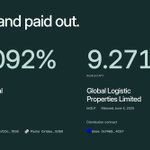
Our first two Bond Tokens were exactly that kind of bond, from Singapore and Hong Kong. Holders earned 9.27% and 15.41% APY in dollars, not tokens. All verifiable onchain.
4
133
Redemptions are effectively paused in many private credit funds.
This would never happen with Bondi

Two oversubscribed tender offers filled under half of tendered shares.
Ares Strategic Income Fund (~$10.2B net assets) filled 38.2% of 50.4M shares, ~$515M in cash. Final amendment corrects September results.
Priority Income Fund filled 17.93% of 9.0M shares, ~$4.8M at $2.97.

8
168
Grace periods on loans are millennia older than paper money!
Around 1750 BC, Hammurabi's laws had a force majeure clause. Law 48 covered a ruined harvest. If storm or drought killed the crop, the farmer paid nothing that year. In the law's words he "washes his debt-tablet in water", softening the clay contract to rewrite it without that year's interest. 🌾
A grace period, carved in stone.
Day 97
The first recorded sovereign debt crisis is 4,400 years old.
Around 2400 BC, the city of Lagash lent barley to its rival Umma. Lagash's ruler, Enmetena, had the claim inscribed in clay. With interest, the debt had grown to about 8.64 million liters, 7.5 times the 1.15 million lent.
How do you get 7.5 times? The numbers fit a third a year, the usual barley rate, with interest charged on the interest too. Seven years of that turns 1 into 7.49.
Umma never paid. By Lagash's own account, Umma's ruler, unable to repay, tore down the boundary marker between the two cities and attacked. Enmetena beat him.
A default settled by war, 4,400 years before anyone called it sovereign debt.
Day 96
Debt is one of the first things people ever wrote down, and civilization has run on it ever since. For the next weeks I'm telling its history, a story a day, from clay tablets to the Bond Tokens we build at Bondi.
Mesopotamia, about 1800 BC. The Laws of Eshnunna set the price of a loan. Borrow a shekel of silver, pay back a shekel and a fifth a year later. Barley paid a third. The law didn't invent these rates. Lenders were already charging them, and the law made them the standard.
Why a fifth? They counted in sixties. A mina was 60 shekels, and one shekel per mina each month adds up to 12 sixtieths a year, a fifth. (that same base 60 is why an hour still has 60 minutes and a circle 360 degrees.)
Thousands of their loan tablets survive, each naming lender, borrower, amount, rate, due date and witnesses. A bond prospectus today has the same fields.
Day 95
Most RWAs used as collateral onchain are fund shares. You own a slice of a manager's book, and you leave when the fund lets you. (if they let you :))
A Bond Token is one real bond, in $100 pieces. You can redeem with us anytime, plus you know the issuer, and cashflows.
Debt is one of the first things people ever wrote down, and civilization has run on it ever since. For the next weeks I'm telling its history, a story a day, from clay tablets to the Bond Tokens we build at Bondi.
Mesopotamia, about 1800 BC. The Laws of Eshnunna set the price of a loan. Borrow a shekel of silver, pay back a shekel and a fifth a year later. Barley paid a third. The law didn't invent these rates. Lenders were already charging them, and the law made them the standard.
Why a fifth? They counted in sixties. A mina was 60 shekels, and one shekel per mina each month adds up to 12 sixtieths a year, a fifth. (that same base 60 is why an hour still has 60 minutes and a circle 360 degrees.)
Thousands of their loan tablets survive, each naming lender, borrower, amount, rate, due date and witnesses. A bond prospectus today has the same fields.
Day 95
Ninety days of threads. Here is where it all points.
$10M launch is just the starting plan. $100M is the near milestone, and it is not with the exact same sixteen bonds in the $10M scaled up, because every issue has a finite float.
It is more bonds, different bonds, new baskets, fresh issues as they come to market. The USD-denominated corporate bond market is ~$19 trillion outstanding. We have barely touched it.
Then the layer above, the one I called a 1,000,000x capital efficiency increase on Day 73. In TradFi a fully rebalancing and compounding bond ETF needs $5M to $10M of every bond in inventory, so a diversified one starts at $100M to $200M before filings, custody and market making. That wall is why five hundred plus bond ETFs sit with the same six mega managers.
Onchain the building blocks are single-name Bond Tokens, already composable, so a manager will pick the rebalancing option on Bondi and Bondi's infrastructure will rebalance automatically onchain: thousands of dollars per name instead of millions.
The ETF Vault assembles them into one token, with rebalancing, coupon distribution and decomposition back into the underlying built in. Same product, a millionth of the capital.
And then the ultimate mission itself: direct issuance. The issuer sells the bond onchain from day one, to the whole world at once. Every new onchain holder is one more unit of global demand on paper that used to reach a few hundred institutions.
Compressed yields for the issuer, real access for everyone else.
$100M TVL first. Then the ETF. Then issuance. Same rails.
Day 94
Ali Sarp Mestcioglu retweeted
A yield quote tells us little about when capital comes back.
We explore how corporate bond maturities can help shape onchain portfolios and why a bond’s repayment date is different from an investor’s exit.

Ali Sarp Mestcioglu retweeted

AMA with Bondi Finance xitter.gq/i/broadcasts/2jPqMlBkm…

Ali Sarp Mestcioglu retweeted

In 15 minutes I'm asking @bondifinance the question every bond token has to answer: if the company that issued the bond defaults, what do you actually own, and who sells it for you?
Live with @ali_sarp and @kadiogluakin.

AMA with @bondifinance today at 15:00 UTC
Bondi brings publicly traded USD corporate bonds on-chain as Bond Tokens - fully backed 1:1, coupons paid in stablecoins.
On the call:
• @ali_sarp — Co-founder, Bondi Finance
• @kadiogluakin — Co-founder, Bondi Finance
• @daniilkozin — CEO, EasyMM
We’ll talk about real yield from corporate credit and how bonds become fully composable on-chain primitives.

Ali Sarp Mestcioglu retweeted
AMA with @bondifinance today at 15:00 UTC
Bondi brings publicly traded USD corporate bonds on-chain as Bond Tokens - fully backed 1:1, coupons paid in stablecoins.
On the call:
• @ali_sarp — Co-founder, Bondi Finance
• @kadiogluakin — Co-founder, Bondi Finance
• @daniilkozin — CEO, EasyMM
We’ll talk about real yield from corporate credit and how bonds become fully composable on-chain primitives.
Add US-issued ones to that $7.15 trillion and you get the $19.25 trillion dollar corporate bonds market, and most people have never owned a single one. 🌍
Buying one still takes a broker account, and outside the US usually $200,000 per bond.
The dream behind Bondi is simple. Any bond, in $100 pieces, held in any wallet, with every coupon landing onchain. Bond Tokens as complete bond primitives.
Every bond price you see is quoted per $100 of face value. A price of 98 means 98% of face. 🧾
You can't actually buy $100, though. At a broker, a quantity of 1 is $1,000 of face. Dollar bonds from companies outside the US are a $7.15 trillion market, and they usually start at $200,000 of face, then go up in $1,000 steps.
A Bond Token (BT) is $100 of face of a real bond. Same bond, a ticket 2,000 times smaller.
