

the process of how i work and what i build AI systems builder | co-founder | SilHills Tech.
Austin, Texas
Joined July 2014
- Tweets138
- Following121
- Followers384
- Likes1.9K


Pinned Tweet
most AI disappoints because there is no system behind it. not a tool problem, a systems problem
i learned that building an assistant for my own job. it ran on context docs, layered skills, and a file structure it could navigate
i came from partnerships and sales. now i build these systems for companies and people
5
389
been having a good time creating v1 of the Austin landscape backdrop on Claude. day & night cycle. anyone else in Austin want this?
1
4
117
Andrew Nord retweeted

Claude or ChatGPT is the least important AI decision you'll make this year.
Everyone argues about which model is smarter. Meanwhile, the part that actually runs your business sits underneath it: what the system knows about you, which tools it can reach, and the jobs it already knows how to do.
That part doesn't belong to the model. It belongs to you.
Ours lives outside the AI, in files we own; how we work, our clients, our skills, our tool connections. The same files run in 4 different AI apps (Claude Code, Cursor, ChatGPT and Grok). We connected our tools once, and all 4 can use them.
When a better model ships, we point it at the same files and keep going. Nothing gets rebuilt.
Pick the one you like. Then build the part that outlasts it.
the Claude Code desktop app has been getting better fast, easily becoming a top tier UI harness

We've been working hard on making the Claude Code desktop app great for running lots of sessions side by side.
It's now much quicker to start sessions, easier to split work across a few, and you can always see what each of them is doing. Here’s what's new:
1
90
Andrew Nord retweeted
Automation on top of a system that doesn't know your business just runs the wrong job faster.
A lot of businesses we talk to already have the automation. What they don't have is anything for it to plug back into.
It can't see your tools. It doesn't know how you decide. When something changes, it breaks, and you build another one to patch it.
Build the foundation first.
That's what we do.
Andrew Nord retweeted
If you can't walk away with it, you don't own it.
Everything we build lives in a repository on our partners' own accounts (a repository is a folder system your AI reads from). They can take it and leave whenever they want.
Sounds like a bad business model. It's the only honest one. The only thing keeping someone with us is that we keep delivering.
Build on your own ground.
Everyone has access to AI. The hard part is putting it to work.
Some owners have nothing built. Some have 500 automations and a house of cards. Same problem underneath; no foundation.
check out this article from my co-founder to see how we put it to work

Most AI in business is built on sand.
500 automations that don't talk to each other is not a system. It's a house of cards.
Build the foundation first; everything you add plugs into it.
Here's how we do it.

1
39
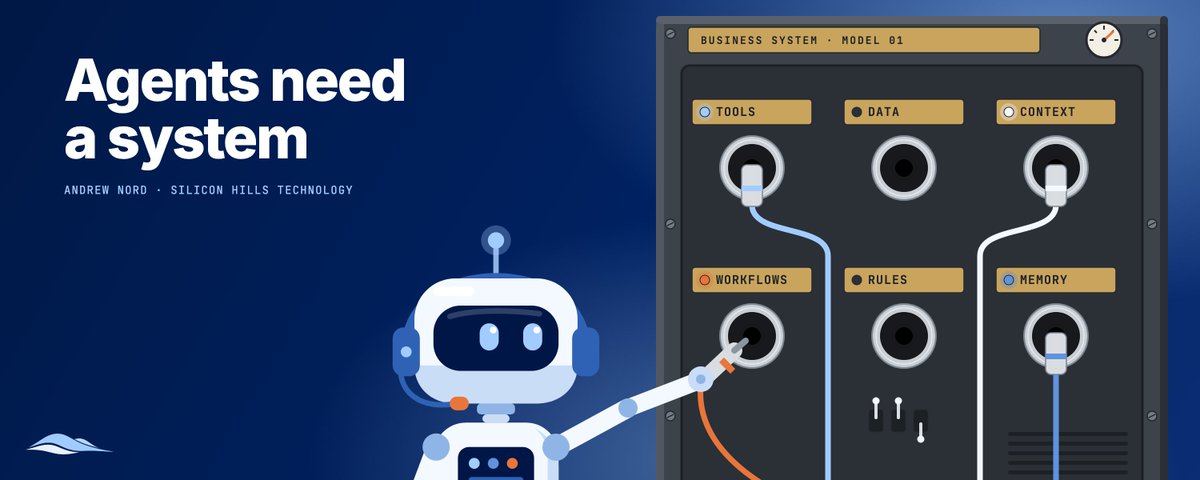
Grok Bot, Dots & Muse shipped in the last few weeks & they're good. what we keep running into with clients is what's underneath them: the workflows, the context, the data, & knowing how agents work
this one goes into what that looks like for our clients

unpopular opinion but the .hard effect is nicer. especially on Mac. finally something to click on to move a window

In iOS 26, the scroll edge effect default is .soft.
In iOS 27, it is .hard.

ALT Side by side iPhone screens running the same SwiftUI code. On iOS 26.5 the coral card fades gradually under the navigation bar. On iOS 27 a defined edge cuts across the card's subtitle.
1
201
excited to put out my first article. it's a deep dive into how the system i run my own work on is built, which is the same structure we use for every business we work with
enjoy!

no matter how smart the models get, they will never be mind readers without the proper context and pointed direction, and that comes down to the foundation and the architecture of the folders, and the data that is in them
i see most people do this half-assed or not at all, a long prompt and almost nothing in the folders, and then wonder why they get bad results
3
143
i've never been a desk setup guy. a good monitor and the laptop, that has been it forever
the past couple months i have been slowly getting new gadgets, keyboard, mouse, better desk, and it has changed more than i expected. remapping the mouse configurations has been a massive boost for day to day work. my eyes have been opened
1
2
146
the build tracker went live on our dashboard today. every plan i put together reports into it while the sessions run, the scope, the diff, the blast radius, and every decision that got made along the way
before this i was calling up specific project docs, reading them inside my harness, and pointing the agents at them. all of that still exists underneath, the difference is there's a visual now that updates itself, so the agents read it to pick up context anytime & the humans can look company wide to see exactly what is built or in flight
the next iteration will be tying it into our internal CRM, so every project is attached to the client for complete efficiency and organization
4
207
what i keep seeing in the people getting the most out of AI is that they're building systems that compound. one thing at a time, verify it holds, add onto it once the foundation is solid
doing that for a year straight puts you further ahead than any tool you could pick up today
1
1
87
when i plan builds or projects, i have an artifact page that the loop updates as each phase lands. the single source of truth for the AI to reference throughout the build
my own metrics on it, the ones that i find useful for the task at hand. this keeps me fully in the loop & aligned day to day
1
125
two lines i put in almost every prompt now
"review this for conciseness without it affecting the quality of the output"
"make sure this is fully verified and working against the test before moving forward"
one kills the over-building, the other stops it from telling me it's done when it isn't
94
the interesting shift this year hasn't been the models progressing (of course they are), it's the harnesses. the more pointed ones are the most effective, and that seems to be what the frontier companies are missing
Claude Code will happily build more than i asked for. Grok and Cursor stay closer to the thing i actually wanted
the models keep getting better on their own. the harness is what separates good work from cleanup
hopefully the competition goes toward more pointed and targeted, not backtracking and following along every turn
1
130
Andrew Nord retweeted

crafting a solid plan does 80% of the job when building with AI...
it's the only real thinking part, pretty much the only step where the agent needs you for real
here are 3 very simple ways to improve your plans, and with them your outputs...
use a plugin like Compound Engineering or Matt Pocock's grilling skill:
> this is reverse prompting, so use a BIG model (Fable 5 or GPT-5.6 Sol, always on high for planning)
> brainstorm by answering its questions, go as deep as you can on why you're building this, don't focus on the how
> ground your decisions in websearch: what's the best tool for the task, is there an API or CLI to automate it
then be very specific about the harnesses you'll run, the models you need and their effort levels
finally, always call another agent to review the plan, and iterate until it's perfect
from there you run a goal and loops, and watch the agents ship the vision
