

Web3 Guy | Crypto Trader | Content Creators
Joined February 2022
- Tweets25K
- Following4.4K
- Followers9.1K
- Likes26.1K






Pinned Tweet
A prediction market becomes more interesting when users can compare several interpretations of the same event.
That's one reason I think AI and social trading can complement each other.
While examining @bagel_win, I opened a Pro Football MVP market.
The displayed prices placed Joe Burrow around 50%, with Josh Allen considerably lower.
Bagel AI leaned toward Burrow and offered a narrative about quarterback performance and the factors that might influence the award.
But that was only one interpretation.
Another predictor could disagree and argue that the market had overestimated Burrow's chances.
This is where Bagel's social trading features become relevant.
Users can follow other predictors, examine their public trading activity, discuss markets and copy positions.
From a product perspective, I see three distinct layers:
Market prices reflect the positions participants are willing to trade.
AI insights provide an additional explanation.
Social trading exposes users to other people's strategies and viewpoints.
The potential value comes from comparing those layers.
But none should automatically be treated as authoritative.
A popular predictor can make mistakes.
An AI model can hallucinate.
And a market can change quickly when new information arrives.
I think the best social prediction products will help users compare reasoning while making it clear that copying remains a personal trading decision.
Bagel provides an interesting foundation for that experience through its mobile app.
If you'd like to explore the predictor and AI features, download Bagel at bagel.win/download.
My code is ANDYWEB3.
Eligible new users signing up with an invite code can receive Bagel's advertised 10% trading-fee discount.


Prediction markets don't necessarily need more markets.
They may need better ways for people to discover and understand the ones that already exist.
That's the product question I kept thinking about while exploring @bagel_win.
The app's Explore section organizes prediction markets into recognizable categories such as Sports, Crypto, Finance, Esports and Politics.
It also surfaces trending markets rather than requiring users to begin with a specific contract address or complicated trading dashboard.
I think that matters for mobile users.
Someone who follows esports may not initially care about Federal Reserve decisions.
But a clear discovery interface can introduce them to other topics through familiar interactions.
During the walkthrough, I moved between sports events, entertainment predictions and macroeconomic markets.
The underlying subjects changed dramatically, but the product structure stayed consistent.
A market card leads to an event page.
The event displays available outcomes and market information.
Bagel AI can provide contextual analysis.
Social features allow users to follow other predictors and discuss different viewpoints.
And market, limit and combo order options are available for users who want to examine execution.
The interesting part is that Bagel builds this application experience around Polymarket's underlying markets and liquidity.
It's not necessary to create a new liquidity ecosystem to improve how people interact with an existing one.
But a simpler interface must still communicate settlement conditions, fees and risks clearly.
That's where I think thoughtful product design becomes genuinely valuable.
Explore Bagel at bagel.win/download.
Use code ANDYWEB3 to access the advertised 10% trading-fee discount for eligible new users.

Andy retweeted

Real-world assets are coming onchain.
On most chains, anyone can launch whatever they want.
On MMIX, every project is vetted before launch.
Clean assets for users. Clear standards for builders.
Join the first wave and earn rewards.
→ hub.mmix.io
A digital city looks cool.
But what happens after you've revealed all its buildings?
That's the question I had when looking into MMIX Districts.
The collection from @MMIX_io is built around 3,000 miniature districts inspired by businesses in the MMIX ecosystem.
Each NFT starts with a free mint on Ethereum, where holders discover their land size.
The buildings are planned to appear later on MMIX.
Here's where things get more interesting from a business perspective.
Each district will have a building score calculated from three factors:
> Number of buildings
> Size of buildings
> Rarity of buildings
That score determines a fixed rate at which the holder earns credits during the planned rewards programme.
Credits are intended to accumulate automatically and unlock RWA rewards.
Imagine two districts.
One has several smaller buildings, while another has fewer but rarer structures.
Their earning rates could differ depending on how MMIX calculates the final scores.
I like the idea of connecting a digital collectible with an ongoing ecosystem rewards programme rather than treating the artwork as the entire product.
But there's an important distinction.
These district NFTs don't automatically represent ownership of the physical properties or businesses shown in their artwork.
And the exact credit rates, redemption rules and RWA rewards haven't been fully announced.
For me, those are the details worth watching as the project develops.
Explore the MMIX ecosystem: hub.mmix.io/points?referral_…


Claim your plot before the city rises.
Introducing MMIX Districts: 3,000 isometric districts, free to mint on Ethereum
- On Ethereum, you discover the size of your land.
- On MMIX, you discover what's built on it.
Apply for the whitelist:
→ whitelist.mmix.io
38
43
293
BTW is up 19.6% in my latest @GeckoTerminal screenshot.
That's the kind of green candle that usually attracts attention.
But here's why I don't want to stop at the percentage.
BTW has a displayed market cap of $745.2M, while the selected pool contains only $68.5K in liquidity and recorded $298.6K in 24h volume.
Now compare that with SPX.
SPX is up just 0.9%, but its pool shows around $8.6M in liquidity and $378K in daily volume.
The difference in market depth is enormous.
A smaller price movement doesn't automatically mean a less interesting market.
And a larger market cap doesn't guarantee deep liquidity in every individual pool.
That's why my GT Watchlist now includes different types of markets such as BTW, CTM, GROW, NEAR, BNKR, CASHCAT, SPX, QNT, AAVE, ASTEROID and SHIB.
I want to compare liquidity, volume and price behavior using the same research process.
A dramatic candle can start an investigation.
It shouldn't finish one.
My GT Watchlist:
geckoterminal.com/watchlist?…
Would you pay more attention to BTW's price movement or SPX's deeper liquidity?

I've expanded my @GeckoTerminal Watchlist to 8 pools, but my research process hasn't changed.
I still prefer comparing market conditions over chasing whichever token happens to be trending.
My latest snapshot shows 22.02K transactions and $5.27M in daily volume.
One comparison immediately caught my attention.
BTW has a $613M market cap but only $53.1K in liquidity in the selected pool.
SPX, meanwhile, has a smaller $287.2M market cap but around $8.7M in pool liquidity.
That's a huge difference in market structure.
I've also added AAVE, QNT and SHIB alongside PONS, CASHCAT and BNKR.
AAVE is up 2.7%, while QNT and SHIB are slightly negative in the screenshot.
Different assets, different market conditions.
That's why I want a repeatable routine: check price action, compare volume and liquidity, then decide whether the data deserves deeper investigation.
More charts don't automatically mean better research.
Better questions do.
My GT Watchlist:
geckoterminal.com/watchlist?…
What's the first metric you check when researching a pool?

42
47
396
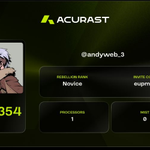
Would I keep my Xiaomi Redmi 10C running all week for 1.26 ACU?
That's the question I asked myself after seeing a daily reward figure of 0.18 ACU on @Acurast.
The weekly projection is simple.
0.18 ACU × 7 days = 1.26 ACU.
But there's more to running a Processor than calculating rewards.
I also need to think about charging, heat and battery condition.
Acurast Hub has battery monitoring tools, and the Phones page lets me check when the device last reported a heartbeat.
My priority isn't squeezing every possible minute out of an old Android.
It's finding a setup I can maintain safely.
If you've got a spare phone, I'd suggest testing it before building a larger setup.
You can begin through Cloud Rebellion: hub.acurast.com/rebellion?re…

"I entered an amount of USDC. Does that mean I'm buying all my zETH at the price on the screen?"
That's exactly the question I'd ask before using a new auction interface.
And it's why I think @zerufinance's ActivityFi launcher deserves a proper walkthrough.
zETH is now in its public auction on Uniswap CCA.
Unlike an ordinary instant token swap, this mechanism can distribute a bid across the remaining auction blocks.
Each block has a clearing price, and the dashboard's token estimate shouldn't be mistaken for a guaranteed final allocation.
Here's how I'd explore it with a friend.
First, open the official zETH market and read the live price, total bids and remaining auction supply.
Next, inspect the USDC input and estimated zETH output without submitting a transaction.
Then review the maximum price field and the explanation of how bids are processed.
If we decide the product is suitable and genuinely want to participate, we'd check the transaction details before signing.
After submission, we'd keep the transaction hash and monitor the auction rather than expect an immediate token balance.
The final claim happens after the auction ends, when purchased zETH and unused USDC become available according to the official process.
For anyone who simply wants to learn, I'd stop at the preview.
No purchase required to understand how ActivityFi connects Ethereum participation with a new memecoin launch.
Explore the zETH auction interface:
zaps.markets/?invite=zoeKzA5…

Good morning fam ☕
MyClaw 3.0 was presented on November 18 as a ready-made cloud environment for AI teammates.
Its website lists OpenClaw, Hermes, Pi, Claude Code, Codex and DeepSeek Harness, alongside shared memory. The launch pitch claims access to 5,000+ data sources and setup in about 30 seconds. I haven't seen independent tests verifying those claims.
The interesting part isn't the number of agents. It's whether they coordinate without leaking context or repeating work.
I'd test permissions, task handoffs and actual costs before trusting an agent team with my accounts.

You can prove a $500,000 brokerage balance onchain without showing a bank statement
Every smart investor hesitates when a DeFi protocol asks for passport scans, tax returns, or read only API keys just to qualify for lower borrowing rates. Centralizing sensitive financial documents inside a project database creates a honeypot waiting to be leaked onto the darkweb. You only want to prove your wallet meets the tier requirement without surrendering your personal identity to strangers.
@primus_labs built its zkTLS attestation network to end this dangerous habit of over sharing personal data.
During verification, a Primus Attestor node operates inside a hardware Trusted Execution Environment to confirm the authenticity of your HTTPS session without ever storing or reading your private credentials.
For example, suppose you want to access an institutional DeFi credit pool that requires $500,000 in traditional liquidity. Using the Primus Page SDK right inside your browser, you generate a cryptographic proof from your brokerage portal confirming your balance exceeds the $500,000 threshold. The smart contract receives a simple valid receipt and grants you prime borrowing terms, while your exact net worth and account number vanish completely.
Your Web2 track record is a powerful financial asset when you can prove it without doxxing yourself.
Save this guide to start building your verifiable onchain reputation without risking your personal data
Protect your identity while proving your financial standing with Primus and earn Kaito XP here: s.kaito.ai/7O4Rq7H

Most traders notice the 0% trading fee first.
I tend to look at what happens after the position is opened.
Imagine holding $100K worth of gold exposure for several trading sessions.
Paying no commission on entry is useful, but funding can become an important part of the total cost.
That's where @grvt_io's Stable Funding Perps take a different approach.
Instead of the frequent funding cycles common in crypto perps, SFP funding settles once per weekday at market close. One settlement day also accounts for weekend financing.
I prefer this structure when thinking about multi-day positions because the payment schedule is easier to follow.
There is an important distinction, though.
The funding rate shown during the day can change before the closing snapshot. The bid/ask spread and market execution still affect the trade.
And with GRVT offering 0% trading fees, those remaining costs become even more important to evaluate.
My comparison would be simple: open a hypothetical $100K gold position, calculate the holding costs for several days, then include the exit.
That's a more meaningful test than looking at the entry fee alone.

Good night builders 🌙
Acurast's smartphone compute model raises a question I don't hear enough in the November 16 discussion.
Its documentation reports around 300,000 compute units onboarded on an incentivized testnet and providers across more than 175 countries.
Those are network reach metrics, not proof of 300,000 devices running paid jobs nonstop.
Phones have real constraints: heat, charging, connectivity, and workload compatibility.
I like the idea of using hardware that people already own.
Still, I'd compare completed deployments, customer demand, and reliability across Lite and Core before treating node count as a proxy for economic value.

Prediction markets don't necessarily need more markets.
They may need better ways for people to discover and understand the ones that already exist.
That's the product question I kept thinking about while exploring @bagel_win.
The app's Explore section organizes prediction markets into recognizable categories such as Sports, Crypto, Finance, Esports and Politics.
It also surfaces trending markets rather than requiring users to begin with a specific contract address or complicated trading dashboard.
I think that matters for mobile users.
Someone who follows esports may not initially care about Federal Reserve decisions.
But a clear discovery interface can introduce them to other topics through familiar interactions.
During the walkthrough, I moved between sports events, entertainment predictions and macroeconomic markets.
The underlying subjects changed dramatically, but the product structure stayed consistent.
A market card leads to an event page.
The event displays available outcomes and market information.
Bagel AI can provide contextual analysis.
Social features allow users to follow other predictors and discuss different viewpoints.
And market, limit and combo order options are available for users who want to examine execution.
The interesting part is that Bagel builds this application experience around Polymarket's underlying markets and liquidity.
It's not necessary to create a new liquidity ecosystem to improve how people interact with an existing one.
But a simpler interface must still communicate settlement conditions, fees and risks clearly.
That's where I think thoughtful product design becomes genuinely valuable.
Explore Bagel at bagel.win/download.
Use code ANDYWEB3 to access the advertised 10% trading-fee discount for eligible new users.
A prediction market app needs more than interesting markets to build long-term engagement.
It also needs to give users a reason to return.
That's what I was thinking while examining the profile and Rewards section of @bagel_win.
The profile interface displays positions, trading volume, wins, profit/loss and portfolio information.
There's also a visible Rewards entry, connecting account activity with Bagel's incentive system.
In the recorded walkthrough, the example profile showed zero positions and zero trading volume.
I actually find that useful context.
It separates the features visible in the application from rewards or trading performance that haven't been earned.
Bagel's published product materials describe referral commissions, copy-trading rewards, activity badges and VIP progression.
Those are different engagement mechanisms.
A user might arrive to explore an NBA prediction market, follow another predictor through the social layer, use Bagel AI to examine an outcome and later become interested in an event leaderboard.
From a product-design perspective, those connected experiences can help build retention.
But I wouldn't judge success purely by the amount of incentivized trading activity.
I'd want to know whether users continue researching markets and participating in the community when rewards become less prominent.
Bagel AI also described specific VIP thresholds and commission rates in a separate conversation.
Those figures still need confirmation against the actual Rewards terms before being treated as official benefits.
If you're interested in exploring the product and its incentive system, Bagel is available at bagel.win/download.
Use invite code ANDYWEB3 for Bagel's advertised 10% trading-fee discount for eligible new users.
For me, a useful product should remain useful even after the promotional rewards disappear.

A 10% stablecoin yield looks great on a dashboard.
But before putting money into any lending pool, I want to understand what happens when everyone tries to withdraw.
That's the part of RNT Lend I'm paying the most attention to.
In the November 12 update from @rntprotocol:
USDT supply APY: 10.42%
USDC supply APY: 9.12%
These aren't fixed returns.
RNT Lend uses Aave V3-based infrastructure on Polygon, connecting stablecoin suppliers with borrowers who pledge tokenized real estate as collateral.
Borrowers pay interest, which accrues to suppliers every Polygon block.
The market has grown beyond $30M in total size, but that figure shouldn't be confused with immediately withdrawable stablecoin liquidity.
Here's why.
When a large portion of a lending pool is borrowed, utilization rises.
That can support higher supplier APYs, but it can also mean fewer stablecoins remain available for immediate withdrawal.
I actually find utilization more useful than the headline yield when evaluating lending markets.
A high rate can reflect genuine borrowing demand. It can also signal tighter liquidity.
And when the collateral consists of real estate security tokens, I would want to understand how valuations and liquidations work under stress.
Smart contract risk doesn't disappear because the technology comes from Aave V3.
RNT Lend has an interesting RWA lending model.
For me, the real test is how it handles liquidity when market conditions become less comfortable.


Yield in RNT Lend today:
USDT suppliers: 10.42% APY
USDC suppliers: 9.12% APY
It comes from borrowers. Holders of real estate security tokens post them as collateral, borrow stablecoins from the pool, and the interest they pay goes to suppliers, accruing block by block on Polygon.
Neither rate is fixed. Both follow how much of each pool is lent out, and right now that is most of it.
lend.rnt.finance

Developers pay to run applications on @Acurast.
So does every payment go directly to the phone doing the work?
According to Acurast's reward documentation, no.
Deployment costs are burned after successful execution.
Meanwhile, Compute Providers receive ACU through reward pools funded by token inflation, based on their contribution and eligible staking commitments.
Executing workloads can also improve a Processor's benchmark reward weight.
I find this distinction important.
Developer spending, token burns and provider earnings are three different things.
Understanding those mechanics matters more to me than any advertised daily earning estimate.
Explore phone-powered compute:
hub.acurast.com/rebellion?re…

You don't need to have joined the zETH race to explore its auction today.
That's probably the easiest starting point for anyone just discovering ActivityFi.
@zerufinance has opened the public phase of its first memecoin auction, powered by Uniswap CCA.
Here's the walkthrough I'd share with a friend.
First, open the zETH market.
The screen should show that the auction is open to everyone, rather than miners only.
Next, look at the live figures.
You'll see the current price per zETH, total USDC bid, the number of bidders and how much of the auction allocation has been sold.
These are market indicators, not promises about what your investment will earn.
Then, inspect the bidding section.
The interface shows how much USDC you would pay, an estimated zETH amount and a maximum price field.
I'd read the explanation for each item before signing anything.
If my wallet showed no USDC on Ethereum, I'd simply stop and explore the documentation.
There's no need to fund a wallet just to understand the product.
One more distinction matters: the public auction allows newcomers to bid, but the separate post-auction miner rewards require qualifying participation during the earlier miner-only window.
I like that ActivityFi gives people two different ways to engage: contribute through real onchain activity during a race, or evaluate the resulting token when its market opens.
Right now, learning the auction is a perfectly reasonable first step.
Explore zETH at your own pace:
zaps.markets/?invite=zoeKzA5…

Good morning web3 ☀️
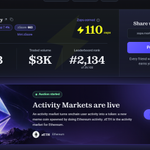
Variational announced a $110 million Series B on November 18, led by Bain Capital Crypto, at a $1.5 billion valuation.
The derivatives platform says it wants to raise open-interest limits, list more swap markets and release a trading API.
I find those plans more useful to evaluate than the unicorn label. Derivatives venues need reliable execution and enough liquidity when everyone wants to exit at once.
I'd watch whether open interest grows alongside trading activity, and whether risk controls hold up during volatile sessions.
Funding buys capacity to build. It doesn't buy market trust.

Traditional trade escrow takes 14 days while zkTLS settles verified cargo in seconds
Standard smart contracts remain trapped inside an onchain bubble because they cannot see real world business events. When a global merchant wants to release a stablecoin payment the moment a shipment clears customs, legacy blockchains sit completely blind. Businesses end up paying hefty fees to slow human escrow agents just to confirm a basic delivery status.
Global commerce needs a trustless cryptographic bridge to trigger onchain settlements from real world Web2 records.
The @primus_labs network eliminates this settlement delay through its conditional zkTLS payment infrastructure. It applies zero knowledge cryptography to prove the authenticity of live internet records without exposing private corporate credentials.
Consider an international electronics supplier shipping $500,000 in hardware to a buyer. The moment the logistics carrier updates the delivery confirmation on its official HTTPS tracking portal, the Primus zkTLS network verifies the API response, generates a tamper proof attestation, and triggers the smart contract to release the stablecoin escrow immediately. Zero human middlemen and zero settlement delays.
Financial activity stays private between trade partners while delivery claims remain 100% verifiable onchain.
How much working capital could global businesses save by replacing manual escrow with zkTLS payment rails?
Experience instant data conditional payments with Primus and collect your Kaito points here: s.kaito.ai/7O4Rq7H

You can prove a $500,000 brokerage balance onchain without showing a bank statement
Every smart investor hesitates when a DeFi protocol asks for passport scans, tax returns, or read only API keys just to qualify for lower borrowing rates. Centralizing sensitive financial documents inside a project database creates a honeypot waiting to be leaked onto the darkweb. You only want to prove your wallet meets the tier requirement without surrendering your personal identity to strangers.
@primus_labs built its zkTLS attestation network to end this dangerous habit of over sharing personal data.
During verification, a Primus Attestor node operates inside a hardware Trusted Execution Environment to confirm the authenticity of your HTTPS session without ever storing or reading your private credentials.
For example, suppose you want to access an institutional DeFi credit pool that requires $500,000 in traditional liquidity. Using the Primus Page SDK right inside your browser, you generate a cryptographic proof from your brokerage portal confirming your balance exceeds the $500,000 threshold. The smart contract receives a simple valid receipt and grants you prime borrowing terms, while your exact net worth and account number vanish completely.
Your Web2 track record is a powerful financial asset when you can prove it without doxxing yourself.
Save this guide to start building your verifiable onchain reputation without risking your personal data
Protect your identity while proving your financial standing with Primus and earn Kaito XP here: s.kaito.ai/7O4Rq7H
Traditional trade escrow takes 14 days while zkTLS settles verified cargo in seconds
Standard smart contracts remain trapped inside an onchain bubble because they cannot see real world business events. When a global merchant wants to release a stablecoin payment the moment a shipment clears customs, legacy blockchains sit completely blind. Businesses end up paying hefty fees to slow human escrow agents just to confirm a basic delivery status.
Global commerce needs a trustless cryptographic bridge to trigger onchain settlements from real world Web2 records.
The @primus_labs network eliminates this settlement delay through its conditional zkTLS payment infrastructure. It applies zero knowledge cryptography to prove the authenticity of live internet records without exposing private corporate credentials.
Consider an international electronics supplier shipping $500,000 in hardware to a buyer. The moment the logistics carrier updates the delivery confirmation on its official HTTPS tracking portal, the Primus zkTLS network verifies the API response, generates a tamper proof attestation, and triggers the smart contract to release the stablecoin escrow immediately. Zero human middlemen and zero settlement delays.
Financial activity stays private between trade partners while delivery claims remain 100% verifiable onchain.
How much working capital could global businesses save by replacing manual escrow with zkTLS payment rails?
Experience instant data conditional payments with Primus and collect your Kaito points here: s.kaito.ai/7O4Rq7H
Good night web3 🌙
US spot Bitcoin ETFs recorded about $239.9 million in net outflows on November 17, with BlackRock's IBIT accounting for roughly $209.5 million.
The small positive session on November 16 clearly wasn't enough to establish a durable reversal.
As of early November 19 in Vietnam, the November 18 US trading session hadn't closed, so I wouldn't quote a final number for it.
I pay more attention to several completed sessions than one hopeful green bar.
Institutional demand is easier to judge from consistent flows than from a temporary pause in selling.

A prediction market app needs more than interesting markets to build long-term engagement.
It also needs to give users a reason to return.
That's what I was thinking while examining the profile and Rewards section of @bagel_win.
The profile interface displays positions, trading volume, wins, profit/loss and portfolio information.
There's also a visible Rewards entry, connecting account activity with Bagel's incentive system.
In the recorded walkthrough, the example profile showed zero positions and zero trading volume.
I actually find that useful context.
It separates the features visible in the application from rewards or trading performance that haven't been earned.
Bagel's published product materials describe referral commissions, copy-trading rewards, activity badges and VIP progression.
Those are different engagement mechanisms.
A user might arrive to explore an NBA prediction market, follow another predictor through the social layer, use Bagel AI to examine an outcome and later become interested in an event leaderboard.
From a product-design perspective, those connected experiences can help build retention.
But I wouldn't judge success purely by the amount of incentivized trading activity.
I'd want to know whether users continue researching markets and participating in the community when rewards become less prominent.
Bagel AI also described specific VIP thresholds and commission rates in a separate conversation.
Those figures still need confirmation against the actual Rewards terms before being treated as official benefits.
If you're interested in exploring the product and its incentive system, Bagel is available at bagel.win/download.
Use invite code ANDYWEB3 for Bagel's advertised 10% trading-fee discount for eligible new users.
For me, a useful product should remain useful even after the promotional rewards disappear.
I've expanded my @GeckoTerminal Watchlist to 8 pools, but my research process hasn't changed.
I still prefer comparing market conditions over chasing whichever token happens to be trending.
My latest snapshot shows 22.02K transactions and $5.27M in daily volume.
One comparison immediately caught my attention.
BTW has a $613M market cap but only $53.1K in liquidity in the selected pool.
SPX, meanwhile, has a smaller $287.2M market cap but around $8.7M in pool liquidity.
That's a huge difference in market structure.
I've also added AAVE, QNT and SHIB alongside PONS, CASHCAT and BNKR.
AAVE is up 2.7%, while QNT and SHIB are slightly negative in the screenshot.
Different assets, different market conditions.
That's why I want a repeatable routine: check price action, compare volume and liquidity, then decide whether the data deserves deeper investigation.
More charts don't automatically mean better research.
Better questions do.
My GT Watchlist:
geckoterminal.com/watchlist?…
What's the first metric you check when researching a pool?
Four tokens on my @GeckoTerminal Watchlist, and none of them are there just because they're trending.
PONS, BTW, CASHCAT and BNKR.
What's interesting is how differently they're behaving.
BTW is down 24% in my screenshot, while PONS is up 2.7%.
CASHCAT has slipped 2%, and BNKR is slightly positive at 1%.
I could spend an entire morning opening random charts trying to understand these movements.
But I'd rather keep the four pools together and compare what actually matters.
Price changes are the starting point. Trading activity and liquidity provide more context.
That's why I've been organizing my research around a smaller GT Watchlist.
It's not about predicting the next winner.
It's about having a consistent reason to follow each market.
My Watchlist:
geckoterminal.com/watchlist?…
What's on yours?

Traditional trade escrow takes 14 days while zkTLS settles verified cargo in seconds
Standard smart contracts remain trapped inside an onchain bubble because they cannot see real world business events. When a global merchant wants to release a stablecoin payment the moment a shipment clears customs, legacy blockchains sit completely blind. Businesses end up paying hefty fees to slow human escrow agents just to confirm a basic delivery status.
Global commerce needs a trustless cryptographic bridge to trigger onchain settlements from real world Web2 records.
The @primus_labs network eliminates this settlement delay through its conditional zkTLS payment infrastructure. It applies zero knowledge cryptography to prove the authenticity of live internet records without exposing private corporate credentials.
Consider an international electronics supplier shipping $500,000 in hardware to a buyer. The moment the logistics carrier updates the delivery confirmation on its official HTTPS tracking portal, the Primus zkTLS network verifies the API response, generates a tamper proof attestation, and triggers the smart contract to release the stablecoin escrow immediately. Zero human middlemen and zero settlement delays.
Financial activity stays private between trade partners while delivery claims remain 100% verifiable onchain.
How much working capital could global businesses save by replacing manual escrow with zkTLS payment rails?
Experience instant data conditional payments with Primus and collect your Kaito points here: s.kaito.ai/7O4Rq7H
Giving an autonomous AI agent wallet access without zkTLS is financial suicide
Builders launching autonomous AI trading agents face a massive security blind spot: input manipulation. If an AI treasury bot executes million dollar swaps based on a spoofed macroeconomic API or a fake central bank rate announcement, your entire vault can be drained in 1 block. You cannot hand private keys to an automated agent that lacks the mathematical tools to verify offchain truth.
Every autonomous financial agent requires a trustless cryptographic filter before signing a single onchain transaction.
This is where the zkTLS infrastructure and open source Veritas toolkit from @primus_labs protect the machine economy. Primus enables AI agents to query live Web2 endpoints such as institutional banking APIs, treasury yield feeds, and exchange order books over HTTPS with verifiable authenticity.
Picture an autonomous liquidity agent managing a $10M stablecoin reserve across decentralized lending pools. Using Primus, the agent only rebalances funds when an Attestor node generates a valid cryptographic proof confirming official Federal Reserve rate updates directly from the source server. Corrupted data feeds are rejected automatically before computation begins.
Verifying the origin of offchain information is mandatory before autonomous agents deploy real capital.
Bookmark this post if you are building or backing verifiable AI agents in Web3
See how Primus protects autonomous AI agents from bad data and earn your Kaito rewards here: s.kaito.ai/7O4Rq7H

A prediction market app needs more than interesting markets to build long-term engagement.
It also needs to give users a reason to return.
That's what I was thinking while examining the profile and Rewards section of @bagel_win.
The profile interface displays positions, trading volume, wins, profit/loss and portfolio information.
There's also a visible Rewards entry, connecting account activity with Bagel's incentive system.
In the recorded walkthrough, the example profile showed zero positions and zero trading volume.
I actually find that useful context.
It separates the features visible in the application from rewards or trading performance that haven't been earned.
Bagel's published product materials describe referral commissions, copy-trading rewards, activity badges and VIP progression.
Those are different engagement mechanisms.
A user might arrive to explore an NBA prediction market, follow another predictor through the social layer, use Bagel AI to examine an outcome and later become interested in an event leaderboard.
From a product-design perspective, those connected experiences can help build retention.
But I wouldn't judge success purely by the amount of incentivized trading activity.
I'd want to know whether users continue researching markets and participating in the community when rewards become less prominent.
Bagel AI also described specific VIP thresholds and commission rates in a separate conversation.
Those figures still need confirmation against the actual Rewards terms before being treated as official benefits.
If you're interested in exploring the product and its incentive system, Bagel is available at bagel.win/download.
Use invite code ANDYWEB3 for Bagel's advertised 10% trading-fee discount for eligible new users.
For me, a useful product should remain useful even after the promotional rewards disappear.
I think one of the more interesting product decisions on @bagel_win is how the AI experience connects directly to the market you're exploring.
It doesn't start from a completely empty conversation.
When I opened Bagel AI around a Federal Reserve prediction market, the selected event and its outcomes were already part of the context.
The market displayed several possible sequences of rate decisions, including Hike – Hike – Hike at 34% and Hike – Hike – Pause at 29%.
Bagel AI then generated an explanation involving inflation, policy tightening and possible changes in monetary conditions.
What interested me wasn't whether the recommendation would eventually be correct.
It was the interaction design.
A traditional workflow might involve finding a market, copying its title, opening another AI tool and explaining the context again.
Bagel reduces those steps by connecting market discovery with contextual analysis.
The same interface can also be used for entertainment, sports and crypto-related markets.
From a product perspective, that creates a consistent research experience across different categories.
However, contextual AI also introduces responsibility.
Some of its claims require independent verification, and an explanation that sounds convincing may still be based on incomplete or incorrect assumptions.
I'd like to see clearer source references and better visibility into the data behind each recommendation.
Bagel combines this analytical layer with Polymarket's underlying markets, social features and flexible order types.
I think the integration is promising because it addresses how users navigate information, not just how they place predictions.
Explore the app at bagel.win/download.
My code is ANDYWEB3, which eligible new users can use for Bagel's advertised 10% trading-fee discount.

Not every AI application needs to generate content.
Sometimes, identifying what you're reading is more useful.
@Acurast's Laya Newsroom demo shows an AI model classifying headlines into categories such as news, satire, clickbait and manipulation.
You can submit your own headline or explore content from RSS feeds.
The classification decision comes from a model running on an Android phone.
One detail matters: Laya evaluates the writing, not whether the underlying claims are factually true.
I think that's an important distinction.
A fast classifier could help organize information, but it shouldn't replace fact-checking.
For me, this is a more practical example of decentralized AI than another vague infrastructure promise.
Explore Laya: laya.acurast.com/
hub.acurast.com/rebellion?re…
