

Your go-to source for Korean memory & Asian chip news ⚡ The biggest stories in AI, tech & markets. Straight from LOCAL sources. $SKHY $005930 | ENG/KOR
Joined November 2025
- Tweets3.8K
- Following1.3K
- Followers1.8K
- Likes1.3K




Pinned Tweet
So P Equity Research picks up a screenshot from Antfeed, and an hour later Elon Musk is talking about Chinese RAM. 👏👏👏
source via @antfeedapp


Part 2
apple's decades-long relationship with chinese manufacturers got me thinking about samsung and sk hynix, and all these long-term memory supply agreements.
a contract is a pretty abstract idea, almost an extension of that western instinct to believe certain rules should hold regardless of how circumstances change (see part 1).
but contracts are only part of it. there's also the more concrete question of who needs whom more, and how much either side stands to lose.
think about apple.
foxconn and apple's other suppliers in china spent decades building an entire manufacturing ecosystem around apple's products.
contracts, factories, equipment, know-how and working relationships that neither side could easily replace overnight.
and none of that means the terms stayed the same. relationships can last for decades even as contracts get renegotiated.
now, being harder to replace doesn't mean customers will keep paying premium prices when demand falls. even foxconn's decades-long relationship with apple doesn't mean it gets to dictate the terms.
but there's a big difference between being just 'another memory supplier' and having your technology so deeply embedded in a customer's future products and investment plans that replacing you becomes a real problem.
samsung and sk hynix are already moving in that direction, especially with hbm. and i think the next challenge is turning that technological advantage into bargaining power that holds up even when the market turns against them.
not immunity from the memory cycle, but a stronger position when the next downturn comes.
and american hyperscalers have a part to play too.
if they expect korean memory makers to invest billions in capacity for their future demand, they should have some serious skin in the game.
samsung and sk hynix already have deep ties with their biggest customers.
but do these new LTAs actually make those relationships harder to walk away from, or are we getting too excited about longer contracts on paper?
because when the cycle turns, i'd rather have customers with real reasons to stick around than have to drag them to court over contracts they no longer want to honor.


part 1
apple shipped nearly a quarter of a billion iPhones last year, continuing more than a decade of shipping hundreds of millions annually.
what gets me isn't just the scale, but how apple has this almost obsessive idea of what the 'ideal Phone' should be and somehow gets factories in china to make hundreds of millions of them with toyota-like consistency and porsche-level finishes.
and apple is about as western capitalist as it gets: strict contracts, rigid standards, relentless audits and almost obsessive control over every supplier.
you'd think that kind of 'rule-driven approach' would clash with china's traditionally 'relationship-driven' business culture, yet apple has somehow made it work for over two decades, going all the way back to the early iPod days in shanghai.
and i wonder if this difference between rules and relationships has something to do with how the west and east have historically seen the world.
the ancient greeks searched for 'universal truths' beneath a changing world, principles that hold regardless of circumstances. apple's pursuit of the 'ideal Phone' feels like a modern expression of that same search for something universal, just in hardware.
chinese thought, on the other hand, traditionally placed more weight on 'concrete realities', human relationships and adjusting to changing circumstances.
the west creates the zero to one, china figures out the 1 to 100. of course reality is much more complicated than that, but maybe this old contrast helps explain why apple and chinese manufacturing work so well together.
apple refuses to compromise on its vision and standards, while chinese manufacturers constantly adjust to the realities on the ground to deliver what apple wants (no matter what).
but how do you keep something like this going for over 20 years? i have a hard time believing it was just about 'enforcing contracts".
apple spent decades investing in suppliers, developing manufacturing capabilities and building relationships (through contracts, close cooperation and 'other means') that gave both sides enormous incentives to 'keep working together'.
what i can't get over is how one of the world's most contract-abstract-ideal-driven companies managed to build such durable relationships in china, where business has traditionally depended on a lot more than just what's written in a contract.
maybe the contracts were never the whole story.
both sides had way too much invested in the relationship to just walk away.
and that's what got me thinking about samsung and sk hynix, and whether all these long-term memory supply agreements will actually hold up when the cycle (inevitably) turns...
Part 2
Part 2
apple's decades-long relationship with chinese manufacturers got me thinking about samsung and sk hynix, and all these long-term memory supply agreements.
a contract is a pretty abstract idea, almost an extension of that western instinct to believe certain rules should hold regardless of how circumstances change (see part 1).
but contracts are only part of it. there's also the more concrete question of who needs whom more, and how much either side stands to lose.
think about apple.
foxconn and apple's other suppliers in china spent decades building an entire manufacturing ecosystem around apple's products.
contracts, factories, equipment, know-how and working relationships that neither side could easily replace overnight.
and none of that means the terms stayed the same. relationships can last for decades even as contracts get renegotiated.
now being harder to replace doesn't mean customers will keep paying premium prices when demand falls. even foxconn's decades-long relationship with apple doesn't mean it gets to dictate the terms.
but there's a big difference between being just 'another memory supplier' and having your technology so deeply embedded in a customer's future products and investment plans that replacing you becomes a real problem.
samsung and sk hynix are already moving in that direction, especially with hbm. and i think the next challenge is turning that technological advantage into bargaining power that holds up even when the market turns against them.
not immunity from the memory cycle, but a stronger position when the next downturn comes.
and american hyperscalers have a part to play too.
if they expect korean memory makers to invest billions in capacity for their future demand, they should have some serious skin in the game.
samsung and sk hynix already have deep ties with their biggest customers.
but do these new LTAs actually make those relationships harder to walk away from, or are we getting too excited about longer contracts on paper?
because when the cycle turns, i'd rather have customers with real reasons to stick around than have to drag them to court over contracts they no longer want to honor.
There's a new version of this post
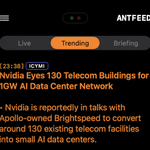
ICYMI: NVIDIA EYES 130 TELECOM BUILDINGS FOR MINI AI DATA CENTERS
Nvidia is reportedly in talks with Brightspeed to convert roughly 130 existing telecom buildings into small AI data centers, according to The Information.
The sites could provide around 1 GW of computing capacity, potentially avoiding some of the delays facing new data center projects.
Could repurposing existing infrastructure speed up AI deployment?
And could smaller AI data centers become the next big trend?
More breaking AI and semiconductor news from Korea and around the world on Antfeed. Free on iOS and Android!
#Nvidia #AI #DataCenters #Brightspeed #AIInfrastructure #Semiconductors


FROM CHIPS TO CHAMPIONSHIPS, SAMSUNG IS HAVING ONE HELL OF A YEAR.
Record-shattering memory earnings, and Samsung's baseball team is just one win away from its first Korean Series title since 2014.
At this rate, even the Lions players might deserve a share of those semiconductor bonuses lol.
Sorry, Galaxy division...


AMERICA'S DATA CENTER CRACKDOWN: WHY KIS CHIP ANALYSTS AREN'T PANICKING
U.S. data center restrictions have rattled semiconductor stocks, but Korean chip research powerhouse Korea Investment & Securities remains confident in the AI investment cycle.
In its November 6 report, the brokerage argues that widespread construction bans remain unlikely.
Local governments still want the jobs and tax revenue, while AI companies could ease opposition by covering infrastructure costs.
Meanwhile, Samsung and SK Hynix have already fallen 47% and 58% from their 2026 highs, respectively.
The brokerage sees strong valuation support and maintains its Overweight rating on semiconductors.
Could local opposition really derail America's AI buildout?
And have Samsung and SK Hynix already priced in the worst?
We recapped Korea Investment & Securities' latest research on Antfeed, alongside more semiconductor news and analysis from Korea and around the world.
Free on iOS and Android!
#Samsung #SKHynix #Nvidia #AI #DataCenters #Semiconductors #HBM #MemoryChips #KoreanStocks


1980S KOREAN OFFICE WORKERS REMINDED THEY ARE EMPLOYEES, NOT SOLDIERS
SEOUL, 1980s. Long before Samsung became a global technology giant, its employees were experiencing something closer to 19th-century Prussian cadet training, complete with morning assemblies, rigid discipline, and unquestioning obedience.
Apparently, the only difference between military service and corporate life was the paycheck.
This corporate culture reflected Korea's decades of military dictatorship, influenced in part by Japanese imperial military traditions and reinforced by the ever-present threat of invasion from North Korea.
Armed with employee ID badges and an unwavering sense of duty, the Samsung Warriors marched toward global domination 🙃.


AMERICA'S BIGGEST EXPORT ISN'T TECHNOLOGY. IT'S SECURITY AND THE DOLLAR
The U.S. has roughly $40 trillion in national debt, yet can borrow at relatively low interest rates.
Fordham University economist Sun Yong Kim(@SunYongKim1) argues that America's military power and security guarantees help underpin the dollar's global dominance.
Countries like Korea, Japan, and Australia rely on U.S. security commitments, giving them strategic reasons to support the dollar-based financial system.
In return, America benefits from global demand for its debt.
But there's a potential problem.
The biggest long-term threat to dollar dominance may not be China, but America's own growing isolationism.
Could pulling back from global security commitments eventually raise America's borrowing costs?
And what would a weaker U.S. security umbrella mean for Korean stocks, interest rates, and the dollar?
We covered the full analysis on Antfeed, along with more global finance, geopolitics, and technology insights.
Free on iOS and Android!
#USD #USTreasuries #Geopolitics #Dollar #Korea #China #GlobalMarkets #Finance


WHAT IF SLOWER AI SPENDING IS GOOD FOR GOOGLE AND AMAZON?
Steve Eisman, the real-life investor from The Big Short, sees an interesting possibility in the AI selloff.
Slower data center construction could actually benefit Google, Amazon, and Microsoft.
Why? Less CAPEX means less pressure on cash flow.
Google and Amazon reported quarterly free cash flow of negative $9 billion and $33 billion, respectively.
But for Nvidia, AMD, and memory chipmakers, slower AI spending could mean weaker demand.
Meanwhile, CoreWeave's bond yields have surged from 9% to 15%, raising questions about how long debt-funded AI infrastructure expansion can continue.
Could slower AI spending actually help Big Tech's bottom line?
And what happens to chipmakers if their biggest customers start spending less?
We recapped Steve Eisman's latest analysis on Antfeed, along with more AI and technology coverage.
Free on iOS and Android!
#Google #Amazon #Microsoft #Nvidia #AMD #CoreWeave #AI #DataCenters #Semiconductors


AI IS DRIVING A MEMORY SHORTAGE. KOREAN ANALYSTS SEE A W-SHAPED RECOVERY
AI demand is accelerating, and new memory capacity won't arrive in a meaningful way until after 2028.
The 2027 price forecasts are striking:
HBM: +121%
DRAM: +40%
NAND: +32%
Yet Samsung trades at just 2.9x projected 2027 earnings, and SK Hynix at 2.5x.
Korean analysts see a potential W-shaped stock recovery in November and December as valuations catch up with earnings.
Are Korean memory stocks pricing in too much pessimism?
And could agentic AI make the memory shortage even worse?
We recapped the latest Korean semiconductor research on Antfeed, along with more AI and technology analysis from Korea and around the world.
Free on iOS and Android!
#Samsung #SKHynix #HBM #DRAM #NAND #Micron #AI #Semiconductors #MemoryChips
🤖 Made with AI


THE AI SELLOFF: ARE KOREAN MEMORY STOCKS GETTING TOO CHEAP?
Samsung and SK Hynix are back near their July valuation lows.
Their 12-month forward price-to-book ratios have fallen to 1.21x and 1.23x, respectively.
But Korean analysts argue the selloff may be overdone.
Growing HBM exposure could reduce earnings volatility and support higher valuations than in previous memory downturns.
Meanwhile, tighter U.S. data center regulations may delay new projects, but existing construction should face limited disruption.
Could HBM keep memory stocks from revisiting their historical valuation lows?
And is the market already pricing in too much bad news?
We covered the latest Korean semiconductor research on Antfeed, along with more AI and technology analysis from Korea and around the world.
Free on iOS and Android!
#Samsung #SKHynix #HBM #DRAM #Semiconductors #AI #MemoryChips #TechStocks

