

I build Shopify apps and talk to D2C founders every week. Posting what actually breaks in retention, checkout and ops. Co-founder, Schwifty Mind Labs.
Bangalore, India
Joined November 2024
- Tweets269
- Following108
- Followers20
- Likes53









Pinned Tweet
I build Shopify apps for D2C brands. Most of what I've learned came from things breaking in their stores, not from dashboards.
3
2
50
BFCM won't break your store at the homepage.
It breaks in the places nobody checks: an order tagged wrong, a discount stacking with another, a COD order no one confirms.
What's the one thing that went wrong in your store last sale?
8
I'll also share the building side: installs, failed experiments, pricing, launches. Real numbers where I can.
1
10
I think Shopify stores are slowly becoming collections of automations that nobody fully understands.
An order is placed.
One workflow tags the customer.
Another updates inventory.
Another sends a notification.
Another triggers a fulfilment action.
Then the order gets edited, cancelled or refunded.
Which workflows run again?
Which ones should stop?
Can two automations contradict each other?
Shopify just expanded Flow triggers to respond to field updates across orders, customers, refunds, returns, inventory and more.
That's powerful.
But I think there's an emerging problem:
The more a business automates, the harder it becomes to understand what actually happened when something goes wrong.
We need to move beyond building automations.
We need visibility into how those automations behave together.
How many Shopify merchants actually audit their workflows after setting them
I think brands underestimate how much the visibility of a reward affects whether customers actually use it.
A customer receives ₹200 in store credit.
But then what?
They forget about it.
They don't know where to find it.
They don't remember when it expires.
They visit the store again and never realise they have a reward waiting.
The brand thinks it has created a retention incentive.
The customer barely remembers receiving one.
Shopify has now made store credit balances visible in the customer account header.
A small UX change, but an interesting one.
Because a reward only creates value when the customer remembers it exists and has a reason to use it.
Maybe the problem with loyalty isn't always the reward itself. It's how well the reward is communicated throughout the customer journey.
How do you make sure customers actually notice and redeem the rewards they earn?
1
1
16
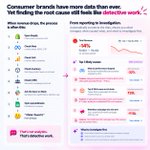
I think D2C brands are looking at demand shifts at the wrong level.
A skincare brand sees that moisturiser sales are growing.
Great.
But what's actually driving that growth?
New customers discovering the category?
Existing customers buying more frequently?
Customers moving from one price segment to another?
A particular ingredient becoming popular?
A specific product generating repeat purchases?
These are very different signals.
And they should lead to very different decisions around inventory, marketing and product development.
Shopify just expanded Sidekick's ability to analyse store metafields and metaobjects alongside sales metrics.
I think this is an interesting direction.
The next step in ecommerce analytics isn't just understanding which products sell. It's understanding which customer behaviours and product attributes are driving the sales.
How deeply do you analyse demand today: by product, category, customer cohort or product attributes?
1
2
46
India just had a strong festive ecommerce season.
But here's a number I find more interesting:
42% of 3,274 established D2C brands analysed by GoKwik reported declining sales compared with September.
Meanwhile, home and kitchen GMV grew 81%.
Water purifier sales increased 10.6x.
Health and wellness brands lost share.
Same festive season. Very different outcomes.
I think this highlights a problem with how consumer brands plan growth.
Too many decisions are made using category-level trends and last year's performance.
But consumer demand doesn't move uniformly.
It shifts between categories, products, price points and geographies.
The question isn't just:
"Is my category growing?"
It's:
"Where is customer demand moving, and is my brand positioned to capture it?"
How quickly can your team detect when demand starts shifting away from your category or products?
3
1
54
I think D2C brands need to rethink how they expand into Tier 2 and Tier 3 cities.
A recent report analysing 8 crore+ orders found that on-time delivery in smaller cities crossed 80%.
And yet, I think delivery is only half the equation.
Imagine launching in Coimbatore.
You get organic orders.
You test a few local creators.
Customers start recommending the brand.
Delivery is reliable.
Repeat purchases start coming in.
Now you have something worth scaling.
But most brands still approach expansion as:
Find a new audience → Run ads → Get orders.
I think the better approach is:
Find local demand → Build local trust → Prove fulfilment → Encourage word-of-mouth → Scale acquisition.
You don't just acquire customers in a new city. You build a market there.
How many D2C brands actually have a city-level growth strategy?
2
33
Do support this amazing cause

This Deepavali, a lamp worth lighting: Smriti, @mid_org's record of India’s civilizational heritage, now holds over 11 lakh manuscript records and 1 lakh inscriptions, free to search, in one place.
That is roughly a tenth of the 1 crore+ manuscripts India’s national survey has mapped, and about a third of the 3 lakh inscriptions estimated to survive. To our knowledge, no other open platform brings Indian manuscripts and inscriptions together, at this scale.
When we, @Shreyas_mysuru, @SudarshanHS, @RahulDewanV2 & I, started on this journey a year ago, the intent was: a dataset that is public & free. What we have managed so far is owed to our donors, teammates, volunteers, custodians and partners.
This year, there are two priorities:
1. A platform for researchers and enthusiasts to add to and correct the knowledge base.
2. Fresh digitisation grants to partner institutions, for which we are raising a corpus of ₹15 crore.
A request to every donor: be our ambassador. Every hour spent fundraising is an hour not spent digitising. If you would like to help or volunteer, please write to [email protected] or DM @midf_org.
तमसो मा ज्योतिर्गमय।
smriti.midf.org.in


20
I think D2C brands might be underestimating Tier 2 and Tier 3 cities.
Here's an interesting number from a recent ClickPost report analysing 8 crore orders across nearly 400 brands.
On-time deliveries:
Tier 2 and Tier 3: 83%
Tier 1 metros: 78%
Read that again.
Smaller cities actually had better on-time delivery performance.
Yet many brands still approach expansion outside metros cautiously.
I think the question has changed.
It's no longer just:
"Is there enough demand in this city?"
It's:
Can I acquire customers profitably?
Can I deliver within a reasonable timeframe?
Can I build local trust?
Can I serve repeat demand?
And here's something I'd love to understand:
Do D2C brands actually have a city-level growth strategy, or are they still running national campaigns and hoping the logistics work out?
2
28
Your fastest-growing customer market might be the place you're worst at delivering to.
Think about it.
A D2C brand starts getting more orders from Lucknow, Jaipur, Indore and Coimbatore.
Marketing sees growth.
The founder sees a new market opening up.
But inventory is still sitting in Mumbai or Bengaluru.
Which means:
Longer delivery times.
Higher shipping costs.
More pressure on fulfilment.
Potentially more cancellations.
And the brand keeps spending to acquire customers in those markets.
Here's what I find interesting:
Are D2C brands actually aligning inventory placement with where demand is moving?
Or are they still making fulfilment decisions based on where their warehouses happen to be?
Growth isn't just finding customers in new markets.
It's building the ability to serve them profitably.
1
48
Arjun Vijayan retweeted

Storage was always the missing piece in India's solar story. This plugs it.
We are adding solar at record pace. The sun sets at 6 pm. Peak demand doesn't. Till now, coal and imported gas filled that evening gap. 92 GWh changes the math.
What I like as a finance guy .. Rs 14,500 crore of public money pulling in close to Rs 1 lakh crore of investment. Roughly ₹7 of private capital for every ₹1 the government puts in. That's leverage done right.
The mix is sensible. Pumped hydro is 60 of the 92 GWh, about two-thirds. Long asset life, Indian civil works, zero lithium dependence.
The 40% domestic content rule on batteries matters more than people realise. Without it, we would simply swap oil imports for Chinese cell imports. Same dependency, new label.
The 2 GWh for emerging tech is a cheap option on whatever wins next, sodium ion or flow batteries.
Execution will decide the scorecard. Pumped hydro takes years to build. But the direction is right and the cheque is real.
Store more. Import less. Fully agree.
Super rollouts yesterday @narendramodi ji 🙏👍

Store More → Import Less → Power India Round the Clock!
The Cabinet has approved a massive Rs 14,500 crore push to develop 92 GWh of energy storage capacity, supporting an estimate of almost 1 lakh crore investment!
Unique features are:
60 GWh of pumped hydro storage.
30 GWh of battery energy storage.
2 GWh through emerging technologies.
40% minimum domestic content for battery storage projects.
Truly, it is more reliable power, greater renewable energy integration and stronger energy security.
pib.gov.in/PressReleaseDetai…
Here's a number I think D2C founders should pay attention to.
During India's festive season, ecommerce orders grew 31% year-on-year.
But GMV grew only 17%.
Which means average order value was down roughly 10%.
At the same time, customer acquisition costs were reportedly up 15–20%.
Think about that combination.
More orders.
Smaller baskets.
Higher acquisition costs.
You're spending more to acquire customers who are buying less per transaction.
And yet, your order dashboard might tell you that business is growing.
I think consumer brands need to stop treating order growth as a proxy for business growth.
The more important questions:
Are we acquiring profitable customers?
Are customers buying enough to cover acquisition and fulfilment costs?
Are discounts increasing basket size or simply reducing margins?
More orders is not necessarily better growth.
What metric do you trust most when evaluating growth: orders, GMV, contribution margin or repeat purchase rate?
19
Your product catalog might be perfectly fine for your website and still be a mess everywhere else.
A product title that works on your store might not explain enough to an AI shopping agent.
An attribute that's obvious to a human might be missing from the product data.
A price or availability update might not be reflected consistently across channels.
And every new sales channel creates another place where things can go wrong.
Shopify just introduced channel-specific product data mapping, so merchants can customise product information for different sales channels while keeping it updated.
I think this is an underrated ecommerce problem.
Managing a catalog is easy. Keeping product data accurate, complete and useful everywhere you sell is much harder.
This is one of the problems we're exploring with referbro.com/apps/catalogai.
How are you managing product data across your Shopify store and other sales channels today?

26
A D2C brand can grow 20% year-on-year and still have a terrible festive season.
Because the plan said 50%.
Inventory was ordered for 50%.
Ad budgets were allocated for 50%.
Discounts were designed to hit 50%.
Then demand came in below expectations.
Now the brand has to decide:
Cut ad spend or keep chasing the target?
Discount harder or protect margins?
Hold inventory or clear it?
The original plan assumed one version of reality. The business is now operating in another.
I think the hardest part of running a consumer brand isn't making the plan.
It's recognising early when the plan has stopped matching reality and knowing what to change first.
When sales fall short of plan, what's the first decision your team revisits: marketing spend, pricing, or inventory?
10