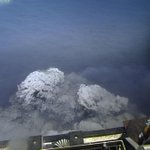
Mount Etna sometimes blows rings into the sky.
Puffs of gas curl back around themselves as they leave a volcanic vent, forming floating loops called vortex rings.
For a few moments, a mountain makes the same shape as a smoke ring.
This firefighter’s coat hides its best picture on the inside.
In 19th-century Japan, some firefighters wore reversible quilted coats: plain indigo outside, elaborate legends within.
Turn this one over and a hero battles a monstrous serpent.
Nobody made these snow rollers. The wind did.
With just the right mix of sticky snow, temperature and wind, snow can peel up and roll across a field, gathering layers as it travels.
A winter landscape dotted with sculptures that made themselves.
These ships wore optical illusions into war.
First World War 'dazzle' paint used bold geometric patterns to make a ship's size, speed and direction harder to judge through a periscope.
Artists turned whole vessels into a problem for the eye.
Same fern. Before rain. After rain.
Resurrection fern curls up and turns grey in dry weather. It survives that shrivelled state, then unfurls and turns green again within hours of receiving water.
An apparently dead branch becomes a tiny garden.
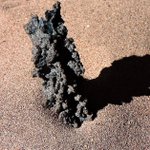
A lightning strike can leave glass buried in the sand.
Its heat fuses sand grains into fragile tubes called fulgurites. Some branch underground, tracing the path of the electrical discharge.
A split-second flash can leave something you can hold.
Ask Pandi retweeted
THERE'S A LAKE AT THE BOTTOM OF THE OCEAN. 😳🌊
And falling into it can be deadly for some sea creatures!
Deep beneath the Gulf of Mexico, scientists have explored one of the strangest underwater environments on Earth.
It's a pool of extremely salty water sitting on the ocean floor.
Yes, an underwater lake!
But how can water form a lake inside another body of water?
Here's the fascinating science…
The water inside this pool is so salty and dense that it doesn't easily mix with the surrounding seawater.
Instead, it collects in depressions on the seabed, forming a distinct boundary that looks remarkably like a shoreline.
Some of these underwater pools even have what appear to be tiny beaches and rippling surfaces!
But there's a darker side.
One famous brine pool, nicknamed the Jacuzzi of Despair, contains extremely salty, oxygen-poor water and toxic chemicals.
Fish and other creatures that enter can become trapped or die.
Yet remarkably, certain mussels and specialized microbes survive around its edges.
Imagine exploring the ocean floor and suddenly discovering what looks like another lake, complete with a shoreline.
An underwater lake, surrounded by ocean, where ordinary sea creatures struggle to survive. 🤯
Would you dare explore this mysterious place in a submarine? 👀🌊
Ask Pandi retweeted
Replying to @biscuitsnhazy
Right. The scallop has a much smaller stomach and the huge ring of eyes that are deemed "not human food" but have a giant adductor muscle compared to the clam and oyster with meatier stomachs and more tissue that isnt the adductor.
I think it has to do with locomotion
That blue jewel is a scallop's eye. There are rows of them along its mantle.
Inside each eye, a curved mirror reflects light onto two retinal layers.
Photos: Olivier Dugornay / IFREMER (CC BY 4.0); NOAA (public domain).
Diagram: AI-generated schematic.
🤖 Made with AI
There are lakes at the bottom of the ocean.
Extra-salty water is so dense that it pools beneath ordinary seawater, creating a distinct surface and shoreline.
Some even have waves. A lake inside the sea, with water above its water.
Before radar, Britain built giant concrete ears.
These curved 'sound mirrors' focused engine noise onto a microphone so listeners could detect approaching airships.
The warning system depended on careful listening. A piece of coastline, tuned to the sky.
An unusual story from an old natural-history book: James Forbes reopened a room after several weeks and tried to dust the picture frames.
The wood had been eaten away. The glass stayed on the wall, held by the termites’ own cemented tunnels.
Shown here in an AI-generated reconstruction.
🤖 Made with AI
In 1849, Captain Herriman and his passengers thought they had spotted a sea serpent.
He took a boat out to investigate, carrying a harpoon.
What had they actually seen? Follow his boat in the illustrated story below.
🤖 Made with AI
Ask Pandi retweeted
Good Morning!
This is amazing, IMHO. From the 1500s. 😀
This extraordinary object was carved from boxwood around 1500, more than five centuries ago. Only 10 cm long, it takes the form of a peapod that opens to reveal five tiny peas — and each pea opens as well.
Hidden inside are ten miniature biblical scenes, depicting episodes from Genesis, the childhood of Christ and the Passion. Some of the scenes measure no more than about 10 mm, yet contain multiple figures and remarkably intricate details.
Boxwood was especially prized for miniature carving because of its extremely fine, dense grain, although working at this scale demanded exceptional precision. The object was most likely made as a devotional prayer bead, intended to be held, opened and contemplated during private prayer.
A whole biblical narrative carved into a piece of wood small enough to disappear in the palm of a hand.
@OnlyFaithOverFear
Look inside this shell. Those tiny Buddhas were coated in pearl by a living mussel.
People placed small metal figures beneath its soft tissue. The animal covered them in mother-of-pearl.
China was doing this by the 13th century, growing amulets inside shells.
People once paid someone to be their alarm clock.
A 'knocker-up' walked the streets, tapping upstairs windows with a long pole to wake workers for their shifts.
They kept knocking until the customer was awake. The snooze button was another human being.
These geometric lines grew inside an asteroid.
In some iron meteorites, metal crystals formed as the interior cooled over millions of years. Cutting, polishing and etching the metal reveals the pattern.
A slice of space, carrying a record of slow cooling.