The recent classical-text transcriptions use Sol 6.1 and Opus 5.5 as separate readers of the same scan.
Neither gets the stored transcription or the other reader’s answer. Web lookup is excluded. Readings are saved before comparison.
The Yilin work exposed a subtle leak: a verse ID can reveal the heading the reader is supposed to recover.
The recent exact-model run is on Zhouyi Zhushu, another reference text, rather than a new complete Yilin transcription.
Replying to @sixlinesapp
@sixlinesapp, an I-Ching app, has another version to track alongside its code: the text behind each explanation.
The Yilin chain now records the reference release, shared content revision and the version each app checkout adopts.

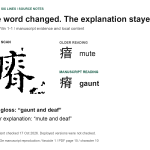
ALT Typeset comparison: old reading 瘖, mute, changes to 瘠, gaunt. The short translation uses gaunt and deaf while the longer explanation still says mute and deaf and needs review. The original manuscript crop follows in image 2.

ALT Actual native-resolution manuscript scan crop of 瘠, gaunt, at character 10 of Jiaoshi Yilin verse 1-1. Wenyuan Ge Siku Quanshu manuscript reproduction, fascicle 1, PDF page 15. Source crop box: x1190–1350, y1655–1778 in the embedded scan. Original black-and-white pixels, without AI generation or enhancement.
Translation, image prompt and image carry separate records of their inputs.
Correcting a translation must not silently mark the prompt or image as reviewed. Original baselines stay; reviewed amendments record what changed and why.
An agent skill in the @sixlinesapp workflow started with a translation error.
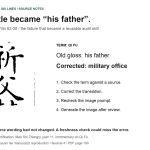
In Jiaoshi Yilin 62-30, 祈父 names a military office. The old gloss read it as “his father”, and the image prompt inherited the mistake.
The Chinese had not changed. A check asking whether the translation was up to date could miss an interpretation that was wrong from the start.
The prompt staged a confrontation with an elder; the correction made him a commander.
A correction in the Jiaoshi Yilin, a book of verses behind @sixlinesapp, an I-Ching app: 崇 became 祟.
The first can mean “revere”; the second, a bane or malign influence. The image shows actual scan crops, including a comparison character from the same page.
The target has 出 above 示. The same-page 崇 has an extra 宀 layer. A confirmed 祟 from the same fascicle supplied another comparison.
These are named, locatable examples of the copyist’s handwriting.
And the trailer is on youtube
Crap...
"Where does the Chinese connection and the code idea come from?
I needed to find him an occupation that was very immersive and constant, something that takes many years to do. So I thought maybe he is translating the I Ching book, which is ancient and difficult, with many layers and possible lines of interpretation. He is completely immersed in this world, and ironically he cannot see where he actually is in his real family life. He is always translating, reading everything through codes. Even in the end, when his wife says something very warm about remembering and sharing memories of the children, he answers by citing this book.
The I Ching is also very visual. It has the hexagrams, which are almost like a computer code – 64 combinations of 0 and 1. They can easily be translated into something else, like those black-and-white dice appearing in the film. And dice means game, the game of life."
Kristijonas Vildžiūnas • Director of Dice-Ching-O-Mat cineuropa.org/en/interview/4… via @cineuropa
A Chinese character behind @sixlinesapp, an I-Ching app, was read as “mute”. The manuscript supports “gaunt”.
The short translation changed. The longer explanation kept the old meaning. This is Jiaoshi Yilin verse 1-1.
An earlier check saw only two changed characters out of twenty-four and skipped the row. But “stone” had become “many”, and “mute” had become “gaunt”.
A small edit count concealed two changes in meaning.
Neon Memoir is live on the Solana dApp Store. It's my entry for the Solana Mobile "Clock In" hackathon on Radiants, and it's also submitted to the Colosseum World's Fair.
Some things I learned shipping it: the dApp Store isn't on Google Play and has no web version, and the one-tap install is Seeker-only. On any other Android phone you can sideload it, and the steps are here: github.com/augchan42/neonmem…
New game on Seeker: Neon Memoir. Pocket-sized, on-chain, no laptop.
Go play.
Article: View article
Play: seekertracker.com/dapps/com.…
@aug_digitalrain cc @solanamobile
Neon Memoir cites Lloyd Strickland’s translation of Leibniz’s 1703 letter to Bignon. He’s seeking support to publish more of Leibniz’s work, including writings on binary and China that remain unpublished.
Project and support: opencollective.com/leibniz-p…
Neon Memoir: 8bitoracle.com/en#neon-memoi…
Replying to @8bitoracle
2/ ... along with a number of the letters to/from Bouvet, as well as one to Grimaldi. There are other writings on binary and China (some still unpublished); these will feature in future volumes of my edition, if I can secure the funding to make them happen
Anyone for some vaporwave? Created with github.com/alchaincyf/huashu…
@AlchainHust
Replying to @Voxyz_ai
Tried huashu’s vaporwave renderer on the I-Ching’s 64 patterns. Kept the sun clear and made it loop to Orbit.
Just submitted Neon Memoir (an @8bitoracle archive) to CLOCK IN, a Solana Mobile hackathon presented by Radiants.
One historical image a day. Explore sourced facts and a fictional copyist’s notes, then file your examination on Solana.
@RadiantsDAO @solanamobile @solanamobileFN @therealchaseeb
Neon Memoir is now submitted to @Colosseum’s Crypto World’s Fair too.
Our little Blade Runner “ENHANCE” tribute now has a China/Europe timeline, built from user feedback.
Project: colosseum.com/arena/projects…
54s update: youtube.com/watch?v=bOYwEzev…
@solanamobile