
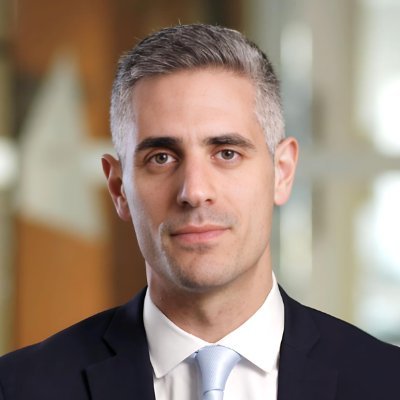
Founder, https://xitter.cf/t.co/904G6eDonQ / Former Editor-in-Chief, The Jerusalem Post / 🇺🇸🇮🇱 / Pretty Jewish. No big whoop. / [email protected]
Jerusalem, Israel 🇮🇱
Joined September 2008
- Tweets77.4K
- Following9.1K
- Followers344K
- Likes29.5K







Pinned Tweet
Last Thursday, I stood in the Oxford Union and delivered the closing argument in a fiery debate about Israel.
Arguing against the proposition that “Israel never truly wanted peace with Palestine,” my colleagues @emilykschrader, @HenMazzig, @EinatWilf and I entered the chamber knowing that we would be facing a largely hostile audience, but determined to make our case nevertheless.
By the end of the evening, we heard from several students that we had, in fact, changed their minds — a reminder that calm, substantive argument can still move people, even in the most challenging environments.
This is the text of my speech. I will share the video as soon as it’s available.
___________________
Madam President,
Members of the House,
Ladies and gentlemen,
It falls to me to bring our case, and this debate, to a close.
My colleagues have ably set out the long history of Zionist and then Israeli efforts to achieve peace with the Palestinians: the compromises proposed, the territorial concessions offered, and the repeated willingness of Israeli leaders and the Israeli public to take extraordinary risks in pursuit of that goal — risks all too often paid for in Israeli blood.
Our opponents, for their part, have offered a very different story. We have heard painful accounts of dispossession — and they are indeed painful, Dr. Karmi. We have heard selective readings of history and arguments that deny any genuine Jewish claim to the land that both peoples call home. We have heard contortions of logic and inversions of truth that seek to explain away every Israeli overture, every negotiation, every concession, as something other than it appeared to be.
And that brings us to the real question before this House tonight.
Because we are not being asked whether Israeli governments have fallen short in their efforts to bring about peace. Some have, while others — including those described earlier — have offered dramatic and far-reaching concessions to bring peace about.
We are not being asked whether Israeli and Palestinian leaders have, at times, missed opportunities that might have brought peace closer. They have.
We are not even being asked whether Palestinians — and Israelis — have suffered due to the absence of peace. They have.
No, the motion before this House tonight is far more extreme. It posits that Israel never wanted peace with Palestine.
Never.
Never?
Not Rabin?
Not Peres?
Not Barak?
Not Olmert?
Not the hundreds of thousands of Israelis who filled public squares in support of peace?
Not the millions who voted for leaders promising territorial compromise?
Not the Israeli parents of every generation who, knowing all too well the cost of war, hoped and prayed and dreamed that their children would be the first to finally know peace?
Never?
Ladies and gentlemen, our opponents have spent this evening asking you to believe something striking: that when Israelis spoke of and prayed for peace, they didn’t mean it. That when Zionist and Israeli leaders offered concessions for peace, they didn’t mean it. That when millions of Israelis voted for peace, they didn’t mean it, either.
This is not an argument about Israeli policy. It is an argument about Israeli motives, about the Israeli soul.
And the difficulty for our opponents is that they have chosen the wrong people.
Because there is no value more essential to the Jewish national soul than peace.
The Jewish tradition is suffused with the quest for peace. It courses through our religious texts, animates our prayers, and inspires our vision of a more perfect world.
It was the prophet Isaiah who envisioned a future in which peace reigned among nations, uttering those immortal words:
“And they shall beat their swords into plowshares, and their spears into pruning hooks; nation shall not lift up sword against nation, neither shall they learn war anymore.”
Every single day, for two millennia, Jews have ended their daily prayers with supplications for peace. The Talmud goes so far as to say that shalom, peace, is one of God’s names, elevating it from an earthly aspiration to the realm of the divine.
It is no surprise, then, that when the earliest Zionist thinkers contemplated the Jewish state they sought to create, they envisioned it at peace.
Socialists and liberals, revisionists and traditionalists, they differed profoundly in their visions of the state to be. Yet across those divisions ran a remarkably consistent belief: that the Jewish national home should one day live at peace with its neighbors.
That aspiration found perhaps its clearest expression in Israel’s Declaration of Independence, issued as five Arab armies advanced upon the nascent state.
Even in that moment of existential peril, Israel’s founders proclaimed:
“We extend our hand to all neighboring states and their peoples in an offer of peace and good neighborliness, and appeal to them to establish bonds of cooperation and mutual help with the sovereign Jewish people settled in its own land.”
And indeed, for generations of Israelis, that aspiration has been not merely a line in a founding document. It has been a sought-after reality, a national ideal, and a deeply personal hope.
I am a relic of the 1980s.
The first word I learned on my first day of primary school in Jerusalem was shalom, peace — an experience shared by all Israelis, including those in this room, on both sides of this debate.
I remember watching, wide-eyed, as Yitzhak Rabin and Yasser Arafat shook hands on the White House lawn, certain that a new era of peace was upon us.
I remember standing in a massive crowd with my father and younger sister as we were swept toward the gates of the Knesset, Israel’s parliament, to pay our respects to Rabin, felled by an assassin’s bullets in his pursuit of peace.
I remember the wave of Hamas suicide bombings that claimed the lives of hundreds of Israelis, including two young girls from my neighborhood — one year my junior — killed in a Jerusalem pizzeria.
And I remember how, even in the midst of that surge of murderous terror, even in the wake of a prime minister’s assassination, Israelis pivoted not to the right but to the left, electing a leader who had explicitly campaigned on a platform of territorial concessions for peace and granting Ehud Barak one of the largest margins of victory in Israeli history.
But Israel never wanted peace?
Never?
Really?
Ladies and gentlemen, that claim crumbles under the weight of documented history.
One can argue that peace has proven elusive.
One can argue that opportunities have been missed.
One can argue that terrible mistakes have been made.
One can even argue that, today, after October 7, the appetite for territorial concessions in the interest of peace is vastly diminished.
But to argue that Israelis never wanted peace is not a serious reading of history.
It is a denial of history.
Indeed, it requires us to believe that millions of people, across multiple generations, did not truly mean what they said — to one another, to their neighbors, and even to God — about one of their most heartfelt aspirations.
For if every expression of peace was merely a ruse, every offer a deception, every aspiration a lie, then we are left with a familiar accusation — that what Jews said was never what Jews meant.
But beneath much of what we have heard here tonight lies an even deeper, and darker, argument.
It is an argument that has animated not only some of the views expressed in this chamber, but too often the positions of Palestinian leaders throughout this conflict.
It is not really about peace negotiations.
It is not really about diplomatic proposals.
It is not really about Camp David or Oslo or Annapolis.
It is about legitimacy.
Because if one denies that the Jewish people have any genuine claim to this land, if one believes that Israel should never have come into being and should cease to exist today, then no Zionist or Israeli offer, no matter how sincere or expansive, can ever be enough.
Peace itself becomes impossible, because one side’s very existence is regarded as an affront, an injustice, a blight to be erased.
But that is not the motion before this House.
You are being asked whether Israel has ever truly wanted peace with Palestine.
And if millions of Israelis marched for peace, voted for peace, and were willing to take far-reaching and deeply painful risks for peace, then the answer to that question is self-evidently yes.
Ladies and gentlemen, the tragedy of this conflict is not that peace has never been sought.
The tragedy is that peace has been sought, and yet proven so painfully difficult to attain.
The tragedy is that two peoples with deep and abiding ties to the same land have so often found themselves unable to reconcile their competing aspirations.
That is a tragedy, and it is one that we should all hope and pray comes swiftly to an end, for the sake of all who live in that cherished land.
But it is not evidence that peace was never desired.
And it is certainly not evidence that an entire people spent generations engaged in an elaborate collective deception about one of their most deeply-held hopes — one that goes to the very depths of their national soul.
For all its mistakes, for all its failures, for all the opportunities lost along the way, Israel has wanted peace.
Jewish tradition says so.
History says so.
The lived experience of generations of Israelis says so.
And I hope this House will say so as well.
I urge you to reject the motion.
Thank you very much.

The ultra-Orthodox Shas party has joined the request, citing "crowding at polling places" and a desire "to avoid a situation in which citizens waiting in line cannot vote."
(The Central Elections Committee has already said that anyone in line at 10 PM will be permitted to vote)

Netanyahu's Likud Party has requested that polling places be kept open beyond 10 PM, though no reason has been announced.
🇮🇱 Voter turnout in Israel’s election as of 4 PM, nine hours into voting, hits 55.7% – believed to be an all-time record.
It is currently raining heavily across Israel, with thunderstorms here in Jerusalem.
This may affect voter turnout in today's election.
We'll have to see if the historic voting trends of the first part of the day continue.
Turnout is up to a greater degree in areas that are largely secular and tend to vote for left-wing parties compared to more traditional and right-leaning areas.
Turnout in heavily ultra Orthodox areas is actually down slightly compared to the 2022 election.
Data via @Nehemia_GA
🇮🇱 Voter turnout in Israel’s election as of 2 PM, seven hours into voting, hits 44.9% – the highest in more than 50 years.
🎙️ I’ll be on NBC News NOW in about 15 minutes, around 10:05 AM ET, to discuss today’s election here in Israel and potential ramifications for the U.S.-Israel relationship.
Do tune in.
🇮🇱 In light of the high voter turnout, Israel’s Central Elections Committee has announced that anyone already in line at 10 PM, when polls are set to close, will be permitted to vote.
🇮🇱 Voter turnout in Israel’s election as of noon, five hours into voting, hits 31.5% – the highest in more than 50 years, since 1973.

In Israel, schoolchildren wear blue and white on special, ferstive occasions.
Participating in the democratic process is such an occasion, so I dress the part every time.
🇮🇱

I am currently at my Jerusalem polling place, which has several ballot boxes. All of them have lines, some quite long. That has not been the case in previous elections.
🇮🇱 Voter turnout in Israel’s election as of 10 AM, three hours into voting, is at 16.68% – the highest since 1981.
Abdul El-Sayed refuses to condemn the blatantly antisemitic ad created to support his campaign.
Why might that be…

El-Sayed campaign statement: "This ad is not affiliated in any way with the Abdul for Senate campaign. Abdul is focused on pushing back against Trump’s agenda that is raising prices for Michiganders. No one speaks for Abdul but himself and his campaign." #MISEN
Democratic Congressman Ritchie Torres.

FACT: The annual funding Israel receives from the US amounts to less than one-tenth of 1% of the federal budget. Less than 1/10th of 1%.
FACT: That annual funding would cover only a few hours of federal health care spending. A few hours.
Yet politicians who specialize in scapegoating would have you believe that Israel is responsible for America’s affordability crisis.
Like every form of scapegoating before it, it is a dangerous lie.
Democratic Congressman Dan Goldman.

If @AbdulElSayed truly means what he says about treating the Jewish community as he would treat his own children, then he would immediately condemn this dangerous ad as outrageously antisemitic and demand that it be taken down.
If not, then he’s full of shit.
🇮🇱 It is now midnight here in Israel. Election Day has begun.
In seven hours, at 7 AM, 12,018 polling places will open across Israel. They will remain open until 10 PM.
7,331,981 Israeli citizens aged 18 and above are eligible to vote in today’s election.
יאללה להצביע! 🇮🇱
Avi Mayer אבי מאיר retweeted
The U.S. allocates $3.3 billion a year for Israel to buy American-made military equipment.
That’s a lot of money!
The U.S. has given Ukraine $68.2 billion in military aid since 2022.
That’s *checks notes* more money.
But we only ever hear about U.S. aid to Israel.
Why?
Avi Mayer אבי מאיר retweeted
Abdul El-Sayed's antisemitic ad blaming Israel for grocery prices and healthcare costs in Michigan had nothing to say about all the other countries that benefit from tens of billions of dollars in U.S. military aid because it wasn't really about that.
It was about the Jews.