









Ajay Vikram retweeted
The Garden closes in 4 hours.
To every collector who already picked a piece: thank you.
To everyone still looking: the last flowers are waiting.
17:00 UTC · 12:00 pm EST🌸🌹


The Garden closes tomorrow, November 12
17:00 UTC · 12:00 pm EST
OpenSea has unhidden the collection. Thanks to @zjbrenner and @slander_eth for the help!
The official OS link is :
opensea.io/collection/doy-ga…

Ajay Vikram retweeted

bars minting open
jack.art/exchange/bars


Ajay Vikram retweeted
Big news! So happy to announce this:
The Garden opens in 24h on networked.art.
You can already preview the collection and choose the ones you love.
138 one-of-ones, 69 Dark and 69 Gold.
Tuesday, November 10
17:00 UTC · 12:00 pm EST
networked.art/garden
111 pieces at auction for 48 hours. Every piece starts at $10. The collectors decide the rest. Patron Editions will also be available to collect for each piece.


Ajay Vikram retweeted

Ajay built 3D Credits. Drop in a Credit ID and it builds it in 3D, plate by plate
Here's mine 🙌🏾 Love seeing builders make stuff like this

Ajay Vikram retweeted
21 builders are on the Credits page now
Each was recognized for something they made
When more people credit the same builder, their cards stack into a deck you can swipe
The video is a preview, since nobody has a second card yet: humancredit.co/builders

Ajay Vikram retweeted

I combined 64 Checks into a Single Check on day one. I still love it today, but I also gave up something important:
I can no longer sell 1, 5, or 10 of those Checks.
That’s why I think the real significance of Credits Phase 3 goes far beyond launching an ERC-20. @jackbutcher may have finally solved one of the hardest contradictions in his earlier work:
The more art is compressed into a purer form, the more liquidity tends to disappear.
Checks VV is the clearest example.
64 Checks can be combined into 1 Single Check, and 64 Single Checks can ultimately become 1 Black Check.
The dead end of this kind of pure deflationary model is that every step upward compresses more value and artistic expression into fewer objects, while locking away more liquidity at the same time.
Credits takes a very different path.
It creates a beautiful hourglass-shaped structure.
At the bottom layer, Credits are numerous, accessible, and highly liquid. Combine 80 Credits into a Statement and the artistic expression becomes much richer, but liquidity drops sharply.
If the story ended there, it would still be another version of Checks.
But Jack added Phase 3: a Statement can be permanently surrendered, releasing its rating into a fully liquid ERC-20 token, Balance.
That completes the cycle:
High liquidity → condensed into art (low liquidity) → released back into high liquidity
Liquidity compression → Art → Liquidity re-expansion
The important part is that the art is not erased.
Once a Statement is locked, its visual form and onchain history remain. Meanwhile, Balance holders receive new dynamic wallet art that changes with balance, provenance, and color mixing.
So this is not a crude “NFT into token” conversion.
It is a coexistence of art and liquidity in different forms.
And this design may even reshape how people think about composing in the first place.
With Checks, every step forward feels heavy because you know the loss of liquidity is irreversible.
With Credits, Balance provides something critically important: a liquidity exit.
It is not a price floor. It is the certainty that there is still a divisible path out.
Knowing that such a path exists may actually make people more willing to participate in Phase 2, to compose, experiment, and create.
If Checks taught the market how to compress value into art, Credits may have finally added the missing piece:
how to let liquidity come back to life without erasing the art or its history.
🤖 Made with AI


credits is an artwork about belief
each credit was created from a private payment - an $8 transaction on x money
each transaction id, originally visible only to sender and recipient, was converted to a sha-256 hash to create an artwork made of four 8x8 printing plates in cmyk (cyan, magenta, yellow and black)
the transaction id and settlement timestamp became public source data for the onchain artwork
the x money transaction settlement time (in seconds) determined which plates print - there are 15 different possible combinations of cmyk, so this process repeats 4 x per minute
if the original transaction id contained an 8, the resulting artwork metadata keeps track of each
the rarity calculation considers the color combination, the number of active pixels, the space they occupy after the plates shift, the number of 8s in the transaction id, and the registration of the plates
these qualities are measured against the completed collection and translated into a credit rating between 80 and 800
the rating measures those traits - it cannot account for every reason someone might value an image
the rating is fixed - the price is whatever someone is willing to pay
80 credits can be burned to create a statement
the collector chooses which credits to use and how to arrange them - their individual ratings are added together, and their colors become the material of the new artwork
a statement can take different visual forms without changing its rating
statements can also be overprinted - one is burned into another, combining their ink, ratings and histories
balance is the proposed next form
under this design, a statement can be permanently surrendered for its rating in divisible erc-20 tokens - one point becomes one balance
the statement is locked rather than destroyed - its artwork and history remain, but it can no longer be transferred
its quantity and color composition can move independently
each receiving wallet gets one non-transferable erc-721 artwork
the artwork stays with the wallet and reads its current balance of the transferable erc-20 token
the tokens move - the artwork updates
if the wallet holds nothing, the artwork remains and displays zero
when balances meet, their colors mix in proportion to the amounts received - when they split, each part carries a share of that mixture
the colors preserve an aggregate ancestry, not a traceable list of individual credits or statements
exchange custody can mix them further - a buyer may receive the exchange’s mixture rather than the particular colors a seller deposited
someone who never owned a credit or a statement can inherit their colors
credits, statements and balances can exist at the same time
some people keep the individual marks, some compose them into pages, and some surrender the page for something they can divide and exchange
others may simply prefer the balance artwork
composition reduces the number of surviving credits, overprinting reduces the number of surviving statements, and surrender moves statements out of circulation while releasing their accumulated rating as balance
the appetite for liquidity becomes one of the forces shaping all three collections
but making something divisible does not mean someone will want to buy it - actual liquidity still requires buyers and funded markets
balance offers divisibility, not a promise of demand
the market becomes a medium - its activity changes the distribution of the work, and when trading stops, that distribution remains
the price can disappear, the artwork cannot


Ajay Vikram retweeted
1/
New set submission : "BALANCE"
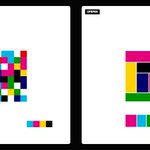
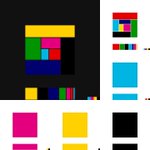
The set is generated by using credits where % ink parity of a color in a credit decides the size and color of a block in its opepen version.
Editions are categorised on basis of number of 8s in a credit.
In the set number of 8s conceptually represent balance of an opepen drawing a parallel to balance in a bank account.
Edition 1 : five 8s
Edition 4 : four 8s
Edition 5 : three 8s
Edition 10 : two 8s
Edition 20 : one 8
Edition 40 : zero
Edition 1 is generated from most rare credit #11469 from the collection which have five 8s and only credit with dark background.
Edition 4 have pieces with four 8s
From edition 5 to Edition 40 one color dominates in each edition type in order of C ,M, Y, K and only color palettes containing that color is used in generating opepen of that edition type.
For example :
Edition 10 - "M" dominated
so uppermost block is Magenta colored and also the largest block in all pieces of edition 10.
only color palettes conataing "M" are used in generating opepen in ed 10 like m, cm, my, mk, cmy, cmk, mky, cmyk.
interestingly if we follow this concept only a set of max "8" color palettes are possible out of total 15 color palette for each edition type.
The base of opepen arranges all colors that exist in it in order of % ink parity from left to right.


Credit → Opepen

1/
New set submission : "BALANCE"
The set is generated by using credits where % ink parity of a color in a credit decides the size and color of a block in its opepen version.
Editions are categorised on basis of number of 8s in a credit.
In the set number of 8s conceptually represent balance of an opepen drawing a parallel to balance in a bank account.
Edition 1 : five 8s
Edition 4 : four 8s
Edition 5 : three 8s
Edition 10 : two 8s
Edition 20 : one 8
Edition 40 : zero
Edition 1 is generated from most rare credit #11469 from the collection which have five 8s and only credit with dark background.
Edition 4 have pieces with four 8s
From edition 5 to Edition 40 one color dominates in each edition type in order of C ,M, Y, K and only color palettes containing that color is used in generating opepen of that edition type.
For example :
Edition 10 - "M" dominated
so uppermost block is Magenta colored and also the largest block in all pieces of edition 10.
only color palettes conataing "M" are used in generating opepen in ed 10 like m, cm, my, mk, cmy, cmk, mky, cmyk.
interestingly if we follow this concept only a set of max "8" color palettes are possible out of total 15 color palette for each edition type.
The base of opepen arranges all colors that exist in it in order of % ink parity from left to right.
2/
Explore more on : credopepen.vercel.app
Check credits from which the set is generated.
Check % ink parity of each opepen.
Download cards showing opepen. along with its respective credit.
1
5
163