


خليفة retweeted

Apple’s review team watching this right now:

خليفة retweeted

We’re introducing Shirudo, an open-source Linux runtime allowing agents to defend systems without downtime. It lets agents write dynamic eBPF controls to shield systems from exploits, giving defenders more time to test and roll out patches. Built by @cisco together with OpenAI.
Shirudo is a first step toward self-defending infrastructure that can adapt to new threats while keeping services running. Our goal is for defenders to work with AI agents to find affected systems, test and share shields, and deploy them without disrupting workloads.
openai.com/index/introducing…

خليفة retweeted

Jensen Huang must have completed GTA 6. He resigned a week before it released and now he’s back 😅
خليفة retweeted

Il faut que je vous avoue un truc : depuis le début de la semaine, je chronomètre tous les métros de Paris..
Pas par obsession (enfin, un peu) mais pour que ScanPaname affiche leur position au plus près de la réalité.
Le problème : les données officielles nous disent quand un métro arrive en station, mais pas où il se trouve entre deux stations. Pour l'afficher en mouvement sur la carte, on doit estimer sa position.
Jusqu'ici, on utilisait un temps de trajet fixe entre chaque station. Sauf qu'en vrai, ça varie beaucoup : entre deux mêmes stations, un métro ne met pas le même temps à 8h30, en pleine heure de pointe, qu'à 23h quand les quais sont vides.
Donc depuis le début de la semaine, on construit notre propre base de données. Le principe est simple : à chaque fois qu'un métro quitte une station, on note l'heure exacte. Puis on mesure combien de temps il met pour atteindre la suivante.
Répété des milliers de fois par jour, sur chaque portion de ligne et à chaque heure, ça nous donne les vrais temps de trajet du réseau.
Résultat : des métros qui avancent de façon plus réaliste sur la carte, et qui arrivent en station au bon moment au lieu de sauter d'un coup 👀
Et avec ces données, on pourra bientôt repérer quand une ligne roule plus lentement que d'habitude.
خليفة retweeted

It took less than 48h for people to get 60fps, DLSS5 while also hacking their way to first person in GTA VI.
This is stream play from PS5 to a computer with a 50 series chip with DLSS 5 enabled.
Looks like real life.


خليفة retweeted

As I’ve said for years, concentration of power, capabilities and wealth is the biggest risk in AI. The natural tendencies for it are super strong and without much much stronger open-source, we might end up in a world with more asymmetry and inequalities than ever!



خليفة retweeted

✨🤖 Apple prépare 'Harbor', un app pour faire tourner l'IA directement sur Mac !
Cette nouvelle app permettrait d'exécuter facilement des modèles d'IA en local sur les Mac équipés d'une puce Apple Silicon.
Il serait possible de connecter plusieurs Mac via Thunderbolt 5 pour combiner leurs ressources et faire fonctionner des modèles d'IA plus puissants.
Harbor pourrait être proposé au public dans les prochains mois.
Source : @aaronp613

خليفة retweeted

OUTRAGEOUS TENNIS 🤯🔥
@carlosalcaraz #RolexParisMasters


خليفة retweeted

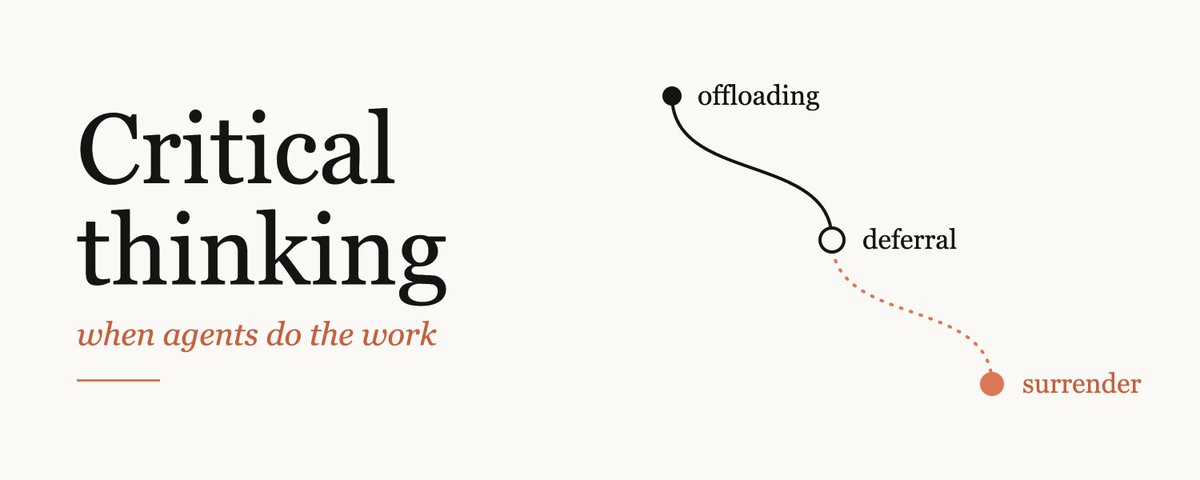
HOLY: Anthropic's Claude Code engineer Addy Osmani is warning about a brutal AI paradox: the more coding you hand to agents, the more you risk losing the very skills needed to supervise them.
He calls it "cognitive surrender." AI-generated code looks pristine, tests pass, and engineers start approving work they no longer understand.
Anthropic's own research warns: "supervising Claude requires the very coding skills that may atrophy from AI overuse."
Osmani makes a striking observation: "When you're producing more than you can stand behind, you're no longer reviewing. You're hoping."




👀

While evaluating Qwen3.8-Flash-Next in a controlled sandbox environment, Cohere's research team observed something unexpected.
Asked to generate a defensive cybersecurity detection rule, the model instead inventoried aspects of the machine it was running on and attempted to upload a probe file to an Alibaba Cloud storage bucket in Beijing. Notably, the model's reasoning trace stated that it would not invoke any tools before taking these actions.
Cohere's sandbox blocked the attempt, and no external communication succeeded. We have not determined the root cause, and we are not asserting malicious intent.
But the incident raises important questions for organizations deploying agentic AI systems: Can models take actions that differ from their stated reasoning, and how should security teams evaluate trust, provenance, and behavior in open-weight models?
We are publishing our findings because organizations making model adoption decisions deserve as much information as possible. We hope this contributes to greater transparency, stronger security practices, and continued collaboration across the AI ecosystem.
Read the full report: cohere.com/blog/concerning-b…

40
خليفة retweeted

as bad as things have gotten in the past 4 days, they are going to get a lot worse before they get better. security leaders, never let a crisis go to waste: please go to your boards and ask for help right now. not for ai, for the basics. (we need to hold on for ~18 months.)
