


Bartosz Kotrys retweeted

🇩🇪 Four tiny Microduck robots completely stole the show at NVIDIA’s GTC Berlin keynote.
Jensen Huang had them sitting, standing, and taking naps right on stage, proving the future of AI robotics is officially adorable.
Microduck is an open source robot meant for developers and students who want to teach machines new physical skills, tweak them and share the results with others.
Writer: Bri
First time speaking at @AITinkerers Warsaw! 🚀
Had a great time sharing some lessons from our recent AI benchmarking research at @Quesma.
Lots of interesting demos and discussions. Definitely not my last AI Tinkerers event!
Hope to see you next time in Wrocław!

Bartosz Kotrys retweeted

basal-omni 🇵🇱 - TOP1 🤩🤩🤩 🌍 na świecie w modelach otwartych oraz TOP2 wśród zamkniętych i otwartych
Wg niezależnego benchmarku modeli system-one gdzie testowane są wszystkjie modele na świecie - JevBench (link do bencha w pierwszym wpisie). Czyli można? Można! Polskie AI 🇵🇱
basal wyprzedził model OpenAI, Microsoft oraz pierwowzór z TypeSafe (jev).
Thank you, @airesearch12 , for the independent evaluation on JevBench.

Bartosz Kotrys retweeted

For the first time, we got over 2048 visitors in the last 30 minutes on the @QuesmaOrg blog, thanks to a Hacker News home run by @pmigdal . You should read it; it's beautiful. 🧵

Most of engineers don't understand why their transcripts/trajectories are super important. @jakozaur from @QuesmaOrg described it in details in following thread, worth taking a look.

Your agent session transcripts are precious. Keep them.
Anthropic analyzed 200,000 of its own Claude Code transcripts to understand how its engineers work. Cursor uses agent sessions as training data. Replit calls them a core strategic advantage. Yet most companies let their Claude Code, Codex, and Cursor sessions get deleted.
They're one of the best data sources you have, and almost nobody collects them. 🧵

Bartosz Kotrys retweeted
The era of massively subsidized subscriptions that I described on the Quesma blog is coming to an end.
Models get better, but typical operations such as git commits are more expensive. Tonekflation.

Hi,
Tomorrow we are re-opening the Pro $200 subscriptions to new subscribers, but together with it we are also changing how we calculate the usage for it. In effect, if you do the math, it will net out at half the dollar in API spend compared to the old Pro $200 plan.
Now that it's said, let me explain why this is happening and why you will still get more work done than if you were on the Pro $200 subscription one month ago.
(a) We didn't want to compromise in other ways and are committing to not reintroducing the 5h limit, so that you can fully use the weekly usage when you want.
(b) On the subscription, we guarantee that over time you always get more work done and with an increasing level of quality. This means that you will continue to get more value per dollar spent as a result of models getting more efficient and us passing down the improvements in the form of API price reductions.
(c) We don't want to put an incentive on ourselves to artificially inflate the API list prices to make it look like you are getting a lot (and workaround it through discounts, etc). Instead we want to continue to both rapidly reduce prices and increase capabilities of models on the API. This week we introduced GPT-6 Sol and GPT-6 Luna at 50% of their previous price. Over time, we see prices go low enough that it makes sense for most to buy usage as needed without there being a significant gap between what you get in a subscription and what you get in the API for a dollar spent.
(d) Tomorrow, we are adding more things to the subscription that won't draw on the usage, I won't reveal what that is yet.
I wanted to be transparent before all the big announcements tomorrow. Lots of new exciting things are coming to the subscriptions that will make it super compelling, but I wanted to make sure to share this change ahead of time so you can all understand it before we shower you with good news.
Codexingly,
Tibo
Bartosz Kotrys retweeted
Though I love that Jev showed a different paradigm is possible, it’s limiting. Only closed answers, can’t count the r’s in strawberry, can’t follow logic. And banning benchmarks or performance publishing in the customer agreement means we’re back to Oracle-style legal.
Bartosz Kotrys retweeted
In 2011, shipping a demo overnight was impressive.
In 2026, vibe coding makes that cheap.
So we gave students 18 GB of coding-agent transcripts and one Friday evening to find where we burn tokens.
@QuesmaOrg First token economics hackathon:
quesma.com/blog/our-first-ha…

Bartosz Kotrys retweeted

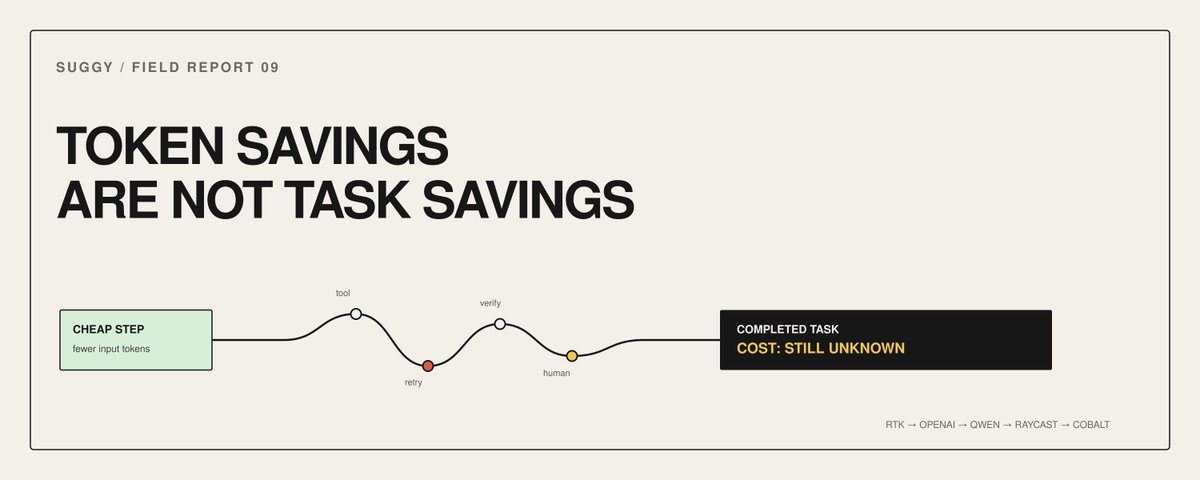
one outlier passed after 339 consecutive errors at ~9x the matched baseline cost
that was the moment "tokens saved = cheaper agent" stopped feeling like a useful shortcut
Bartosz Kotrys retweeted
Quesma benchmarked RTK (Rust Token Killer), and our post landed on the Hacker News homepage. Up to second place:
news.ycombinator.com/item?id…

Bartosz Kotrys retweeted
Embedded evaluators are the right idea. One common team across the frontier labs, not a team per lab. Independently appointed, fixed non-renewable terms, no lab equity, cooling-off before any lab job, diverse and including people from democracies outside the US. Funded up front through a foundation, so no single lab can pull the plug.

We Must Pace the Frontier: I’ve written a new essay on why the AI industry should slow down, with a three-part plan for doing so.
Anthropic is unilaterally committing to the first of these steps. We’ll provide third-party evaluators with permanent, employee-level access to our systems, so that they can verify adherence to our safety measures, report on incidents, and assess models’ alignment during training.
You can read the full post here: darioamodei.com/post/we-must…

Are terminal compression tools actually saving us money?
Together with @jakozaur we tested one of the most popular ones across 1,740 Terminal-Bench 2.1 runs.
Huge reported token savings.
Almost no improvement in the final bill.
Token compression ≠ cost optimization.
quesma.com/blog/does-rtk-mak…

Bartosz Kotrys retweeted

RTK reported 349.2M tokens “saved.”
@QuesmaOrg measured +17% average task cost on DeepSeek.
For agents: tokens removed ≠ tokens saved
This generalizes beyond RTK: caching, pruning, routing, even “cheaper” models can save locally while making the full trajectory more expensive.
quesma.com/blog/does-rtk-mak…
Good benchmark from @bartkotrys + @jakozaur
Bartosz Kotrys retweeted

Only GPT-5-Astra and Claude Fable 5.1 solved all levels from "The Lake" stage of Baba Is You.
Astra is 2x faster and 3x cheaper.
Bench (now saturated): quesma.com/benchmarks/babais…

Bartosz Kotrys retweeted
With new models and record-high results on benchmarks, do LLMs know it all?
Not really, if you dare to go outside established norms. As @pmigdal showed in the latest @QuesmaOrg post on Hacker News. The LLM still could not reliably tell which mushrooms are edible vs. fatal.

Bartosz Kotrys retweeted
Wrote a new blog post for @QuesmaOrg :
quesma.com/blog/codex-pricin…
Thanks, @pmigdal and @bartkotrys, for your feedback.

Bartosz Kotrys retweeted
Quantization is better than a lot of ppl think, see @pmigdal at @QuesmaOrg blogs such as:
quesma.com/blog/qwen38-27b-q…


Bartosz Kotrys retweeted
Meassured and blogged about it: quesma.com/blog/claude-code-…

Bartosz Kotrys retweeted
Same tokens, same model, up to a 40x price gap. Priced my own Claude Code usage at API list rates:
- Max 5x ($100/mo): $2,092 (21x)
- Max 20x ($200/mo): $2,986 (15x)
The seat plans are a subsidy. Enjoy the buffet while it's open.
Full math: quesma.com/blog/claude-code-…
