
ECE PhD at UT Austin Lapsed aerospace engineer
Joined December 2024
- Tweets31
- Following181
- Followers116
- Likes89

Pinned Tweet
On the job market for Research Scientist roles in AI/ML. My PhD focused largely on RL, synthetic data, distribution shift, and OOD detection across robotics, vision, and language. Looking for hands on, energetic and research focused roles! DMs are open if my profile is a match!
Brett Barkley retweeted

I agree with Jon. Even if AI is or becomes “conscious“, whatever that means, granting it rights or legal personhood (like we did to corporations) would be disastrous for society and human sense of self.

Brett Barkley retweeted

Kudos to Pope Leo. I am disturbed by how some of my fellow AI researchers keep trying to elevate the moral standing of checkpoints and harnesses. I hope the rest of us on Team Meatbag reject this movement and stay focused on solving real problems and helping actual humans.

NEW: According to a bombshell report in the New York Times, Anthropic co-founder Chris Olah threatened to walk out of Pope Leo XIV’s AI encyclical launch in May because the pope rejected the idea that machines can be conscious.
Olah’s team then privately lobbied the pope’s advisers “to take the possibility of model consciousness seriously.” Pope Leo XIV held firm.
For months, Anthropic has wined and dined theologians and religious scholars under nondisclosure agreements, hoping they would bless the idea that Claude has moral standing. thelettersfromleo.com/p/nyt-…

(1/n)
With over 1,300 citations, MBPO is often cited as proof that model based RL beats model free methods. In arxiv.org/pdf/2412.14312 we showed it often completely fails in DeepMind Control. In our new work, Fixing That Free Lunch (FTFL), we explain why and make it succeed.

(11/n)
FTFL shows that understanding when and why algorithms fail is as important as improving their averages. We hope this motivates the RL community to build mappings between environment structure and algorithmic choices as a step toward more generally reliable methods.
(12/12)
In summary, FTFL turns MBPO’s synthetic-data failures into successes and shows how even seemingly similar environment structure can shape algorithmic reliability.
Full paper: arxiv.org/abs/2510.01457

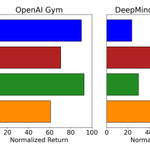
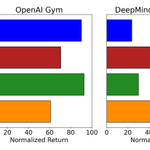
You might be surprised to learn that modern RL favors Dyna-style model-based algorithms for their sample efficiency, yet they can both require up to 40x more wall clock time to train and significantly underperform simple model-free methods across diverse benchmarks.

(9/n) Not only that, but at the time of this post MBPO has >1000 citations and a reproducibility study at Neurips. Despite this, only one paper has noted this performance gap, and it was only noted across hopper tasks in Gym and DMC.
(10/10) In summary, Open AI Gym and DMC are equally conventional testbeds that share a common physics backend (Mujoco). There is no 'good' reason for MBPO and ALM to largely fail in DMC, but they do. We encourage readers to check out our paper for more:
arxiv.org/pdf/2412.14312