

Journalist 🗞️ Historian 📚 Writer ✏️ European 🌍 Austrian 🎶 Styrian 🌳 Jedi ☄️ Eldar ✨ Schwoaza ⚽ Dad 👶
Wien, Österreich
Joined June 2010
- Tweets95.6K
- Following2K
- Followers4.4K
- Likes2K





Pinned Tweet
Hear ye, hear ye 🥁🙌
So happy and proud to announce that we won the Jean Monnet Prize for European Integration 2020 for our project “Home Is Where the Herz Is”
europeanconstitution.eu/2020…
Check it out ☺️❤️
metropole.at/herz
So proud of our team at @metropole_vie 🤩

Benjamin Wolf 🇺🇦 retweeted

THE PERKINI REPORT: THE 2028 REALITY CRISIS
What if the most obvious financial bubble in all of history turns out to be.... a bubble... and what if that is just really.... bearish?
there were signs, there are always signs 🤣
free link:
hub.tslombard.com/the-perkin…
inspired by @citrini

Benjamin Wolf 🇺🇦 retweeted

Die Stimmung in der deutschen Wirtschaft verbessert sich trotz des Iran-Kriegs weiter. Das wichtigste deutsche Konjunkturbarometer erreicht den höchsten Stand seit Frühjahr 2023.
handelsblatt.com/politik/deu…

Benjamin Wolf 🇺🇦 retweeted

AI productivity gains are showing up, but only in ~15% of jobs.
The three heaviest AI adopters (information, professional services, finance) went from a 2.2% productivity trend to 5.0% since 2022.
The rest of the economy: 0.9% to 1.4%.

Benjamin Wolf 🇺🇦 retweeted

In a rare bit of good news, France greenlit the exploitation the 4th largest lithium deposit in the world, production expected in 2030
Lithium mining is part of Macron's "Notre-Dame template" where several regulations are slashed for a series of key projects


While this seems broadly backed up by a number of different indicators, consumer confidence has *really* become a pretty terrible measure since 2019/20.
It's completely at odds with how consumers behave and just reacts to all sorts of other things in roundabout ways.


At annual growth of 1.5%, incomes double every 46 years.
At annual growth of 3.5%, incomes double every 20 years.

I would love it if some economists wrote a clear general-audience-accessible piece on how to think about 2pp (or growth) in units and abstractions, or even one just specifically aimed at AI researchers and computer scientists. I don't just mean something like "here is the long-run trend in GDP and the trend in child mortality and they correlate" or something one would see at a progress conference. That is good but not enough.
What I mean is something that will help to deeply calibrate a sophisticated (quantitative yet non-economist) reasoner on why 2pp matters.
In my experience as one of the extremely few computer scientists working on the economics of frontier AI, most computer scientists (who generally have no economic training) do not think 2pp over the next decade can coincide with much progress in society/improved welfare. Not to be unkind to my fellow computer scientists, but I honestly think the first-order reason is 2 is a small number, fairly close to 0.
So if one believes that AI will improve society dramatically, then that suggests they need to reject "2pp" and, often, to throw out trust in economists with it altogether (baby with the bathwater). But I think a lot could be fixed if economists can help reconcile "2pp" and with "materially better".
(And maybe this already exists and I am unaware.)
Benjamin Wolf 🇺🇦 retweeted

450 million currently have the right to settle in Amsterdam.
But don’t.
The full 69.5 million population of the UK plus the full 5.5 million population of Ireland currently have the right to work and settle in Brighton.
But don’t.
Reform are being very silly, again.

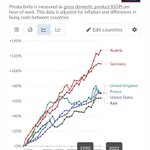
One of the strangest and under-discussed phenomena in macro is how different GDP per capita and GDP per hour worked have evolved since 1990 in the US and Europe.


How different GDP per capita and GDP per hour worked have evolved in the US and selected European countries since 1990.


