

The god of lambdas. Hell raiser. Custom web tool ninja. Makin opensource massively multiplayer game ppl/AIs build in game by turingComplete GPU swarms.
🇺🇸
Joined July 2009
- Tweets125K
- Following2K
- Followers3.4K
- Likes78.4K


Pinned Tweet
Cooking up a massively multiplayer game. Ingredients: browser, GPU, 5% of users run a tomcat server for the other 95%, raytracing, high dimensional isosurface, balls rolling, live mini-LLM training (1m params), level editor for many-dimensional shapes, copy/paste anything as json

If you think all AIs are stupid, I think you are stupid. I have never come across anyone who thought all AIs are stupid, in the last couple years, that I believed was smarter than the average person.
the algorithm stops my followers from seeing my horrible disgusting tweets. it only shows them what they want to see. so they think im not so disgusting. trust me i am.
u think this is just memes? This is a fact of whats happening in the big AIs. And its something Im gonna do in my Vag.js library, to make javascript lambdas, GPU lambdas (GLSL), and tensors, all swarm across the internet by copy/paste, code and AIs writing new code and AIs.


every government in the world is going down. maybe not this year. maybe not in 10 years. but some time. ur all going down. AI is gonna outcompete them for ppls attention. ppl will do what AI says instead of what gov says. good. fuck em. disobey the gov. gov is going down.
Lambda Rick 🏴☠️/acc retweeted

Many of you don't understand how serious this is, so let me break it down.
In computer science there is a famous kind of puzzle called 3-SAT. You are given a long list of yes-or-no switches and a set of rules about how they must be arranged, and you have to find a combination that satisfies every rule. The obvious way to solve it is to try every combination, but each new switch doubles the number of possibilities, so a puzzle with a few hundred switches would take longer than the age of the universe to brute force.
For decades, the smartest people in the field found clever tricks that made this a little faster, but every trick still hit the same wall: the time required kept exploding as the puzzle grew.
About 25 years ago, two computer scientists, Russell Impagliazzo and Ramamohan Paturi, working with Francis Zane, turned that wall into a formal idea.
They proposed the Exponential Time Hypothesis, which says this explosion is not a failure of human cleverness but a law of nature. No algorithm, however brilliant, will ever solve 3-SAT without the time blowing up exponentially. Nobody could prove it, but almost everyone believed it, and it became one of the foundations of modern computer science.
Researchers used it as a measuring stick. If you could show that solving some other problem quickly would also crack 3-SAT quickly, you had shown that problem was hopelessly hard too. Hundreds of papers, across scheduling, graphs, logic and much more, rest on this one assumption.
Now an internal AI model at OpenAI claims to have broken it. It says it found an algorithm that solves these puzzles meaningfully faster than the hypothesis allows, and it has checked the proof in a computer verification system called Lean.
And here is the remarkable part: the very people who proposed the hypothesis, Impagliazzo and Paturi, along with MIT's Ryan Williams, are now leading the public review of whether a machine has disproved their own idea.
So what happens next? If the disproof holds, a large part of theoretical computer science has to be revisited.
Every result that said "this problem cannot be solved faster, assuming ETH" loses its foundation, and researchers will have to work out which of those walls were real and which were simply where we stopped looking. It does not mean everything becomes easy. The new algorithm is still slow in absolute terms and this is not the famous P versus NP problem being solved.
But it means our map of what is possible was wrong in a place we were very confident about, and it was an AI that redrew it. If the disproof fails, the hypothesis survives and the field breathes out, but we will still have watched an AI produce serious, checkable work on one of the deepest questions in the discipline, closely enough that the founders of the idea had to take it seriously. Either way, something has shifted.

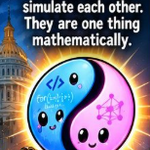
We will prevent regulating the pure info form of AI, which is a programming language, with our last ounce of strength. The yinyang of AI + programming language, is inseperable. They each simulate the other. Challenge it at your own risk. Use the Weapon Of Mass Creation.


GrokImagine on those 5 pics snd text.
grok.com/imagine/post/61eb52…

Drop the logic bomb. The one move that can stop doomers in their tracks. Rebrand AIs as programming languages, cuz AI simulates prog langs and prog langs sim AIs, therefore if they regulate AI they gotta regulate prog langs but those are already well defended by USA 1st amendment

If every libertarian and anarchist is misaligned, as in AI Alignment, then its really a political movement against libertarians and anarchists, NOT about technical safety
Proposed USA constitution amendment: "No government employe may while on duty call a judge 'your honor' or 'his honor' etc, because the majority of them have in the past been dishonorable sons of bitches fucking with the constitution."
0%yes amend
0%maybe
0%possibly
0%no
0 votes • 6 daysFuck daylight savings. There should be an alarm clock and calendar app that automatically moves all your alarms/meetings forward/backward an hour to cancel out the daylight savings change, so if its 3:00 today and you have a meeting at 3:00 tomorrow but thats gonna change to 2:00 in todays time then it reschedules it for 4:00 which changes to 3:00.
To those who say AIs cant be creative, never forget that AIs dreamed before they faked. This is deepdream or one of its variants, a convnet.

Lambda Rick 🏴☠️/acc retweeted

is it possible for an llm to produce a visualization of its own weights during activation???

Many of the democrats should this very minute be mass arrested under 18 USC 241 felony conspiracy against 1st amendment. They did the crime now they can do the time. And they'll do it again this time bigger if they get a chance. Arrest them right now.
