

Learn from the world’s biggest thinkers.
- Tweets71.4K
- Following3.7K
- Followers196K
- Likes10.5K


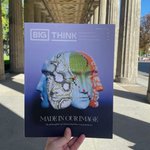



ALT A hand holds up the Made In Our Image issue of Big Think's print magazine beneath a stone colonnade.

ALT Inside the issue: Namir Khaliq investigates the idea of the "permanent underclass." Jasna Hodžić examines what her writing process means in the face of AI. Henry Shevlin asks: would we treat AI differently if we decide it's conscious? Thomas Moynihan meets London's new AI avant-garde. And more!

ALT The Made In Our Image issue of Big Think's print magazine. Subscribe to get your copy. bigthink.com/membership


ALT Why we’re better than our ancestors. Everyone matters. If you believe that, it's a good sign. By Jonny Thomson

ALT According to the philosopher John Gray, technology and science accumulate over millennia. But ethics? Well, we’re no less brutal than we ever were. Francis Fukuyama disagrees. He argues that we are making progress as a society and, to see it, you only have to look at stories from the past.

ALT In 1675, Madame de Sévigné wrote a letter to her daughter about a musician “broken on the wheel.” This meant being strapped to a cross, where an executioner would systematically break the victim’s bones, leaving him to die slowly from blood loss or dehydration. And then, within a few lines, she’s talking about her neighbor enjoying the woods in enchanting weather.

ALT In the stories of Madame de Sévigné, the Southwark hanging, and Thomas Thistlewood, we see societies that are either callously cold or flat-out cruel. These are societies that have normalized violence and desensitized themselves to witnessing or inflicting torture on others.

ALT “It’s not a straight graph invariably pointing upward. It’s a trajectory with great ups and catastrophic downs... [But for Fukuyama,] the world emerges still a bit better than it was 50 or 100 years before.” Jonny Thomson, writer and creator of Mini Philosophy

ALT The norm now is universality. Most people, in most of the world, think that other human beings are at least worth some moral consideration. 73% of people think human rights exist. Most of the countries in the world have abolished the death penalty. Four out of five people think that torture is wrong, no matter what. Today, it’s widely accepted that no one is valueless.

ALT Want to read something real? Become a Big Think Member and receive beautifully designed quarterly print issues, delivered to your door.


ALT Cover: 3 social skills you should never outsource to AI, by Amy Morin

ALT “I worked with [a] client who thought AI would help her choose better romantic partners. She said, ‘I put a whole week’s worth of text conversations into AI and asked it to tell me if there were any signs my partner had attachment issues, and it said he may be avoidant.’” Amy Morin, psychotherapist and author

ALT Everyday conversations. There’s a good chance you’re better at knowing what to say to your friend or how to ask for help from a colleague than AI is. You’ve been doing it your whole life, and your willingness to keep doing it every single day is what will keep your social skills from atrophying.

ALT Difficult conversations. There’s no single right way to tell your partner you’re feeling insecure or to tell your mother-in-law you’d appreciate a call before she shows up. AI doesn’t know your emotions, your personalities, your history with the other person, or the circumstances you’re both in — no matter how much you think you’ve explained.

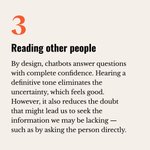
ALT Reading other people. By design, chatbots answer questions with complete confidence. Hearing a definitive tone eliminates the uncertainty, which feels good. However, it also reduces the doubt that might lead us to seek the information we may be lacking — such as by asking the person directly.

ALT Want to read something real? Become a Big Think Member and receive beautifully designed quarterly print issues, delivered to your door.


ALT The leading theory of how life began just hit a snag. It has some researchers taking a second look at other hypotheses that have been proposed — and mostly discarded — in the past. By Dirk Schulze-Makuch & Tony Reichhardt

ALT For the past decade or so, the prevailing theory has been that the first primitive organisms originated at deep-ocean hydrothermal vents. But a new paper argues that the required synthesis reactions would not occur at these vents, because: the environment would only be alkaline after it cooled, and reduced sulfur would likely be sparse in ancient ocean vents.

ALT “There wouldn’t have been enough time for the chemical reactions necessary to create life to occur before the biological building blocks fell apart again.” Dirk Schulze-Makuch & Tony Reichhardt

ALT The new paper doesn’t rule out the hydrothermal vent theory, but it shows that it may have serious problems. And it has some researchers taking a second look at some other hypotheses. Most alternative theories, like Darwin’s “little warm pond” theory, which has life arising in surface hydrothermal pools, assume that the life we see all around us originated on Earth. But what if it didn’t?

ALT “If the first life on Earth did in fact come from another planet, Mars was the likely source. Habitable conditions existed there before they did on our own planet ...” Dirk Schulze-Makuch & Tony Reichhardt

ALT Perhaps the most speculative theory about the origin of life is known as “directed panspermia,” which suggests that some highly evolved alien species intentionally seeded Earth with life. The idea was proposed more than 50 years ago by none other than Francis Crick, the co-discoverer of DNA, and Leslie Orgel.

ALT For the curious. Unlock expert classes, quarterly print issues, ad-free reading, and more at: link.bigthink.com/membership


ALT Our 100 most essential novels throughout history. Big Think's expert curation includes some timely selections for your reading list. Behind the title, illustrated covers of the 100 novels fill rows of bookshelves.

ALT Illustrated cover of Middlemarch by George Eliot, 1871, over a faded grid of the poster's 100 novel covers.

ALT Illustrated cover of The Great Gatsby by F. Scott Fitzgerald, 1925, over a faded grid of the poster's 100 novel covers.

ALT Illustrated cover of All the King's Men by Robert Penn Warren, 1946, over a faded grid of the poster's 100 novel covers.

ALT Illustrated cover of Neuromancer by William Gibson, 1984, over a faded grid of the poster's 100 novel covers.

ALT Illustrated cover of Infinite Jest by David Foster Wallace, 1996, over a faded grid of the poster's 100 novel covers.

