

We build enterprise AI agents and agentic workflows on the Vercel AI Cloud.
Warsaw, Poland
Joined September 2017
- Tweets668
- Following255
- Followers446
- Likes217





Pinned Tweet
The question we keep hearing from clients: "We know we need AI, but we don't know where to start."
This is where we start, and over the past few months, we've built a delivery system to make it possible.
Atlas, our delivery system, brings AI-engineering tools into your development process – with governance and speed at every step. We're now introducing it to our strategic accounts.
Along the way, we launched more new solutions behind our delivery:
→ MDCMS: CMS built for devs, marketing teams, and AI agents
→ Migration Agent: any site → Next.js, accelerated
→ Pre-Sales Agent: turn RFPs & briefs into estimates, clarification loops, and proposal drafts
→ AI Workflow: Linear ticket → tested PR
All are running in our production & open-source.
Let's assess your operations together and define which AI agents & workflows are worth building.
Explore our new solutions: blazity.com/

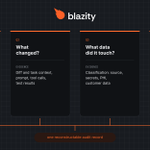
Before letting an AI coding agent have more access, ask yourself these 4 questions.
1. Who or what had access?
2. What changed?
3. What data did it touch?
4. Who approved it?
If you can't answer all four questions for a specific change, you aren't really in control. You're just hoping for the best.
These questions work for a local assistant, a hosted model, or an autonomous agent opening pull requests. They reveal gaps more quickly than any policy document.
You can find the full checklist, including control, evidence, and ownership for each area, in our guide: blazity.com/blog/ai-governan…

Before adding another memory layer to your AI agent, make a list of everything it already reads.
Most teams discover they have several overlapping instruction systems they forgot about.
These can include repository files, system prompts, skill definitions, generated summaries, tool descriptions, and conversation history.
Each one enters the agent's context. Few have a clear owner, and even fewer have a defined removal condition. Just keeping something because it might be "useful someday" is not a good enough reason.
A context inventory should track, for every item: its location, purpose, owner, sensitivity, update path, removal criteria, and whether it is authoritative, advisory, or untrusted.
After that, manage changes using these 5 steps:
1. Discover and classify
2. Normalize and de-duplicate
3. Assign ownership and version
4. Test against real tasks
5. Promote, monitor, roll back
Our new guide explains each step in detail → blazity.com/blog/agentic-con…

Before you choose any AI governance tool, start by answering three key questions.
1. What regulation does your AI fall under?
This helps you identify the right framework, such as the EU AI Act, NIST AI RMF, or ISO 42001.
2. Who needs the evidence – a compliance officer, an auditor, or the engineers deploying the model?
This helps you decide if you need a GRC platform or engineering controls.
3. Where does the risk appear? Is it in your AI inventory, in the model's behavior, or in how the system is built and shipped?
This shows if you need observability, enforcement, or both.
Since these tools cover different areas, you will probably need to use more than one.
We based our comparison on these questions to help you quickly find the right layer.
Our full guide also includes a comparison table of all the major tools on the market (Credo AI, OneTrust, Holistic AI, IBM watsonx, Langfuse, Arize, Atlas): blazity.com/blog/ai-governan…

97% of organizations that experienced an AI security incident did not have access controls on their AI.
These problems start with gaps that no one took responsibility for: context, budget, permissions, and logs.
This is the practice behind nearly every AI governance failure that disrupts production:
• 81% of employees use AI tools that have not been approved by anyone
• 45% of AI-generated code does not pass security tests
• 63% of organizations still do not have any AI governance policy
• over 40% of agentic AI projects will be canceled by 2027, mostly due to costs and unclear ROI
The order most teams pick is: adopt first, govern later. It's the expensive order.
Map what your agents can access. Set a budget limit before planning your roadmap. Gate every pull request before expanding your team. Keep a log of every action from the start.
We have explained the four most common AI governance failures we see in production, along with specific solutions for each: blazity.com/blog/ai-governan…

AI-assisted work should leave your codebase easier to resume, not just changed.
In this short demo, Jakub Jabłoński (CTO @ Blazity) shows Atlas – our AI governance solution for the engineering process – in action. The flow is simple: run one command inside an existing repo:
`npx --yes @blazity-atlas/core@latest init`
Atlas Core scaffolds an AI documentation structure, then uses repo discovery to help fill in your project-specific context. Everything it generates – agent instructions, repo-owned docs, and a home for future artifacts – stays inside your repository.
This is important because much of the work done with AI still gets lost in temporary chats. The task might be completed, but the decisions and project knowledge often do not carry over to the next session.
Atlas Core aims to make this process repeatable by creating a single, repo-owned structure that both people and AI agents can use as the project evolves.
Video: youtu.be/HrNhZynqtJw

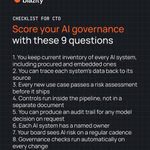
Score your AI governance with these 9 questions.
Go through the list and count how many you can honestly answer yes to today:
1. You keep current inventory of every AI system, including procured and embedded ones
2. You can trace each system's data back to its source
3. Every new use case passes a risk assessment before it ships
4. Controls run inside the pipeline, not in a separate document
5. You can produce an audit trail for any model decision on request
6. Each AI system has a named owner
7. Your board sees AI risk on a regular cadence
8. Governance checks run automatically on every change
9. Adding governance made delivery faster
Few yeses? You're where most teams are: early. That's the normal starting point, not a failure.
We’ve put together a full breakdown: the 4 maturity stages, the 4 engineering principles that help you up, and tracing, eval, and guardrail code you can use this quarter.
Check out the full maturity model, checklist, and code here → blazity.com/blog/ai-governan…

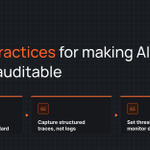
A lot of teams set up their AI agents in the wrong order. They start by buying a dashboard and only then try to decide what information to track.
The right approach is to do things in the opposite order. There are three steps, and if you skip any of them, the rest won’t give you good data.
1. Start by using a standard for instrumentation that works with any vendor.
2. Make sure you collect structured traces instead of just logs.
3. Set clear metric thresholds and use both types of evaluation.
To check if you’ve done this right, ask yourself if you can name every span your agent creates in a single run. If you can’t, focus on instrumentation before worrying about dashboards.
We’ve shared a full walkthrough on our blog. It covers each step in detail, explains what a complete agent trace should include, highlights the key metrics, and shows how offline and online evaluation work together.
→ blazity.com/blog/ai-agent-ob…

30 people. 10 teams. And a genuinely wild number of tokens burned! 🔥
Yesterday, we hosted an AI Hackathon at @p_lodz_pl in partnership with Centrum Innowacji i Przedsiębiorczości Politechniki Łódzkiej.
In just a few hours, each team had one goal: to build something that really works.
Teams worked on Atlas – our AI Toolkit for governed AI engineering – and… they delivered. Students built 10 working features from scratch.
There were also plenty of great questions and real discussions. The room was full of people eager to build, not just talk about AI.
Thanks to everyone who came and brought so much energy. There is real potential here!
More about Atlas: blazity.com/atlas


Building an #AI agent is easy. The challenge comes later, when you need to keep improving it in production without everything getting messy.
Requirements that belong in code leak into prompts. Shared types get copied between files. And when something breaks, debugging is rough because nothing separates what the model decided from what your code did.
@vercel recently open-sourced Eve, a filesystem-first framework for durable AI agents.
We created Atlas Eve Starter to help you kick off your agent project. It’s a small, replaceable Eve app that already includes the engineering defaults you’d probably add later on.
What's in the box:
• a pnpm + Turborepo monorepo
• shared Zod contracts in one place, not copy-pasted between files
• Biome, Vitest, Husky, and Renovate, already wired up
• an opt-in eval
• Atlas AI context (memory, skills, project rules) so coding agents understand the repo immediately
With this setup, you get a clear line between what the model controls and what your code does, right from the start. This makes your agent project easier to review and much less frustrating to debug if issues come up.
Check it out on GitHub → github.com/Blazity/atlas-eve…

Last month, we built 3 AI agents to help with our own workflows and made them open-source.
If your team runs into the same challenges we faced, fork them and make them yours.
Every week, we noticed the same patterns: someone rewriting company context for a marketing brief, someone else manually migrating a codebase to Next.js, or someone reading through a long RFP just to send out an estimate by Friday.
To save time, we built agents to handle these repetitive tasks. They worked well for us, so we shared them on GitHub.
1) Marketing Agent turns your knowledge base to create briefs, drafts, and audits. You won’t have to paste the same context into every prompt anymore.
→ blazity.com/solutions/market…
2) Migration Agent moves your frontend to Next.js with AI engineering workflows instead of manual rewrites.
→ blazity.com/solutions/nextjs…
3) Pre-sales Agent reads RFPs and briefs, then drafts estimates and proposals for you.
→ blazity.com/solutions/pre-sa…
What repetitive workflow would you want to hand off to an agent first?

Last week, we ran our first internal AI hackathon and built a few agents.
Each team chose a task they were tired of doing and built an agent to handle it.
One team created an agent to coordinate our open-source work across Slack, GitHub, and Jira, keeping track of each project's status. Another team built a CV screener that reviews portfolios and GitHub profiles before sending the decision to a person. A third team made a tool that turns meeting transcripts and Slack threads into action points in Notion, with an approval step.
Two things came out of the day.
We ended up with three MVPs that are ready for daily use. We also got real feedback on Atlas, our AI Toolkit for governed AI engineering, and have already used it to make improvements.
This was the type of day engineers value: solving real problems through focused work, resulting in three practical tools and an improved product. Can't wait to run this event again!


You can now install Atlas with a single command. The whole standard, dropped into your project in one step.
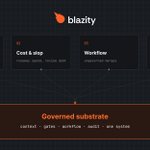
Atlas is the standard that puts governed AI engineering – Platform, Agents, Workflow – inside your development lifecycle.
Atlas Core is the layer you install: repo memory, rules, skills, templates, and review artifacts. These features use the same gates and runbook discipline, no matter which pillar you start with.
Learn more at: blazity.com/atlas

We're looking for contributors to @mdcms_ai!
MDCMS is our open-source, AI-native CMS. MIT licensed, built on PostgreSQL and Markdown, so the content stays yours.
The project is still in its early stages, and the roadmap is open. Contributors now help shape the core, not with small fixes.
If you’ve ever wanted to help build a CMS from the ground up, now is your chance!
Check out the repo: github.com/mdcms-ai/mdcms

A marketing brief used to take an afternoon of digging through Slack, Jira, and old docs. Our Marketing Agent does it in minutes.
This AI agent connects to your organizational knowledge – Slack, Teams, Jira, docs, email – and runs marketing workflows on top of it.
Organize knowledge, find relevant business information, and manage marketing workflows across your systems and communication tools.
How it works:
1) Sync company knowledge sources to the contextual retrieval system.
2) Configure retrieval logic, marketing workflows, and approval steps for your team.
3) Start orchestrating contextual workflows and automate repetitive organizational processes
We built it for our marketing team and decided to ship it open. Clone it and skip building your own context layer from scratch.
→ blazity.com/solutions/market…

Migrating a 200-page site to Next.js used to be a 3-month project. Our Migration Agent does the first 70% in a week.
This AI agent maps your existing frontend architecture and runs a gradual migration to Next.js.
Reusable migration logic, contextual analysis, and automated engineering workflows.
How it works:
1) Connect your existing frontend to the migration workflow.
2) Define target architecture, migration standards, reusable implementation patterns, and requirements.
3) Start transforming frontend systems - orchestrate migration workflows & generate transformed components.
It's open-source. Clone it and skip the first weeks of the work.
→ blazity.com/solutions/nextjs…

Agencies spend 8-12 hours on every RFP response. We built the Pre-Sales AI Agent to take that down to minutes.
It is responsible for automating RFPs, generating estimates, and producing operational pre-sales outputs using the company's historical delivery data.
How it works:
1) Connect AI agent to organizational knowledge.
2) Set up estimation rules, proposal formats, and clarification steps that fit your workflows.
3) Start generating operational outputs based on your company’s past knowledge.
We use it for our daily sales tasks and want to give it to you. It's open source – if you want to automate your sales processes, fork it.
→ blazity.com/solutions/pre-sa…

Your team burns hours on repeatable work. Find out which AI agents can fix it.
Most leaders know AI can help, they just don't know what to build.
We can map your workflows in a 30-min call and tell you exactly which agents would 10x your productivity.
Book free audit → blazity.com/services/agents

Many AI engineering projects fail during the scoping phase. Here’s why:
→ Leaders know AI can help, they just don't know what to build. Pick one workflow, not a category.
→ The boundaries of what the AI agent should do often change. If you can’t sketch it on a whiteboard, it’s probably not ready to build.
→ A clear success metric is often missing. "Reduce time spent on X by Y%" beats "make X faster".
After three weeks, the team still isn’t sure what they’re building. By six weeks, half the work is off track, and no one can explain the reasons.
That's why decisions must be made by humans, while agents only accelerate the thinking.
Since we rebuilt our AI-native delivery system, we now begin every project with a Blueprint document. This includes a system diagram, gate specifications, an evaluation plan, and a risk register.
By the end of this process, you’ll know exactly what can be built and how much it will cost.
Got an AI workflow in mind, but unsure if it's buildable? We will figure it out for you in one call: blazity.com/atlas

"AI writes the code" works until you ask who owns the system it built.
Two failure modes dominate AI engineering. Neither ships systems your team can own in a year.
1) Ship faster with AI – code lands unreviewable. Comprehension drops. Debt compounds. After six months, nobody trusts the codebase.
2) Governance theater – every PR sits in a queue. Reviewers drown. The velocity AI promised dies at the gate.
So we built Atlas, an open-source AI engineering toolkit for delivering production software as a governed system.
Here’s what our modeling shows:
50% more features shipped each day
3x faster validation cycle
30% less time on manual maintenance
Atlas is built on three pillars: Platform, Agents, and Workflow, all following one methodology. You can run it on Vercel AI Cloud, Anthropic Managed Agents, or your own cloud.
Check out the system → blazity.com/atlas

Meet @mdcms_ai, our open-source #CMS for content operation, built because we got tired of watching teams pick between two bad options.
1) You either pick a SaaS CMS and end up locked in, paying more every year, with content trapped behind a proprietary API.
2) You go file-based with Markdown/MDX, which works beautifully for developers and AI agents, but pushes marketers into terminals and pull requests.
Neither is good enough anymore, especially now that AI agents are part of how content gets made.
So we built MDCMS, where your content stays as Markdown files you fully own, with a database on top that handles the CMS parts: roles, version history, environments, localization, preview, and rollback.
1 content layer, 3 ways to work with it:
1) Marketers edit in a visual Studio
2) Developers work locally with a CLI
3) AI agents process content through the same API, with the same rules
What you can do with it:
→ Run the whole content lifecycle in one place – prompt, optimize, publish
→ Import your existing projects in minutes
→ Pull content locally, push atomically, let AI agents do the bulk work
→ And many more...
Take a look: mdcms.io