

Group leader at KIT working on multiphase flows, turbulence and heat transfer
Baden-Baden, Germany
Joined November 2015
- Tweets24
- Following299
- Followers71
- Likes538




Alexander Stroh retweeted

Closing ceremony of #ICMF2023
Arigato #Kobe 💙
Rendez-vous à #Toulouse 😊
@MatarLab @PREMIERE_UKRI #ICMF2025 #ICMFToulouse – at Kobe City Chuo Ward, Hyogo


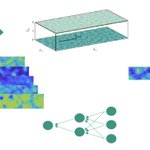
Our website with the ML-model for prediction of ks for rough surfaces went online: roughness.org - you can try it out uploading your rough surfaces.
#EFMC14 #ISTM #KIT


Please join our #EFMC14 talk "Predicting roughness-induced drag based on
active learning" by
Jiasheng Yang during the mini-symposium on shear flows
over complex surfaces on coming Wednesday, 14th at 18.45. We will present our newly released online ML-tool for prediction of ks! – at Spata-Loutsa, Greece


So with our tool you can simply upload your 2D height distribution of the rough surface and get an estimation of ks from our ML-model. #EFMC14 #roughness #MachineLearning #KIT #istm – at Spata-Loutsa, Greece


Our new paper on generation and simulation of roughness in minimal channels went online today!
cambridge.org/core/journals/…
We demonstrate a set of tools for a cheap DNS of a turbulent flow over roughness. Next step: creation of a large dataset and doing some machine learning! 😉 – at Baden-Baden, Germany
It's great to see that we can print riblets for our wind-tunnel facility on an in-house SLA 3D printer with this precision! #formlabs #istm #kit #riblets #dragreduction
formlabs.com/de/blog/model-u… – at Baden-Baden, Germany

Our new article on secondary motions of Prandtl's second kind went online:
link.springer.com/article/10…
Interestingly the motions are present not only in generic turbulent flow configurations, but also in non-equlibrium technical flows e.g. in combustion engines.
#kit #tudarmstadt

Check our new publication on applying transfer learning for prediction of roughness effects on turbulent flow:
cambridge.org/core/journals/…
#jfm #roughness #turbulence #MachineLearning

Take a look at our new publication where parametric forcing is used for roughness stripes modelling. This method allows the use of usual DNS resolution (instead of high-res IBM) and still properly reproduces
secondary motions formation and topology change. doi.org/10.1017/jfm.2021.850

2
Alexander Stroh retweeted

Machine Learning has great potential for use in Chemical Engineering - here is our first preprint from work at @KITKarlsruhe with @MattSchniewind @blitz737 and @P_Friederich #AI #ML #KI arxiv.org/abs/2101.08130

Alexander Stroh retweeted
Reminder of two excellent researcher positions available in our Chemical Engineering/Machine Learning DFG project with Pascal Friederich (@P_Friederich) and Alexander Stroh (@blitz737)
aimat.iti.kit.edu/75_158.php
pse.kit.edu/karriere/joboffe…

Alexander Stroh retweeted
Machine Learning for Chemical Engineering - watch this video for a summary of our recent work at @KITKarlsruhe with @blitz737 @P_Friederich & @MattSchniewind youtu.be/5054M6JRIyc


Our paper on secondary motions generated over rough stripes in a turbulent channel flow went online! #JFM #JFMrapid #ISTM #KIT #fluidmechanics #turbulence #secondaryflows
cambridge.org/core/journals/…

3