

AI will never be the same again
my GitHub →
Joined December 2025
- Tweets1.5K
- Following272
- Followers2.7K
- Likes3.1K




GTA 6 is hiding over a million dollars on the ocean floor, and most players will swim right past it
there are 7 shipwreck treasure sets under Vice City's water, and guides value each finished set at $50K to $200K+
you unlock it after the Island Dreams mission in Chapter 1, when Kenton Rees hands you scuba gear and a metal detector
the hard part is remembering where you've already searched. that's where Claude Code comes in
it watches your dives, logs every detector ping, depth and route, then emails you what's left and the fastest path to it. that's the email in the photo
5 sets get you 100%. all 7 get you paid
prompt is below ↓

the prompt:
"You have screen access. I'm treasure diving in GTA 6. Log every metal detector ping, my depth, oxygen and route on each dive, and mark which shipwreck sets and underwater discoveries I've already collected. When I stop, plan the shortest route to what's left and email me a summary."
full treasure diving guide (Kenton, all 7 sets, payouts): gmtreks.com/gta6/page/01M7QV…

GTA 6 missions have a hidden fast lane, and Claude Code knows how to find it
Story missions now have multiple ways out, and police chases let you ignore the suggested route entirely.
Record a few attempts and Claude compares every run: where you lost time, which exit had fewer cops, which car got you out cleanest.
Missions follow the same rules as free roam, so a shortcut that works once keeps working
and Claude turns failed runs into a repeatable fastest route.


Source:
Rockstar told IGN that GTA 6 missions were built to "open things up where possible," with alternate escape routes and chases where you can skip the suggested path:
dexerto.com/gta/gta-6-is-giv…

I gave Claude eyes on my GTA 6 screen, and now it plays like my backseat squadmate
You still hold the controller. Claude just watches the capture feed and talks you through the fight.
It calls out flankers before you see them, tells you when to swap to the shotgun for tight rooms, and says when it's quiet enough to reload.
A radar in the corner tracks how many enemies are still around. When the area's clear, you get the tally: enemies down, damage taken.
It also keeps a running count of your cheat unlocks, so you know exactly how many workouts and range medals are left before Body Armor and No Reload open up.
It feels like playing with someone who never gets bored of watching.


Wall Street just gave GTA 6 one weekend to make $1.5 billion, or it counts as a miss
Take-Two's own filing shows why the pressure is that insane.
The company shrank 18% right before launch, and now it needs $3.35 to $3.5 billion from October to December, almost double last year.
Its profit forecast for those three months is bigger than for the entire year.
For scale, GTA 5 made $1 billion in three days, so GTA 6 has to do 50% more starting tomorrow.
Every number from the filing is in the chart below ↓


GTA 6 comes out tomorrow, and millions of creators are about to post videos Rockstar can take down
The rule that catches most of them sits on a support page last updated in January 2025.
Rockstar's written permission only covers non-commercial use, which it defines as not making money from the footage you post.
Monetized videos are tolerated in practice, but nothing in writing grants them.
The policy lists what gets removed: leaked footage, endings and cutscene compilations, in-game TV shows posted on their own, cheating and glitch guides, unauthorized mods, and anything breaking the Terms of Service.
Spoilers are the real trap, because the policy sets no end date. A clip of the ending can still be taken down months after launch.
And asking a chatbot won't save you. In one test, AI assistants couldn't load Rockstar's page and answered from forum threads written for GTA 5.
So I built a prompt that checks your video against the actual policy before you hit upload ↓

Claude Code now has a second model whose only job is to decide when Claude is allowed to stop
It's called /goal, and it's in the newest docs.
You write a finish line. After every turn, a separate model checks it. Not met yet? Claude starts the next turn by itself. No more "done" on code that doesn't build.
The part almost nobody reads: the judge can't run commands or open files. It only reads the chat. If Claude doesn't print the real test output, the judge can't confirm anything, and your goal keeps going.
Add /advisor on top. A cheaper model does the routine turns, Opus steps in only at the hard decisions. Anthropic says that usually costs less than running the stronger model the whole way.
Below is the prompt I use. Start in auto mode, type /goal, paste it, fill the brackets, walk away.
It stops when the work is proven, judged impossible, or hits your turn limit.


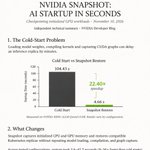
NVIDIA just found a way to bring massive AI models online up to 36× faster without buying faster GPUs
Its new open-source Snapshot system saves an initialized model's CPU and GPU memory, then restores that state when another inference replica is needed.
Instead of loading weights, compiling kernels, and rebuilding CUDA graphs every time, the system skips most of that startup work.
In NVIDIA's tests, cold starts that took minutes dropped to just 3.6–42.7 seconds.
It works with vLLM, SGLang, and TensorRT-LLM on compatible Kubernetes infrastructure.
For anyone running AI agents at scale, this could mean faster recovery, quicker scaling, and less time paying for GPUs that aren't serving requests.

NVIDIA revealed a 3× performance trap back in 1999, and most developers would still fall for it today
I found an old GeForce 256 optimization document explaining how the GPU could process 15 million vertices per second.
But there was a catch.
Without reusing vertices, developers could only reach 5 million independent triangles per second.
The fix was surprisingly simple: indexed geometry, which lets multiple triangles share the same vertices instead of processing duplicates.
The document also warned against unnecessary state changes and CPU–GPU synchronization.
Nearly three decades later, the lesson still applies to modern GPU workloads: before buying more compute, make sure you're not wasting the compute you already have.
Official NVIDIA source: developer.download.nvidia.co…

Source:
developer.nvidia.com/blog/st…

Anthropic was already working on the blueprint for Claude in 2021, and its earliest research revealed something most AI builders still underestimate
The paper explored how to turn a powerful language model into an assistant that's helpful, honest, and harmless.
One finding stood out: training models to rank better and worse responses worked far better than simply teaching them to imitate examples.
Even modest alignment techniques became more effective as models grew, without sacrificing their underlying capabilities.
The lesson still matters for AI agents today: generating good examples isn't enough. You also need a way to evaluate which outputs are actually better.
Claude's foundations were being studied long before Claude had a name.


Claude just made its newest model up to 2.5× faster, but there's a catch most developers will miss
Fable 5.2 now supports Fast Mode through a single API setting: speed: "fast"
You can enable it per request without switching models or changing your integration.
But the economics are interesting.
Standard pricing is $8 input / $40 output per million tokens. Fast Mode doubles that to $16 / $80, while delivering up to 2.5× faster output.
For interactive coding agents, that speed could justify the premium.
Background automation and overnight jobs are a different story.
Claude Code has a f*cking useful feature that can save your longest coding sessions
When Claude compacts a conversation, important working context can disappear.
Your agent may remember the goal but lose the constraints that made the implementation correct.
Claude Code's PostCompact hook gives you a way to restore critical instructions automatically after compaction.
Pair it with a short project state file containing active tasks, non-negotiable rules, verification commands and unresolved failures.
The result is a more reliable workflow for multi-hour builds without stuffing every instruction into every prompt.
I turned the pattern into one copy-ready setup.
You f*cking need to know this before using Claude Fable 5.2 for serious work
The newest Claude model has five reasoning levels, but setting everything to MAX is not the smartest move.
Claude's own documentation recommends starting at HIGH, testing XHIGH on demanding tasks, and reserving MAX for cases where cost and latency barely matter.
Here's the useful part: build a small evaluation set from your real tasks, run the same tests at different effort levels, and compare accuracy, tokens and time.
I turned that into a copy-ready workflow for Claude developers.
The goal isn't to make Claude think as long as possible. It's to find the cheapest reasoning level that consistently gets the job done.

Don't overlook this resource:
support.claude.com/en/articl…

You f*cking need to know this before using Claude Fable 5.2 for serious work
The newest Claude model has five reasoning levels, but setting everything to MAX is not the smartest move.
Claude's own documentation recommends starting at HIGH, testing XHIGH on demanding tasks, and reserving MAX for cases where cost and latency barely matter.
Here's the useful part: build a small evaluation set from your real tasks, run the same tests at different effort levels, and compare accuracy, tokens and time.
I turned that into a copy-ready workflow for Claude developers.
The goal isn't to make Claude think as long as possible. It's to find the cheapest reasoning level that consistently gets the job done.
The guy who built Claude Code shared a f*cking important lesson most AI developers still ignore
Boris Cherny doesn't just ask Claude to write code. He gives it a way to prove the code works.
His workflow combines planning, shared CLAUDE.md instructions, parallel sessions and verification.
The key insight: every recurring mistake should become a project rule, and every completed task should be checked against real tests.
I turned his recommendations into a practical Claude Code workflow you can adapt to your own repository.
Stop judging agents by how confidently they finish. Judge them by what they can verify.

