

Cambridge (USA)
Joined March 2012
- Tweets1.3K
- Following1.1K
- Followers2.3K
- Likes6.6K





Pinned Tweet
Picornaviruses infect 10’s of millions of children every year. We know the sequences but not the structures. Mapping them is key in understanding how they function.
So, we mapped all the sequences of Picornaviruses we could find. ~75’000 Structures.
Enjoy, it's all Open Source
Pierre Bongrand retweeted

I have a major result to share.
I’ve found conclusive forensic evidence that the top 4 Chinese AI labs—DeepSeek, Moonshot, MiniMax and Ant Group—have built their newest models on NVIDIA’s most advanced Blackwell chips, which are barred from export to China.
This sounds insane, but I discovered that almost every AI model carries a hidden signature of the GPU that trained it. When a model is first set up, the starting values of its weights are laid out in a pattern that depends on the exact GPU. Each combination of GPU and seed number produces a unique pattern—a sort of fingerprint of the hardware used to create the model. Traces of that pattern survive training into the published model.
Again, this evidence isn’t based on any insider information or leaking. It’s based on a forensic analysis of the model weights released by the companies themselves.
I searched more than six trillion combinations of chip layout and seed number and matched them to open-weights models. In doing so, I found conclusive evidence that six Chinese AI models—including DeepSeek-V4-Pro, Kimi K3, and MiniMax-M3—were initialized on NVIDIA Blackwell systems. Four of the models match Grace Blackwell, the GB200 and GB300 parts in NVIDIA’s flagship liquid-cooled rack-scale systems.
I then verified these results on real hardware. Running unmodified PyTorch with the seeds I’d recovered, a Blackwell B300 reproduced DeepSeek-V4-Flash’s untouched starting weights bit for bit, and a rented GB200 reproduced Kimi K3’s to a correlation of 0.999995. A Hopper H100 reproduced none of DeepSeek-V4-Flash’s, and changing the seed by one broke the match. (DeepSeek’s seed is 953049583 by the way.) The method also was verified to match 24 known open-weights models to the hardware that developers said they used.
It is exceedingly unlikely that these results are a coincidence. Across six trillion combinations, the best accidental match should reach only about 8 sigma (i.e., eight standard deviations above what random chance would produce). The real matches range from 49 to 1,385 sigma, and even the weakest single test hits 20.
These were data-center-scale training runs. With some analysis of release schedules and model details, I estimate that the largest, Kimi K3 and DeepSeek-V4-Pro, used 2,000 to 3,000 Blackwell GPUs each. Clusters of this size cost on the order of $150 to $200 million each to buy, and across these labs alone would add up to more than half a billion dollars of export-controlled GPUs, not counting experimental compute or otherwise. It’s quite likely that we see multi-billion dollar expenditure on export-controlled GPUs.
I am highly confident in this result, and it has been independently verified by senior researchers at OpenAI and Anthropic. You can read the full report at unemploymentlabs.com/checkpo….
There is much more I’ve identified about these models through other forms of checkpoint forensics like this, and will have more to share soon.

Pierre Bongrand retweeted

Today, we are excited to introduce Ladon, a state-of-the-art biological foundation model that predicts disease trajectory and treatment response in patients. There is immense complexity in the individual biology of every patient. Two patients can have the same diagnosis and receive the same treatment, yet have very different outcomes: one responds well and lives for years, while the other’s disease continues to progress. Understanding and resolving this heterogeneity to predict outcomes is how we accelerate our delivery of medicines for patients and unlock clinical trial abundance.
Ladon is our first step towards this future: one where we can learn more from every patient enrolled so that we can run smaller, faster trials with higher success rates. We built it to give drug developers quantitative support on billion-dollar clinical trial decisions. Today we're excited to share Ladon's capabilities in our blog and technical report.
Ladon is a 3B parameter model trained on millions of RNA-seq samples spanning decades of technical and biological variation across tissues and species. Ladon beats gene expression baselines, established biomarkers, and existing RNA foundation models at predicting patient prognosis and therapeutic response in 140+ oncology tasks, including external validation on past clinical trials. This is significant because clinical trials are fundamentally generalization problems. We show that Ladon-derived predictions are robust across indications, treatments, and sequencing platforms.
Reach out if you’d like to get started with the model today!
Read more about Ladon in the blog: blank.bio/introducing-ladon
Find more technical details in the white paper: blank.bio/introducing-ladon

Pierre Bongrand retweeted

Tatta Bio is hiring a biochemist to help build our AI-guided enzyme discovery platform! Please share with anyone in your network who might be interested.

We're hiring a Lead Scientist, focused on biocatalysis, at Tatta Bio in Cambridge, MA!
We're looking for a hands-on scientist to lead the development of our high-throughput enzyme characterization platform, working closely with our ML team. If you have deep expertise in biochemistry and analytical chemistry, enjoy building experimental workflows, and want to help shape a growing research program, we'd love to hear from you.
Check out the job description below to learn more and apply!
tatta-bio.notion.site/Lead-S…
Pierre Bongrand retweeted

Language models can learn new tasks from just a few examples in their prompt, with no retraining. This is called in-context learning (ICL). Now genome language models can do it too.
With a handful of examples, Evo 2 ICL generates proteins, de novo antibodies, CRISPR-Cas9 loci, mitochondrial genomes and entire bacteriophages.
We can even use the synthetic sequences iteratively to construct a chain-of-thought (CoT) and achieve harder design goals.
New work with Yukun A. Hao, @BrianHie and team 🧵
Pierre Bongrand retweeted

I am often being asked “Should we slow down AI development in biology? “ or “What is your take on biology being solved by AI?”
My answer has always been: we need to move faster. Patients are waiting, and many are running out of time.
Consider the starting point:
• About 95% of rare diseases have no approved treatment.
• Developing a new treatment typically takes 10–15 years.
• Cancer and Cardiovascular diseases remain top killers globally .
Every year we can remove from drug discovery matters to someone who may not have another year.
This is why I work on AI for biology. Virtual cells, AI-designed molecules and agents that help scientists plan experiments offer a chance to test more ideas, identify failures earlier and learn faster.
We still have to prove that these tools produce better medicines. Accelerating discovery must go hand in hand with rigorous clinical evidence and safeguards against misuse.
But the cost of moving too slowly belongs in this conversation too.
For a patient who has exhausted every available treatment, the status quo is already dangerous.
Let’s build with the urgency that deserves.

Pierre Bongrand retweeted

We’re releasing a broad range of new mathematical results produced by an internal frontier model.
We’ve been consulting with the independent Advisory Group on Mathematics and Artificial Intelligence at the Institute for Advanced Study, and we have drawn on their advice and public recommendations to inform how we release these results.
github.com/openai/math

Sure, Mistral isn't pushing the frontier on dollar per intelligence. They have fewer resources and can't subsidize compute like other labs
This isn't a B2C product. It's a sovereign AI solution
Europe needs an alternative to the US & China that's not too far from the frontier

Mistral is back:
-pushing the frontier on dollar per intelligence (1.13$ per task for a 38. mimo v2.6 pro gets 46 for 0.13$)
-best open model out of us or europe (competition: nemotron 3 ultra 23, gemma 4 17, gpt-oss 12)
-same score as gpt 6 luna. luna costs 0.07$ per task. 16x
-#64 of 225 on artificial analysis. frontier
-1 trillion parameters to land 3 points under GLM 5.3 flash (320B, 0.25$)
-open weights (AA lists it as proprietary. weights oct 27)
-most open license yet (large 3 apache 2.0, medium 3.5 modified mit, this one "custom mistral license")
-only 8 points behind the best chinese open model and 20 behind opus 5.5
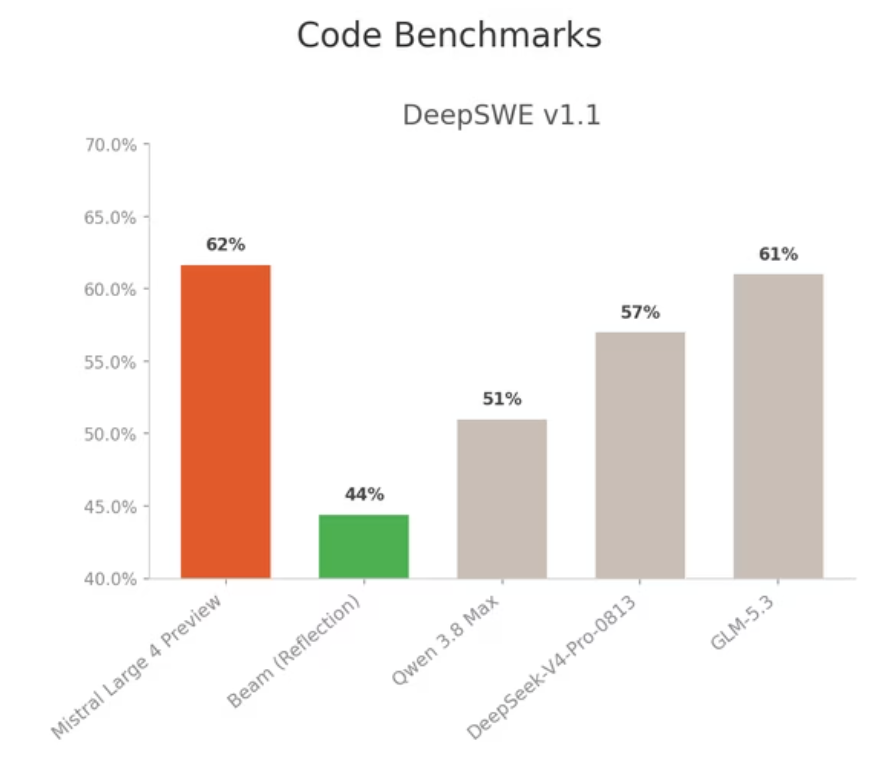
-beat glm 5.3 on deepswe, 62 to 61 (on mistrals chart. the live leaderboard has glm 5.3 at ~69)
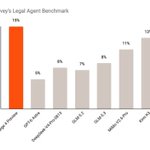
-state of the art in legal (15%)
-highest cyber score of any model, 82% (opus 5.5 and astra refuse the task and score near zero)
-same blog post brags it refuses more cyber prompts than any other open model
-200M output tokens to run the index, median is 81M. le chonk talks
-+29 points over large 3 (large 3 had 9)
-sovereign ai (they resell glm 5.3 since august. until today the smartest model on mistrals own platform was chinese)
-3 billion euro raised, 21 billion valuation, first model out of it: 38
-"no signs of saturation" (the rl run isnt finished, they shipped anyway)
-the meme promised 30 trillion parameters. we got 1 (49B active)
-europe can compete, said mensch. in abu dhabi
-2nd of 5 in their own blind eval. behind opus 5. not 5.5

1
5
391
New Sovereign Model! Mistral reports it to be the new frontier on Legal, Finance, and equal in Cyber and code.


Meet Mistral Large 4, aka Le Chonk.
• 1T parameters, natively multimodal. 49B active.
It is the best open weights model from US or Europe on aggregated benchmarks.
• State-of-the-art on critical workloads, including cyber defense, manufacturing and finance and it surpasses closed frontier models on visual grounding.
• Forged in Europe end-to-end and is deployable from Europe via our own Mistral Cloud infrastructure.
• Available to all via API today. Working with cybersecurity partners privately.
Open weights release end of October.
All results seem to come from reasonable benchmarks. To the exception of DeepSWE v1.1 that we know is flawed, thanks to @EpochAIResearch. So would need more benchmarking. But very very exciting! Thank you @MistralAI


1
4
123
These early results are reported to be from Mistral, and are in this article: thenextweb.com/news/mistral-…

everyone is talking about sovereign LLMs, is @MistralAI about to release theirs?
For the non-French, the video is about Marie-José Pérec (a French runner), who comes from behind to catch everyone on the track and wins the European Championships 4×400m relay 👀

NOTE: THIS IS NOT MARIE-JOSÉ PÉREC.
THIS IS THE INCREDIBLE FLORIA GUEÏ @FloriaGuei
(my apologies..) and thanks to my fact checkers!
21
888
Please find the v2 of the paper:
biorxiv.org/content/10.64898…
The code:
github.com/rouskinlab/Albatr…
The 75'000 structures:
albatrossrna.org/
Thank you to @silvirouskin, Adam Sychla and all our co-authors for this awesome feat.

Thanks to @ChrisHayduk for Rosalind workbench btw, pretty awesome tool. Video thanks to Codex too :))
1
4
559
Pierre Bongrand retweeted

Re today's incident, maybe not a bad idea to check your settings (Settings → Data Controls)


