

Sport scientist + physiologist + cycling coach= cyclist engine builder; @cyclingclubpod; powered by doom metal
Wisconsin, USA
Joined April 2011
- Tweets2K
- Following623
- Followers865
- Likes1.3K




Pinned Tweet
I've been slowly compiling this list of sport science/ex phys accounts since the early 2010s. It's heavy on the endurance sport and environmental physiology side, but hopefully some people will find it useful. Recommendations for additions welcome! xitter.gq/i/lists/128965489
Hello endurance coaches, performance staff, sport scientists, and exercise researchers. Our 13th cycling and endurance performance journal club will occur Thursday 29-Oct-2026 at 2pm (GMT-05:00) Central Time (US and Canada).
FYI, we didn't plan it so our 13th session would be on the week of Halloween, but it does seem serendipitously appropriate.
The paper we will be reviewing is: RØNNESTAD, B. R. et al. "Heat Training Efficiently Increases and Maintains Hemoglobin Mass and Temperate Endurance Performance in Elite Cyclists." Med. Sci. Sports Exerc. 54, 1515–1526 (2022).
ovid.com/jnls/acsm-msse/abst…
Interested in attending? DM me here or on LinkedIn for the Zoom link.-
Club Purpose
The purpose of this club is to help build a bridge between science and practice. Along with this, we seek to build a community of individuals who see science as a key component of moving cycling and endurance sports forward.
Intended Outcomes
-Practitioners will become better at consuming and critically applying scientific findings to their practice
-Researchers and academics will have a platform to share and engage in relevant research
-Researchers and practitioners will have a space to exchange and develop knowledge and ideas
Session Format
A relevant paper is assigned for reading, the paper is presented on the date, and a guided conversation follows about how the study can be interpreted and applied to practice. This session is scheduled for an hour, and it is our intention to have the bulk of conversation completed by then. However, it is important to note relevant discussions often go past the hour mark and we are happy to host those longer discussions as long as they are deemed productive.
Conduct & Etiquette
Please come prepared having read the article with questions, comments, and/or insights at the ready. Study limitations and practical applications are regularly discussed, so definitely make sure to note your thoughts on those topics while reading the paper.
Arrive on time. Turning off camera view is discouraged, but it is understood life can get in the way of making that possible.
Lastly, be professional. Make friends. Let's grow together.
RESEARCHERS. If you would like to present your own research at one of our future meetings, please connect with me via direct message. We'd love to offer you an audience to share your research with.
I will look forward to seeing you all in the next one!

Found this today in an old article I wrote.
What I sent @cyclingtips (now @outsidemagazine) to publish vs. what actually got published😅. #cycling #physiology #EpsteinFiles


Watch me commit career suicide in high-performance cycling with one tweet:
The number one dumbest thing in high-performance cycling is the fact proven ex-dopers are allowed to work in the sport after their pro career ended. These people should not be offered a job in a bike shop let alone work with impressionable young athletes on high-performance teams. You will never be able to convince the general public the sport is anti-doping as long as these people are allowed to freely work in it.
It's also not fair to clean athletes who end up on teams with ex-doper staff. Why should their reputation and performance risk being questioned because they ended up on a team with some loser cheat?
SEND A FUCKING MESSAGE ALREADY!!! Call out the individuals. Call out the management. Call out the teams. Call out the sponsors. (Below if you like). Fuck these people.
Not to jinx it, but @GoogleAI has already credited @EvenepoelRemco with the @UCI_cycling World Time Trial Championship win in Kigali, Rwanda this weekend. Congrats, mate?😄

Jason Boynton, Ph.D.🚴🏼♂️📈🎙 retweeted

I want to bust a common #Cycling myth 💥
That spinning at high cadences is "more aerobic," shifting power from the muscles to the cardiovascular system, thus ⬇️ fatigue & ⬆️ performance. But science tells a different story. Let's break down the evidence. #CyclingScience 🚴🧵👇

I don't see 'marginal gains' and 'mastering the basics' as mutually exclusive practices. 'Mastering the basics' can come down to understanding the intricate details and nuance of key components of elite performance. Paradoxically, (and depending who is defining it) 'marginal gains' is a detailed orientated pursuit. Done right, I believe both pursuits can occur without enforcing absurd rigidity.

Jason Boynton, Ph.D.🚴🏼♂️📈🎙 retweeted

A cool trick. My birthday is March 7th. If you type 0307 straight after a capital V and hold down the Alt key and press x, the rate dot will automatically appear above the V. So, if you want to put the dot over the V for VO2, remember my birthday and hey presto! You’re welcome ☺️
A few months back I was interviewed by @GQMagazine for an article on the benefits of moderate intensity exercise.
gq.com/story/moderate-intens…
It is important to exercise regularly to maintain and improve both health and performance. However, importantly, when exercise frequency is high it is important to vary exercise intensity across your workouts. In other words, not all workouts need to be performed 'all-out' to reap the benefits of exercise. Indeed, exercising too often at too high an intensity can have negative effects on health, performance, and overall well-being.

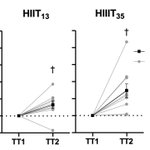
The last study from my PhD investigating the effects of cool and hot HIIT on temperate performance and physiological response in trained cyclists is now available open access in @JSCRonline.
Here is a summary of our (@AbbissC & @JeremiahPeiffer) intriguing findings with a number of practical applications at the end. 1/🧵
journals.lww.com/nsca-jscr/f…

Practical Applications 3): After training in 13° C, combined thermoregulatory, V̇O2, gross mechanical efficiency, HR, and RPE findings suggest a caveat when considering cool environmental temperatures (i.e., temperature in the “optimal” performance range) for training interventions in controlled environments (e.g., indoor training, exercise research). 13/🧵
In conclusion, I think hot HIIT could potentially prove to be a valuable tool in the toolbox for sharpening the performance of elite and world-class endurance athletes when they compete in temperate to hot environmental conditions. However, more research is needed before that claim can be fully validated and their application can be optimized.
Thank you for your time! End/🧵