

We're here to show which leader and country is really world-beating in the battle for global power...and why
London, UK
Joined June 2010
- Tweets22.1K
- Following2.6K
- Followers14.6K
- Likes394





Pinned Tweet
Ten years after Brexit, the final whistle has blown.
Did Britain become richer, stronger and more sovereign — or poorer, weaker and less influential?
Brexit at 10 tests the promises against the data.
No slogans. Just the score.
newsletter.leagueofnations.c…

The proposed UK–EU agri-food agreement would remove most certificates and checks on the products it covers.
Services exporters face different barriers. Our report argues for a separate programme to address them.
Read it on the League of Nations website.
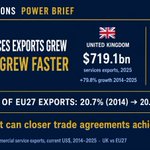
Britain added roughly $319bn in annual services exports between 2014 and 2025.
The EU27 added about $1.67tn from a much larger starting point.
The growth rates: 79.8% and 86.3% respectively.
Read the full comparison on the League of Nations website.

Britain’s services exports grew by 79.8% between 2014 and 2025. The EU27’s grew by 86.3%.
UK exports reached $719.1bn. The EU27 total reached $3.60tn.
Read the comparison in our latest services-export report on the League of Nations website.

THE SCORECARD IS OUR JUDGEMENT. THE SPENDING FIGURES ARE THE EVIDENCE.
Our Russia–EU brief scores plans, policies and performance. Those ratings are the League's interpretation, not a World Bank finding or a prediction of who would win a war.
Read the argument—and test it—on The League of Nations website.

24% COLLABORATIVE PROCUREMENT. A 35% COLLECTIVE BENCHMARK.
That is one concrete test of Europe's defence cooperation, using the EDA's 2025 figure and voluntary benchmark.
Shared orders still have to deliver. Count compatible equipment, dependable supplies and readiness alongside the money.
Read the League's match report on The League of Nations website.
EUROPE HAS ECONOMIC WEIGHT. CAN IT TURN IT INTO COLLECTIVE DEFENCE?
The League's answer is to spend together where shared orders, compatible equipment and common support make forces more effective.
The goal is credible capability. The spending share is one warning light.
Read the match report on The League of Nations website.
A BIGGER SHARE IS NOT A BIGGER ARMY.
GDP shares reveal the burden a country carries. They do not tell us how much usable capability each euro or rouble buys.
The League's match report asks Europe to take the spending gap seriously—and judge its response by delivery.
Read it on The League of Nations website.

RUSSIA DEVOTES MORE OF ITS ECONOMY TO THE MILITARY. EUROPE MUST MAKE ITS RESPONSE COUNT.
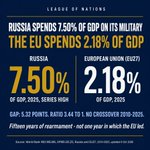
In 2025: Russia 7.50% of GDP; the EU aggregate 2.18%. Across all 16 annual observations from 2010 to 2025, Russia's share was higher.
That is a comparison of economic effort. It does not mean Russia has 3.44 times Europe's military capability.
The League's question: how does Europe turn greater investment into forces that can act together?
Read the full match report on The League of Nations website.

A FRESH DELAY SHOULD HAVE TO EARN ITS CASE.
What happens to emissions, revenue and household support? Who funds the replacement?
Europe's long-term plan deserves better than another vague promise. Read this week's climate brief in the League newsletter.
COUNT THE WORK, NOT THE ANNOUNCEMENTS.
Homes improved. Households reached. Support paid. Energy burdens reduced.
That is the League's proposed scorecard for Europe's extra year before ETS2. Read the full brief in our newsletter.
MOSCOW CAN WAIT.
A slower escape from fossil-fuel dependence can favour exporters, including Russia. That is a strategic risk, not evidence that Moscow directed the summit row.
Read the argument in the League newsletter.
THE INSULATION THAT NEVER REACHES A WALL IS HARDER TO PHOTOGRAPH.
Britain's 2013–14 energy-efficiency changes offer a warning: cutting a programme's cost can also cut the work it delivers.
Follow the historical lesson in the League newsletter.
EUROPE CAN POSTPONE A CARBON CHARGE. IT CANNOT POSTPONE THE NEXT ENERGY SHOCK.
The question is whether the extra year buys warmer homes and cleaner transport—or another argument.
Read today's Power Brief in the League newsletter.
A PENSIONER CANNOT SWITCH BOILERS ON A MINISTER'S TIMETABLE.
Carbon pricing needs usable alternatives: insulation, cleaner heating and practical transport.
Help households through the change. Read the full argument in the League newsletter.
ETS2: full operation moves from 2027 to 2028. Further delay is a risk, not agreed.
The €86.7bn Social Climate Fund includes national contributions.
Will today's political gains weaken tomorrow's energy security? Read our new League newsletter brief.

FASTER IS NOT THE WHOLE PLAN.
The League wants clearer triggers, reliable alternative supplies and an honest account of adjustment costs.
Can Europe turn its proposed trade weapon into leverage it can afford to use? Read the brief:
/
A TRADE GAP IS NOT A POLICY PRICE TAG.
The EU’s €103bn goods deficit with China in Q2 2026 tells us the scale of the imbalance. It cannot tell us what a new restriction would cost.
Our brief follows the distinction—and the stakes:
/
THE GATE CAN CLOSE AT BOTH ENDS.
Restricting market access may create leverage. It can also expose the suppliers Europe still needs.
Our brief asks what must be ready before Brussels reaches for the proposed trigger:
/
YOU CANNOT BUILD A FACTORY WITH A PRESS RELEASE.
Paris and Berlin want faster trade powers. The League’s test: secure replacement supplies, assess retaliation and say who pays.
A sharper weapon still needs an industrial plan behind it. #EUTrade
