

Managing Director, @WebMethodLLC | Cybersecurity Entrepreneur | Identity and Access Management Innovator | Leading with Trust and Integrity
Mesa, AZ
Joined March 2009
- Tweets83.5K
- Following1.8K
- Followers1.4K
- Likes1.1K






One thing that I find interesting is that we tend to frame “the human factor” as a flaw to control instead of a system to design for. More often than not, people aren’t careless. They're just contextual. They respond to urgency, authority, and habit. When security programs ignore that reality, workarounds become inevitable.
Organizations need to ask different questions if they want to make real change. Instead of asking how to stop people from making mistakes, it's better to consider ways to help people recover faster when mistakes inevitably happen.
Culture is ultimately determined by how comfortable people feel flagging problems, not how perfectly they follow rigid policies. forbes.com/councils/forbesbu…
I really enjoyed every individual trend that #IBM listed here, but piecing them all together tells a pretty interesting story.
#AI is hitting a new "era," so to speak. It's being met with completely new limits (compute, energy, organizational, etc.), and people aren't confident in how to move forward. There's a growing collective realization that scaling forever isn’t a strategy. It's just a phase.
There's now a lot more emphasis being put on orchestration and control—we're seeing it with smaller models, purpose-built systems, and even clear ownership of agents and outcomes.
Personally, I see that as a sign of maturity. Breakthroughs may be exciting, but we need well-integrated systems that behave predictably in environments where mistakes matter. ibm.com/think/news/ai-tech-t…

When access is slow, abstract, or owned by “someone else,” people optimize for speed every time. Not because they want to bypass controls — but because momentum is how modern work survives.
As systems become more automated and distributed, access tends to sprawl. Privilege gets copied, inherited, and forgotten. And when responsibility for identity is scattered, cleanup becomes no one’s job.
We often label IAM issues as technical debt, but many are really organizational debt. Until access ownership is clear, visible, and connected to outcomes people care about, policy and reality will stay out of sync — no matter how many controls exist on paper. computerworld.com/article/41…

The scale of everything #Microsoft is building is impressive, but I think their willingness to slow down, listen, and course-correct speaks volumes to their genuine motivations. With demand and expectations being as high as they are, pausing isn't the obvious approach. It's the compassionate, human-first one.
When communities worry about power bills, water use, or long-term jobs, companies need to understand that the real concern isn't necessarily about the technology itself. It's about the need for more security from what that tech could represent.
The future of data centers is going to depend largely on how businesses handle their growth. That's why Microsoft's approach works so well. Instead of building as quickly as possible, they're staying thoughtful about how they're integrating into the places they serve. wired.com/story/microsoft-ha…

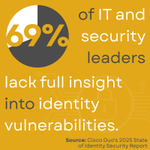
I think it's pretty easy to look at these numbers and conclude that security leaders are in the wrong, but I see a different problem. In my experience, most #security teams are actually good at preventing the attacks they’ve modeled, rehearsed, and bought tools for. The issue is that they're trying to solve outdated problems.
#Ransomware keeps winning because it doesn’t play by any assumptions. It sneaks in through #identity sprawl, standing access that has discreetly outlived its purpose, and exceptions everyone agreed were “temporary.”
Confidence isn’t the real problem. Overconfidence in static controls in a very dynamic identity environment usually is.

I think #AI demand is sometimes talked about as if it's just "more usage."
It's not.
It's always on, always growing, and far less forgiving when something breaks. It's far more involved and complex. That's why this kind of grid modernization is so much more significant than it may seem on the surface.
The ability to predict weather impacts, plan transmission differently, and speed up operations takes a massive strain off of infrastructure that's under constant pressure. Reactive systems aren't enough anymore, and this #Microsoft partnership proves that. reuters.com/sustainability/c…

#Identity governance has always been designed around people. It made sense when people were the scarce resource. Accounts were created deliberately, access was reviewed periodically, and risk moved at human speed.
But quite frankly, that world doesn’t exist anymore.
When machines and agents outnumber humans this vastly, identity becomes something that multiplies automatically, often without a clear owner or expiration. Governance models that rely on tickets, reviews, and static credentials simply can’t keep up.
Honestly, one of the biggest dangers I see with this is the potential for authority to persist long after purpose disappears. Orphaned identities don’t raise alarms. They sit there, waiting to be reused. At that point, attackers don’t need to be clever. They just need to be patient.
Many organizations aren’t necessarily “behind” on security. Truth is, they're operating a system that was never meant to function at this scale. venturebeat.com/security/mac…

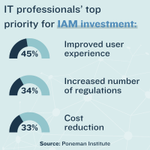
There's a lot about this stat that I find pretty concerning. One of the biggest issues I see is that if #IAM spend is justified mainly by user experience, it usually means identity is being positioned as a productivity tool instead of a control plane. That framing shapes every downstream decision—how much risk is acceptable, how exceptions get handled, how temporary access quietly becomes permanent, etc.
UX should absolutely be part of the conversation, but it can’t be the reason the conversation exists. Identity is where trust is established, enforced, and continuously re-evaluated. If security isn’t the primary driver there, we’re just deferring complexity until it shows up as an incident.

Fragmentation actively works against us, and this is pretty clear here. Identity teams, network teams, and device teams all do the “right” thing in isolation, yet attackers manage to exploit the seams between them.
#Microsoft’s Access Fabric idea is interesting because it acknowledges that access decisions are no longer binary or static, like many seem to still think. They’re contextual, fluid, and constantly renegotiated.
If your controls can’t adapt mid-session, you’re defending yesterday’s environment against today’s threats. Your systems need to actually behave like you believe breach is inevitable. microsoft.com/en-us/security…

Love how #IBM Research is framing CUGA as configurable rather than prescriptive. The idea that you can tune reasoning modes based on cost, latency, and accuracy feels much closer to how enterprises actually operate. We often see that tradeoffs are constant, not theoretical.
To me, releasing this on #HuggingFace also feels intentional. It invites scrutiny from a community that’s very good at finding where systems bend or break. If CUGA holds up under that pressure, it strengthens the case that structured planning and controlled execution are the right counterweight to brittle, prompt-heavy agent designs. Solid way to build trust over time. infoq.com/news/2025/12/ibm-c…

Oritse Uku makes a very important, rarely recognized point here about #ZeroTrust and #IdentitySecurity:
"Zero trust was always the right idea; identity security may finally make it effective."
Zero trust isn't inherently wrong. It was just too abstract to implement at scale. Identity security works because it’s concrete. You can point to an identity, its access, its privileges, and its risk. That makes it easier to explain, easier to fund, and frankly easier to improve.
It allows security to finally be anchored in something organizations can measure, own, and evolve as humans increasingly give way to machines. forbes.com/councils/forbeste…
When we started Webmethod, the goal was never to sell tools. It was to help organizations make sense of identity, access, and risk in environments that keep getting more complex.
Most of the problems we’re brought in to solve aren’t caused by a lack of technology. They come from fragmented identity programs, unclear ownership, and security controls that don’t scale as the business grows. That’s true whether we’re working with a federal agency or a commercial enterprise.
Our work centers on building practical identity and access governance: programs that align with real risk, real compliance requirements, and how systems are actually used. That includes IAM strategy and execution, identity governance, privileged access management, and targeted security assessments that give teams a clear path forward.
We’re also intentional about how we partner. As a trusted Microsoft and IBM partner, we help clients use platforms like Defender for Identity, IBM Verify, and WatsonX in ways that fit their environment, not force-fit architectures that look good on paper but fail in practice.
Cybersecurity isn’t about doing everything at once. It’s about getting the fundamentals right and building from there. That’s the work we focus on every day.

A lot of the debate around centralized IAM still feels stuck in an older world, one where identity mostly meant employees logging into applications. That’s not the environment most teams are operating in anymore.
What this article gets right is the shift in scale and mix. Human identities are now the minority. APIs, services, workloads, bots, and AI agents outnumber people by orders of magnitude, and they often hold far more power inside systems than any single user.
The question I hear most often isn’t whether centralized IAM can handle both human and non-human identities. It’s whether teams are actually ready to treat machines like first-class users, with ownership, lifecycle controls, and accountability. The fundamentals haven’t changed: clean identity data, least privilege, clear ownership, and governance that keeps up with how systems actually behave. The difference is that the blast radius is much larger when those basics are missing.
Machines are users now. Treating them any differently is where most identity programs start to break down. hackernoon.com/the-rise-of-c…

Microsoft’s expanded investment in India is notable not just for the size of the number, but for where the emphasis is going.
Yes, hyperscale infrastructure matters. Having local #data centers, resilience, and low latency is table stakes as #AI moves into real operations. But what stood out to me is the combination of infrastructure, skills, and sovereignty being treated as one system, not separate initiatives.
Embedding AI into platforms like e-Shram and the National Career Service is a good example of what “AI at scale” actually looks like. Not labs or pilots, but systems used by hundreds of millions of people, where trust, access, and reliability aren’t optional.
When AI is woven into national platforms and critical services, questions of data location, access control, and accountability move from technical details to foundational requirements. Big investments always grab headlines. What matters more is whether the pieces fit together in a way that can be sustained. This one looks like it’s being built with that in mind. news.microsoft.com/source/as…

IBM’s acquisition of Confluent makes sense to me when you look at where AI deployments are really struggling: data in motion.
Most enterprises don’t have a data problem, they have a fragmentation problem. Data is spread across clouds, data centers, and legacy systems, and AI systems don’t work well when they’re fed stale or batch-processed information.
Confluent’s strength has always been real-time streaming: moving data as events happen, not hours later. Pairing that with IBM’s hybrid cloud strategy feels like a logical step as organizations move from experimenting with AI to running it inside core operations.
What stands out is less about Kafka itself and more about the implication: agentic and generative AI need continuous, trusted data flows across environments. Without that, governance breaks down and decisions lag behind reality. From an architecture perspective, this is another signal that AI infrastructure is shifting from isolated systems to connected platforms where data, automation, and control planes have to work together.
Execution will matter, but directionally, this aligns with what many enterprises are trying to solve right now. aimagazine.com/news/ibm-to-b…

Identity has been through a lot of “big moments” over the years, but every so often you see something that signals a real shift in the maturity of the space. IBM being named a Leader in the 2025 Magic Quadrant for Access Management is one of those signals.
What I appreciate about Verify’s direction isn’t just the feature set... it’s the acknowledgement that access today spans far more than traditional workforce logins. You’re dealing with customer identities, partner ecosystems, APIs, workloads, and now AI agents that act on behalf of people. That’s a very different operational landscape than it was even five years ago.
The work IBM has been doing around passwordless experiences, lifecycle automation, modern governance, and hybrid identity fits that reality. It reflects a simple truth: identity isn't one system anymore. It’s the foundation that everything else sits on top of, and if you can’t unify access and risk across your environment, you’re guessing in the dark.
From my vantage point, the industry is finally treating identity as the connective layer of digital trust, not an add-on, not a compliance checkbox, but the actual control plane for how people and workloads operate. There’s still plenty of work ahead, but it’s the right trajectory. ibm.com/new/announcements/ib…

The more interconnected our systems become, IT, OT, cloud, edge, AI, the more I’m convinced that identity is the real backbone of enterprise resilience.
Who is accessing what, when, and for what purpose? That question shows up in banking, factories, hospitals, public services, energy grids, everywhere. And the answer keeps getting harder as we move from managing “users” to managing humans, machines, workloads, and now AI agents all operating side by side.
Yet most identity models still rely on assumptions from another era: static roles, long-lived access, periodic reviews. That breaks the moment an AI agent can make thousands of decisions in a day.
For me, resilience comes down to two questions:
Can you trust the identity behind every action? And can you verify that trust continuously?
If not, the rest of the architecture doesn’t matter.
The tools are getting better, adaptive access, stronger governance, AI-driven insight, but none of it works without clean identity data, clear ownership, and a model that adapts as fast as the environment changes. We’re not defending a perimeter anymore. We’re governing an entire ecosystem of identities. The organizations that treat identity as a strategic layer, not background plumbing, are the ones that will move with confidence.

One of the biggest changes I’m seeing in identity security has almost nothing to do with people. It’s the rapid growth of non-human identities i.e., service accounts, APIs, workloads, and now AI agents.
Most teams know this already, but the part that’s catching folks off guard is how quickly the behavior of these identities has changed. AI agents act less like static machine accounts and more like fast-moving coworkers, making decisions and touching systems legacy IAM was never built to monitor.
That’s why the pressure now is understanding how these identities behave, not just tracking their entitlements. And it’s why governance can’t be quarterly anymore. If an agent drifts outside its workflow, you need to catch it in the moment. AI helps surface these signals, but AI agents aren’t “just another” machine identity. Treating them that way leads to blind spots.
For me, it still comes back to the basics: good identity data, clear ownership, and access baselines that teams can actually enforce. You can layer advanced tooling on top, but if the foundation is shaky, you’re just amplifying the problem.
Our workforce may be hybrid, but our identity landscape is now fully mixed: humans, machines, and AI agents all operating side by side. Our security models need to reflect that.
A lot of leaders are talking about #AI strategy for 2026, but I believe the conversation that is the most important, yet the most overlooked, is how #identity models will change along the way.
We're heading into a time where access decisions are automated, trust signals are continuous, and policies apply just as much to machine identities as human ones. Governance frameworks will have to respond immediately. They can't wait.
The line between “user” and “system” gets fuzzier by the month. Our security models need to evolve at the same speed.
So here’s the real question for 2026:
How will you treat AI inside your organization?
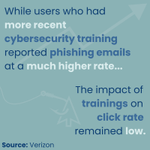
We’ve spent years telling people, “If you see something, say something,” and the data from Verizon's 2025 Data Breach Investigations Report shows that to an extent, it works. Recent training really does lift #phishing reporting rates. But that being said, the same data also makes it clear that clicking behavior barely changes, even with more training.
To me, that says that most clicks aren't a failure of training inherently. More often than not, they're a design failure. When people are overwhelmed, rushed, or juggling too many tools, they default to whatever gets them to the next task fastest. If we want fewer clicks, we have to make the secure choices the easier choices.
