








Pinned Tweet
“Privacy in DeFi is useless if you can’t actually use the money.”
Most private DeFi forces a trade-off.
You hide your balances and positions, but then you can’t really use them.
FHE changes that.
It lets applications process encrypted data without ever seeing the actual values.
@primus_labs built AutoHoG, their FHE execution engine.
In the technical demo:
- ~90ms for a confidential transfer
- 210+ transfers per second
- Run on 8 NVIDIA RTX 5090 GPUs
They also launched a confidential vault on BNB Chain.
Convert supported stables like $U into encrypted $EU at 1:1.
Use them for transfers and supported yield strategies (connected to UnitasLabs infrastructure).
You keep access to DeFi.
Your balances and positions stay private.
FHE is moving from research to something you can actually use.
Which part matters more to you right now: the speed numbers or the vault?

Encrypted transactions stay niche until the computation gets cheaper.
AutoHoG is @primus_labs' answer. FHE lets it merge multiple operations into custom gates, dropping cost without decrypting the data.
The bet is that fewer, smarter gates make large-scale private processing realistic. Still research-grade savings, or already usable for real transaction volume?


“Privacy in DeFi is useless if you can’t actually use the money.”
Most private DeFi forces a trade-off.
You hide your balances and positions, but then you can’t really use them.
FHE changes that.
It lets applications process encrypted data without ever seeing the actual values.
@primus_labs built AutoHoG, their FHE execution engine.
In the technical demo:
- ~90ms for a confidential transfer
- 210+ transfers per second
- Run on 8 NVIDIA RTX 5090 GPUs
They also launched a confidential vault on BNB Chain.
Convert supported stables like $U into encrypted $EU at 1:1.
Use them for transfers and supported yield strategies (connected to UnitasLabs infrastructure).
You keep access to DeFi.
Your balances and positions stay private.
FHE is moving from research to something you can actually use.
Which part matters more to you right now: the speed numbers or the vault?
7
16
175
Good Morning Everyone !!
Most ways to bring web data on-chain still force you to share more than the fact itself.
@primus_labs is built so you can verify any HTTPS data on-chain and leave the personal details private. The pitch is a few clicks for connected dApps.
Useful if the verification stays narrow. Less useful if the flow still feels heavy.
Have you tried moving a specific web fact this way yet?

“Privacy in DeFi is useless if you can’t actually use the money.”
Most private DeFi forces a trade-off.
You hide your balances and positions, but then you can’t really use them.
FHE changes that.
It lets applications process encrypted data without ever seeing the actual values.
@primus_labs built AutoHoG, their FHE execution engine.
In the technical demo:
- ~90ms for a confidential transfer
- 210+ transfers per second
- Run on 8 NVIDIA RTX 5090 GPUs
They also launched a confidential vault on BNB Chain.
Convert supported stables like $U into encrypted $EU at 1:1.
Use them for transfers and supported yield strategies (connected to UnitasLabs infrastructure).
You keep access to DeFi.
Your balances and positions stay private.
FHE is moving from research to something you can actually use.
Which part matters more to you right now: the speed numbers or the vault?
28
42
388
How the new Fungo points system turns activity into levels, boxes, and allocations.
@FungoLabs new points system is live.
I have 2 Fungo Genesis NFTs. All-time current leaderboard rank: 99.
Key details:
- 10% of the total FUNGO supply (1 billion tokens) is allocated to the top 3,000 leaderboard users.
- Every NFT mint gives you points and helps you level up.
- 30 levels, each with Bronze, Silver, and Gold tiers.
- Every level-up rewards you with a Box.
- Boxes can contain FUNGO, ETH, figures, and NFT puzzle pieces.
- Each mint also gives you one ticket for the ETH lottery.
- Genesis holders get a chance to win $1,000 every week (20 winners).
- 3,333 puzzle NFTs will be created, each representing a share of the tokens allocated to the community.
Almost every activity on the launchpad can now bring you rewards.
Which part are you focusing on first: levels or the lottery tickets?

How Primus verifies and computes on data without putting everything in public.
Five technologies sit behind the privacy-focused approach at @primus_labs.
Each has a different role.
zkTLS:
Verifies information from websites without revealing unnecessary data.
zkFHE:
Brings zero-knowledge proofs into fully homomorphic encryption.
FHE:
Lets applications compute on encrypted information.
MPC:
Allows different parties to work together without exposing their individual inputs.
ZKP:
Proves a claim without revealing the information behind it.
zkTLS and zkFHE are the central innovations in Primus.
The others are foundational cryptographic tools.
Together, they point toward a way to verify and use information without putting everything in public.
Which of the five do you see used most in the products you actually try?

“Privacy in DeFi is useless if you can’t actually use the money.”
Most private DeFi forces a trade-off.
You hide your balances and positions, but then you can’t really use them.
FHE changes that.
It lets applications process encrypted data without ever seeing the actual values.
@primus_labs built AutoHoG, their FHE execution engine.
In the technical demo:
- ~90ms for a confidential transfer
- 210+ transfers per second
- Run on 8 NVIDIA RTX 5090 GPUs
They also launched a confidential vault on BNB Chain.
Convert supported stables like $U into encrypted $EU at 1:1.
Use them for transfers and supported yield strategies (connected to UnitasLabs infrastructure).
You keep access to DeFi.
Your balances and positions stay private.
FHE is moving from research to something you can actually use.
Which part matters more to you right now: the speed numbers or the vault?
Privacy shouldn’t come after the damage. It should be there from the start.
Most systems still bolt it on once something breaks. The harder version is designing so the data never sits exposed in the first place.
That's where @primus_labs is building.
Is that actually how any product you use works, or still just the ideal?

“Privacy in DeFi is useless if you can’t actually use the money.”
Most private DeFi forces a trade-off.
You hide your balances and positions, but then you can’t really use them.
FHE changes that.
It lets applications process encrypted data without ever seeing the actual values.
@primus_labs built AutoHoG, their FHE execution engine.
In the technical demo:
- ~90ms for a confidential transfer
- 210+ transfers per second
- Run on 8 NVIDIA RTX 5090 GPUs
They also launched a confidential vault on BNB Chain.
Convert supported stables like $U into encrypted $EU at 1:1.
Use them for transfers and supported yield strategies (connected to UnitasLabs infrastructure).
You keep access to DeFi.
Your balances and positions stay private.
FHE is moving from research to something you can actually use.
Which part matters more to you right now: the speed numbers or the vault?
14
34
402
One day you wake up and see this in your wallet from @primus_labs Airdrop
What will be your first reaction? 😳

30
57
547
How Primus is generating fees and revenue while building private verification.
Primus is turning activity into measurable revenue.
Web3 infrastructure growth needs more than attention.
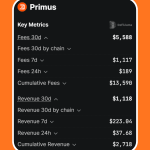
DefiLlama dashboard for @primus_labs:
Fees:
24H: $189
7D: $1,117
30D: $5,588
Cumulative: $13,590
Revenue:
24H: $37.68
7D: $223.04
30D: $1,118
Cumulative: $2,718
The bigger picture is the infrastructure.
Primus is building privacy-preserving verification with zkTLS and zkFHE.
zkTLS verifies real-world Web2 data without exposing sensitive information.
zkFHE brings verifiable computation closer to encrypted data.
The useful question is no longer just how much data connects to Web3.
It is how that data stays useful, verifiable, and private.
Privacy is valuable.
Verifiable privacy is powerful.
Which matters more to you right now: 30D fees or cumulative revenue?

“Privacy in DeFi is useless if you can’t actually use the money.”
Most private DeFi forces a trade-off.
You hide your balances and positions, but then you can’t really use them.
FHE changes that.
It lets applications process encrypted data without ever seeing the actual values.
@primus_labs built AutoHoG, their FHE execution engine.
In the technical demo:
- ~90ms for a confidential transfer
- 210+ transfers per second
- Run on 8 NVIDIA RTX 5090 GPUs
They also launched a confidential vault on BNB Chain.
Convert supported stables like $U into encrypted $EU at 1:1.
Use them for transfers and supported yield strategies (connected to UnitasLabs infrastructure).
You keep access to DeFi.
Your balances and positions stay private.
FHE is moving from research to something you can actually use.
Which part matters more to you right now: the speed numbers or the vault?
Quick way to check your @primus_labs Discord points:
- Open Discord
- Open the chat
- Type /points and send
You’ll see your points right away.
Note: these are different from the website leaderboard XPs. Discord points are what unlock the creator role.

Data is valuable. But being able to trust it without exposing everything is even more important.
That's the problem @Primus_Labs is working to solve in Web3.
Their approach combines two interesting technologies:
zkTLS: Verify information from traditional websites without revealing the underlying private data.
zkFHE: Combine zero-knowledge proofs with fully homomorphic encryption to enable verifiable computation on encrypted data.
Why does this matter?
- Privacy: Keep sensitive information protected.
- Verification: Prove Web2 data is authentic without exposing everything.
- Confidential Computation: Process encrypted data without revealing its contents.
- Real-World Utility: Enable new possibilities for AI agents, DeFi, digital identity, and more.
One of Web3's biggest challenges is connecting real-world data with on-chain applications without sacrificing privacy or trust.
That's the direction Primus is exploring.
The future isn't about sharing more data.
It's about proving what's true while keeping everything else private.

Good Morning Everyone !!
Financial data usually has to choose: stay private or stay auditable.
@primus_labs is trying both. Information stays encrypted on-chain so a cyberattack doesn’t automatically expose it, while accountability and verification remain possible.
The hard part is whether the verification step still leaks more than it should. Is that balance real yet, or still the design goal?
Data is valuable. But being able to trust it without exposing everything is even more important.
That's the problem @Primus_Labs is working to solve in Web3.
Their approach combines two interesting technologies:
zkTLS: Verify information from traditional websites without revealing the underlying private data.
zkFHE: Combine zero-knowledge proofs with fully homomorphic encryption to enable verifiable computation on encrypted data.
Why does this matter?
- Privacy: Keep sensitive information protected.
- Verification: Prove Web2 data is authentic without exposing everything.
- Confidential Computation: Process encrypted data without revealing its contents.
- Real-World Utility: Enable new possibilities for AI agents, DeFi, digital identity, and more.
One of Web3's biggest challenges is connecting real-world data with on-chain applications without sacrificing privacy or trust.
That's the direction Primus is exploring.
The future isn't about sharing more data.
It's about proving what's true while keeping everything else private.
32
56
544
How to claim the Primus airdrop as a Kaito staker.
If you have staked $KAITO or hold YT-sKAITO (minimum 5000), register for the @primus_labs airdrop.
0.06% of the $PRIM supply is allocated for eligible Kaito stakers.
Epoch 2 ends on 21 November.
Register before the window closes:
s.kaito.ai/mRAq8yx
Also keep stacking XP on the Primus point program.
Have you registered yet?

Data is valuable. But being able to trust it without exposing everything is even more important.
That's the problem @Primus_Labs is working to solve in Web3.
Their approach combines two interesting technologies:
zkTLS: Verify information from traditional websites without revealing the underlying private data.
zkFHE: Combine zero-knowledge proofs with fully homomorphic encryption to enable verifiable computation on encrypted data.
Why does this matter?
- Privacy: Keep sensitive information protected.
- Verification: Prove Web2 data is authentic without exposing everything.
- Confidential Computation: Process encrypted data without revealing its contents.
- Real-World Utility: Enable new possibilities for AI agents, DeFi, digital identity, and more.
One of Web3's biggest challenges is connecting real-world data with on-chain applications without sacrificing privacy or trust.
That's the direction Primus is exploring.
The future isn't about sharing more data.
It's about proving what's true while keeping everything else private.
Manifesting 5 figures Airdrop from @primus_labs
$PRIM will make the Airdrop Era Great Again.

How to earn the Witness and other available roles in the @primus_labs Discord.
Current roles: Witness, Creator, Advocate, and Builder.
AlphaNet Member and AlphaNet Builder are no longer available.
Witness: at least 300 points on the server.
Caster: above 500 points.
Broadcaster: dedication, consistency, and hard work.
How to earn points:
Quizzes:
Happen randomly. Moderators usually announce them in the morning so you can prepare.
Content submissions:
Submit content about Primus. Compile it weekly and use it to update points.
Check your points:
Type / in the server chat, find the points command, and click it.
Stay active and keep contributing.
Which role are you targeting first?

Data is valuable. But being able to trust it without exposing everything is even more important.
That's the problem @Primus_Labs is working to solve in Web3.
Their approach combines two interesting technologies:
zkTLS: Verify information from traditional websites without revealing the underlying private data.
zkFHE: Combine zero-knowledge proofs with fully homomorphic encryption to enable verifiable computation on encrypted data.
Why does this matter?
- Privacy: Keep sensitive information protected.
- Verification: Prove Web2 data is authentic without exposing everything.
- Confidential Computation: Process encrypted data without revealing its contents.
- Real-World Utility: Enable new possibilities for AI agents, DeFi, digital identity, and more.
One of Web3's biggest challenges is connecting real-world data with on-chain applications without sacrificing privacy or trust.
That's the direction Primus is exploring.
The future isn't about sharing more data.
It's about proving what's true while keeping everything else private.
Kaito Studio paid creators $875K in October. @primus_labs is not in that number yet.
Its creator pool is 0.24% of the $PRIM supply and pays out after TGE:
- $60M FDV = $144K (16% of Kaito’s October)
- $150M FDV = $360K (41%)
- $250M FDV = $600K (69%)
One campaign, up to two-thirds of a full Kaito month.
When it pays out, a lot of creators get new numbers to post.
November goal: stay on the Primus board through Epoch 2
Which FDV scenario feels most realistic to you right now?

Data is valuable. But being able to trust it without exposing everything is even more important.
That's the problem @Primus_Labs is working to solve in Web3.
Their approach combines two interesting technologies:
zkTLS: Verify information from traditional websites without revealing the underlying private data.
zkFHE: Combine zero-knowledge proofs with fully homomorphic encryption to enable verifiable computation on encrypted data.
Why does this matter?
- Privacy: Keep sensitive information protected.
- Verification: Prove Web2 data is authentic without exposing everything.
- Confidential Computation: Process encrypted data without revealing its contents.
- Real-World Utility: Enable new possibilities for AI agents, DeFi, digital identity, and more.
One of Web3's biggest challenges is connecting real-world data with on-chain applications without sacrificing privacy or trust.
That's the direction Primus is exploring.
The future isn't about sharing more data.
It's about proving what's true while keeping everything else private.
We will all be posting this after the @primus_labs TGE
$PRIM Airdrop will make us rich.

Good Morning Everyone !!
Most verification still asks you to hand over more data than the check requires.
@primus_labs is using zkTLS to flip that: make the web fact verifiable without exposing the sensitive parts. The goal is trust for the app without the extra personal leak.
Useful in real flows, or still mostly a technical promise?

Data is valuable. But being able to trust it without exposing everything is even more important.
That's the problem @Primus_Labs is working to solve in Web3.
Their approach combines two interesting technologies:
zkTLS: Verify information from traditional websites without revealing the underlying private data.
zkFHE: Combine zero-knowledge proofs with fully homomorphic encryption to enable verifiable computation on encrypted data.
Why does this matter?
- Privacy: Keep sensitive information protected.
- Verification: Prove Web2 data is authentic without exposing everything.
- Confidential Computation: Process encrypted data without revealing its contents.
- Real-World Utility: Enable new possibilities for AI agents, DeFi, digital identity, and more.
One of Web3's biggest challenges is connecting real-world data with on-chain applications without sacrificing privacy or trust.
That's the direction Primus is exploring.
The future isn't about sharing more data.
It's about proving what's true while keeping everything else private.


Fungo is allocating 10% of supply to the top 3000. Here is where I stand.
Ranking 278 on the @FungoLabs all-time leaderboard.
Level 7.
293 points.
Fungo will distribute 10% of the total supply to the top 3000 users on the all-time rankings.
Also holding 2 Fungo Genesis NFTs.
What is your rank on the all-time leaderboard (apart from the X campaign)?
Drop your all-time rank if you are tracking it.

5
20
327
$PRIM Airdrop is Coming Soon...
Can we expect 4 to 5 figs Airdrop from @primus_labs
What's your thoughts?

4,948 creators in the @primus_labs Kaito yapping campaign.
Epoch 1 is over. Epoch 2 is running with 5 days left.
450 spots for the $PRIM airdrop:
- 150 Global
- 150 Korean
- 150 Chinese.
Did you qualify in Epoch 1?

Data is valuable. But being able to trust it without exposing everything is even more important.
That's the problem @Primus_Labs is working to solve in Web3.
Their approach combines two interesting technologies:
zkTLS: Verify information from traditional websites without revealing the underlying private data.
zkFHE: Combine zero-knowledge proofs with fully homomorphic encryption to enable verifiable computation on encrypted data.
Why does this matter?
- Privacy: Keep sensitive information protected.
- Verification: Prove Web2 data is authentic without exposing everything.
- Confidential Computation: Process encrypted data without revealing its contents.
- Real-World Utility: Enable new possibilities for AI agents, DeFi, digital identity, and more.
One of Web3's biggest challenges is connecting real-world data with on-chain applications without sacrificing privacy or trust.
That's the direction Primus is exploring.
The future isn't about sharing more data.
It's about proving what's true while keeping everything else private.