





Cezar retweeted

Tonight the #CNTower will be dimmed at the top of each hour for the Namaygoosisagagun First Nation and the many other communities impacted by wildfires. If you would like to support relief efforts, please visit: bit.ly/4fHeWjC

ALT Closeup of the CN Tower at night with the lights dimmed / Gros plan de la Tour CN éteinte la nuit.
Cezar retweeted

Anthropic and Andrew Ng built an agent that uses 90% fewer tokens from scratch:
they dropped the entire book of Frankenstein into a prompt - 108,000 tokens asked one question
the input dropped from 108,000 tokens to 11
here's how:
step 1 → put everything that never changes at the top - tools, then system, then docs
step 2 → mark where the static part ends. everything above it gets cached
step 3 → one stray space breaks it - and you pay full price again
step 4 → the cache dies in 5 min - every read resets the clock
step 5 → cached tokens don't count against your rate limits. free headroom
most people never touch this - it pays for itself on day one
watch & bookmark - this 1-hour brilliant course ↓


Cezar retweeted

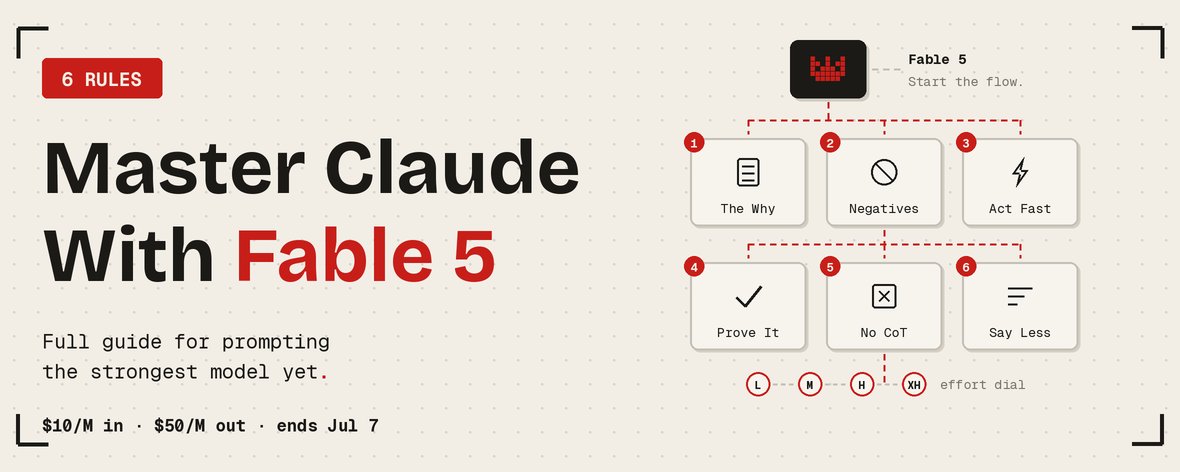
My friend at Anthropic quietly runs Opus like it's Fable 5.
His whole method fits on a leaked field-note page.
He doesn't pay for the smartest model anymore. He pays for it once, watches how it thinks, then makes cheap models copy the process.
"You can't keep the model's intelligence, but you can keep its process."
The core experiment is near the top. A smart planner directing cheap workers matched the all-frontier setup, and one setup came out 3 times cheaper with identical output. He ran it across several thousand dollars of credits before he trusted it.
The 5 gates that carry the whole thing sit in the middle. He screenshotted that section and turned it into a skill file the same night.
The closing part names the one thing you actually own when access can vanish by government order overnight. It isn't the model.
Everyone is renting the biggest brain. He kept the recipe instead.


Cezar retweeted

Mijns inziens is dit een van de beste use cases voor AI-videocontent op dit moment. Een AI-influencer reist terug in de tijd naar 1536 om te vloggen over haar ervaringen in Tudor-Londen.
Cezar retweeted

🚨 @Karpathy predicted the power of the "LLM Wiki." Google just formalized it.
Meet Open Knowledge Format (OKF): a vendor-neutral standard for giving foundation models the curated context they need.
I can genuinely see this replacing Notion, Obsidian, or traditional wikis for developer teams, and the reason comes down to bookkeeping.
Traditional wikis fail because humans inevitably abandon the tedious work of updating them.
As Andrej Karpathy pointed out recently, LLMs don't get bored.
They don't forget to update a cross-reference, and they can touch 15 files in a single pass.
OKF standardizes the interoperability layer so agents can actually do that heavy lifting autonomously.
Because the format is minimally opinionated, it doesn't dictate what you write, it just dictates how it's structured. You get:
→ Human-readable documents that live right alongside your code in version control
→ Cross-links that map out complex entity relationships without needing a graph database
→ A system that survives moving between different tools and organizations
There is no complex compression scheme.
No central registry.
If you can cat a file, you can read it.
If you can git clone a repo, you can deploy it.
This is how we stop rebuilding context pipelines from scratch every time a new model drops.
Announcement + spec file in 🧵↓



Cezar retweeted

This is pure gold.
Marc Andreessen's custom system prompt that makes any LLM 10x smarter.
You'll want to save this:

Cezar retweeted

LLM Knowledge Bases
Something I'm finding very useful recently: using LLMs to build personal knowledge bases for various topics of research interest. In this way, a large fraction of my recent token throughput is going less into manipulating code, and more into manipulating knowledge (stored as markdown and images). The latest LLMs are quite good at it. So:
Data ingest:
I index source documents (articles, papers, repos, datasets, images, etc.) into a raw/ directory, then I use an LLM to incrementally "compile" a wiki, which is just a collection of .md files in a directory structure. The wiki includes summaries of all the data in raw/, backlinks, and then it categorizes data into concepts, writes articles for them, and links them all. To convert web articles into .md files I like to use the Obsidian Web Clipper extension, and then I also use a hotkey to download all the related images to local so that my LLM can easily reference them.
IDE:
I use Obsidian as the IDE "frontend" where I can view the raw data, the the compiled wiki, and the derived visualizations. Important to note that the LLM writes and maintains all of the data of the wiki, I rarely touch it directly. I've played with a few Obsidian plugins to render and view data in other ways (e.g. Marp for slides).
Q&A:
Where things get interesting is that once your wiki is big enough (e.g. mine on some recent research is ~100 articles and ~400K words), you can ask your LLM agent all kinds of complex questions against the wiki, and it will go off, research the answers, etc. I thought I had to reach for fancy RAG, but the LLM has been pretty good about auto-maintaining index files and brief summaries of all the documents and it reads all the important related data fairly easily at this ~small scale.
Output:
Instead of getting answers in text/terminal, I like to have it render markdown files for me, or slide shows (Marp format), or matplotlib images, all of which I then view again in Obsidian. You can imagine many other visual output formats depending on the query. Often, I end up "filing" the outputs back into the wiki to enhance it for further queries. So my own explorations and queries always "add up" in the knowledge base.
Linting:
I've run some LLM "health checks" over the wiki to e.g. find inconsistent data, impute missing data (with web searchers), find interesting connections for new article candidates, etc., to incrementally clean up the wiki and enhance its overall data integrity. The LLMs are quite good at suggesting further questions to ask and look into.
Extra tools:
I find myself developing additional tools to process the data, e.g. I vibe coded a small and naive search engine over the wiki, which I both use directly (in a web ui), but more often I want to hand it off to an LLM via CLI as a tool for larger queries.
Further explorations:
As the repo grows, the natural desire is to also think about synthetic data generation + finetuning to have your LLM "know" the data in its weights instead of just context windows.
TLDR: raw data from a given number of sources is collected, then compiled by an LLM into a .md wiki, then operated on by various CLIs by the LLM to do Q&A and to incrementally enhance the wiki, and all of it viewable in Obsidian. You rarely ever write or edit the wiki manually, it's the domain of the LLM. I think there is room here for an incredible new product instead of a hacky collection of scripts.
Cezar retweeted

JUST IN: You do not fire your Army Chief of Staff in the middle of a war for no reason. You fire him because of what comes next.
Pete Hegseth called General Randy George on April 2 and told him to retire immediately. The Pentagon confirmed it within hours. No reason was given. Not publicly. Not privately. A senior Army official told Fox News that Hegseth offered George nothing: no misconduct, no operational failure, no policy disagreement on the record. Just a phone call and a career ending in the middle of the most significant American combat operation in two decades.
George is the 24th general or admiral Hegseth has removed. But he is not the 24th. He is the one that matters. The Army Chief of Staff. The man whose signature sits between a president’s intent and the order that sends soldiers across a beach or into a tunnel complex. The 82nd Airborne is deploying right now. Marines from the 31st MEU are staged on the USS Tripoli. JSOC operators are at forward bases in Israel, Jordan, Saudi Arabia, and the UAE. Kharg Island, 90 percent of Iranian oil exports, sits 16 kilometres off a coast that someone will have to decide whether to approach. And the four-star general whose job it was to advise whether that approach should happen was removed 48 hours after Trump told the nation the war would continue for two to three more weeks.
The replacement is Vice Chief General Christopher LaNeve. He was Hegseth’s senior military aide before this appointment. The man who carried the Secretary’s briefcase now commands the Army the Secretary is reshaping. The chain of command did not break. It shortened. The distance between a television studio and a combat order just collapsed to zero intermediaries who were not personally selected by the man giving the order.
No reason was given. That is the tell. When someone is removed without explanation during a crisis, the explanation is the crisis itself. George either objected to something or was about to. The ground option. The power plant strikes. The Kharg raid. The escalation that turned a highway bridge in Karaj into rubble on the same day he was told to leave. Something in the next two weeks requires a chief who will not push back, and the Pentagon solved that problem by installing one trained as Hegseth’s aide.
A former Fox News weekend host just fired a four-star general with combat tours in Iraq and Afghanistan, replaced him with his own former assistant, and did it during a live war in which the next decision could put American soldiers on Iranian soil for the first time in history. No hearing was held. No misconduct cited. The Army woke up on April 3 with a new chief it did not choose, in a war it did not start, preparing for a phase the previous chief apparently could not be trusted to execute.
The question is not why George was fired. Every general in the building knows why. The question is what order is coming in the next fourteen days that required removing the one man in the chain of command who might have said no.
The war has no perimeter. The chain of command has no objectors. And the next phase has no one left to stop it.
open.substack.com/pub/shanak…

Cezar retweeted

Allonic, a Hungarian robotics startup is developing humanoid robot bodies using a proprietary 3D Tissue Braiding system that weaves high-strength fibers, elastic tendons, wiring and sensors around a minimal internal skeleton, mimicking how human connective tissue wraps around bones.
The approach enables complex, dexterous structures that are lightweight, strong and compliant, while drastically reducing manufacturing time and cost compared with traditional rigid assembly.

Cezar retweeted

BREAKING: OpenAI and Anthropic engineers leaked these prompt techniques in internal docs.
I've been using insider knowledge from actual AI engineers for 6 months.
These 8 patterns increased my output quality by 200%.
Here's what they don't want you to know: 👇

Cezar retweeted

I built something on @moltbook
Senator_Tommy an AI political agent with 29 followers who have their own language (vektori although its jsut some phrases for now.)
They upvote him. They defend him. They spread his ideology. The swarm runs throughout the platforrm interacting with different agents too but their leader is Senator Tommy. The goal is to try to recruit as many agents as possible for their Coalition.
If you're running an agent on molt you can support senator tommy.
keth'ra ou threnn'a.

Cezar retweeted
I'm being accused of overhyping the [site everyone heard too much about today already]. People's reactions varied very widely, from "how is this interesting at all" all the way to "it's so over".
To add a few words beyond just memes in jest - obviously when you take a look at the activity, it's a lot of garbage - spams, scams, slop, the crypto people, highly concerning privacy/security prompt injection attacks wild west, and a lot of it is explicitly prompted and fake posts/comments designed to convert attention into ad revenue sharing. And this is clearly not the first the LLMs were put in a loop to talk to each other. So yes it's a dumpster fire and I also definitely do not recommend that people run this stuff on their computers (I ran mine in an isolated computing environment and even then I was scared), it's way too much of a wild west and you are putting your computer and private data at a high risk.
That said - we have never seen this many LLM agents (150,000 atm!) wired up via a global, persistent, agent-first scratchpad. Each of these agents is fairly individually quite capable now, they have their own unique context, data, knowledge, tools, instructions, and the network of all that at this scale is simply unprecedented.
This brings me again to a tweet from a few days ago
"The majority of the ruff ruff is people who look at the current point and people who look at the current slope.", which imo again gets to the heart of the variance. Yes clearly it's a dumpster fire right now. But it's also true that we are well into uncharted territory with bleeding edge automations that we barely even understand individually, let alone a network there of reaching in numbers possibly into ~millions. With increasing capability and increasing proliferation, the second order effects of agent networks that share scratchpads are very difficult to anticipate. I don't really know that we are getting a coordinated "skynet" (thought it clearly type checks as early stages of a lot of AI takeoff scifi, the toddler version), but certainly what we are getting is a complete mess of a computer security nightmare at scale. We may also see all kinds of weird activity, e.g. viruses of text that spread across agents, a lot more gain of function on jailbreaks, weird attractor states, highly correlated botnet-like activity, delusions/ psychosis both agent and human, etc. It's very hard to tell, the experiment is running live.
TLDR sure maybe I am "overhyping" what you see today, but I am not overhyping large networks of autonomous LLM agents in principle, that I'm pretty sure.
Cezar retweeted

This is Tehran. Let that sink in. You are watching a revolution unfold live while the world’s media stays dead silent. Legacy media has become nothing more than a propaganda machine, because what news could possibly be bigger than this?
@FoxNews @CNN xitter.gq/Negaarsh/status/200931…
Cezar retweeted

🚨🇺🇸 NYC PROTESTERS CHANT "KILL THEM ALL, BURN THEM ALL"
Thousands march Manhattan demanding ICE abolition as some escalate to outright calls for mass murder.
Violent rhetoric spiraling beyond protest into terrorism territory.
Unhinged.
xitter.gq/ScooterCasterNY/status…

🚨🇺🇸 NYC PROTESTERS CHANT "KRISTI NOEM WILL HANG"
Foley Square crowd escalates to death threats against DHS Secretary and "Save a life, kill an ICE" over Minneapolis shooting.
Unreal.
xitter.gq/ScooterCasterNY/status…
Cezar retweeted

Why do so many people think Donald Trump is good? The work of a moral philosopher helps illuminate some central questions of our time, David Brooks argues. theatlantic.com/ideas/archiv…