


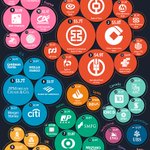


$QNT Token


Christo retweeted

$PLUME — Plume Network
ㅤ
Everyone is watching $ONDO, $LINK, and $QNT compete for the future of tokenized finance.
ㅤ
But what if the real opportunity is a blockchain built specifically for real-world assets?
ㅤ
$PLUME is betting that tokenized securities, institutional capital, and on-chain yield will become major parts of DeFi.
ㅤ
Plume is an EVM-compatible blockchain designed to bring real-world assets into decentralized finance.
ㅤ
Save this checklist:
ㅤ
-> Where the demand comes from
ㅤ
Traditional finance is moving on-chain.
ㅤ
Tokenized Treasuries.
Private credit.
Investment funds.
Real estate.
Institutional yield.
ㅤ
Plume aims to make these assets accessible through DeFi applications.
ㅤ
-> Main narrative
ㅤ
Real-World Assets.
Institutional Finance.
RWA Tokenization.
DeFi Yield.
Blockchain Infrastructure.
ㅤ
-> The real advantage
ㅤ
Most Layer 1 networks focus on general-purpose applications.
ㅤ
Plume focuses specifically on real-world assets.
ㅤ
Plume Chain — RWA-focused blockchain.
Tokenization Infrastructure — Bringing assets on-chain.
Compliance Tools — Institutional asset integration.
RWAfi — Lending, borrowing, and trading tokenized assets.
ㅤ
More tokenized assets.
More institutional capital.
More potential network activity.
ㅤ
-> The adoption angle
ㅤ
This is where things get interesting.
ㅤ
Recent on-chain data shows:
ㅤ
$97M+ — Tokenized RWA value.
$95M+ — Active RWA assets.
$4.7M — RWA assets deployed in DeFi.
ㅤ
Plume's ecosystem includes assets associated with Superstate, Centrifuge, and other tokenization providers.
ㅤ
The opportunity is turning traditionally illiquid assets into productive on-chain capital.
ㅤ
But tokenized asset value is not the same as protocol revenue.
ㅤ
-> The PLUME tokenomics angle
ㅤ
Maximum supply: 10 billion PLUME.
Circulating supply: Approximately 6.81 billion.
ㅤ
$PLUME supports:
ㅤ
Network transaction fees.
Validator staking.
Protocol governance.
Ecosystem incentives.
ㅤ
Token allocation:
ㅤ
59% — Community, ecosystem, and foundation.
21% — Early backers.
20% — Core contributors.
ㅤ
Future distributions remain important.
ㅤ
And RWA adoption does not automatically guarantee PLUME price appreciation.
ㅤ
-> Bull case
ㅤ
If tokenized finance expands, Plume could benefit.
ㅤ
More tokenized assets.
More institutional integrations.
More DeFi liquidity.
More potential PLUME demand.
ㅤ
Its specialized RWA infrastructure could become a competitive advantage.
ㅤ
-> Bear case
ㅤ
Competition + token value capture.
ㅤ
Ethereum and other RWA-focused networks compete for institutional capital.
ㅤ
Regulatory requirements may limit adoption.
ㅤ
And network activity must translate into sustainable token demand.
ㅤ
-> What to watch
ㅤ
Tokenized RWA value.
DeFi utilization.
Network fee revenue.
PLUME staking demand.
Institutional integrations.
Token unlock schedules.
ㅤ
My view:
ㅤ
Narrative: 9/10
Utility: 8/10
Adoption: 7/10
Risk: High
Upside: High
ㅤ
Real-world assets.
Institutional finance.
On-chain yield.
ㅤ
$PLUME is a bet on the infrastructure bringing traditional financial assets into DeFi.
ㅤ
If tokenization becomes mainstream, specialized RWA networks could benefit.
ㅤ
But real revenue and sustainable PLUME demand remain essential.
ㅤ
Save this for your RWA watchlist.
ㅤ
Which has more upside: $PLUME, $ONDO, or $QNT?
ㅤ
Drop your pick below. 👇
ㅤ
Full research & setups on Telegram ↓
t.me/Jus7Degen

Christo retweeted

Most people look at $QNT and ask, “How high can the price go?”
I start with a completely different question: what happens if banks in different countries start issuing tokenized money on different systems and all of those systems need to talk to each other?
Warning: this one is LONG.
Probably one of my deepest $QNT posts yet. Give me a few minutes and read the whole thing. It’ll be worth it.
That question led me straight back to The Clearing House.
And once you understand the architecture The Clearing House is building, the entire Quant thesis starts making a lot more sense.
The Clearing House is one of the most important pieces of U.S. banking infrastructure.
It is owned by 25 banks.
Its CHIPS network has 43 direct participants.
CHIPS settles more than $2T in average value each business day.
During 2025 it processed around $2.014T in average daily payments.
Its liquidity efficiency was around 26:1.
So when I talk about The Clearing House moving toward tokenized deposits, understand the scale.
This is not a crypto company trying to get banks interested.
These are banking rails banks already use.
Now they are preparing those rails for tokenized commercial bank money.
On August 24, 2026, The Clearing House published a discussion with Chief Strategy Officer Sal Karakaplan.
The message was simple but extremely important.
Banks using CHIPS and RTP already have their settlement infrastructure.
They already maintain funds.
They already have liquidity processes.
They already have payment connectivity.
So tokenized deposits should not force them to rebuild everything.
Instead, tokenized transactions can be tightly connected with the systems they already use.
That one idea is massive.
Because the biggest obstacle to institutional blockchain adoption has always been disruption.
Banks do not want to throw away working infrastructure.
They want new capability without destroying the old system.
Now fast-forward one month.
September 24, 2026.
The Clearing House selects Quant.
Quant becomes the announced technology provider for:
Interoperability.
Orchestration.
Transaction management.
Quant also brings Tokenized Deposits-as-a-Service.
So imagine the future banking system.
Bank A issues tokenized dollars on one ledger.
Bank B uses another private network.
Bank C wants programmable deposits but has not built its own blockchain system.
A tokenized-securities platform needs cash settlement.
A treasury platform needs programmable payments.
A public blockchain contains tokenized assets.
CHIPS remains the regulated high-value dollar settlement network.
RTP handles real-time payments.
These systems are different.
But the money still needs to move between them.
Quant’s job is to coordinate that complexity.
I think this is much bigger than “blockchain interoperability.”
This is financial-system interoperability.
And the banks around The Clearing House initiative show how serious it is.
JPMorgan Chase.
Citi.
Bank of America.
HSBC.
BNY.
Wells Fargo.
Santander.
TD Bank.
Then:
BMO.
Citizens.
Fifth Third.
Huntington.
KeyBank.
PNC.
Regions.
Truist.
The comments from these institutions focused on exactly the problems Quant wants to solve.
Tokenized-deposit clearing.
Interbank connectivity.
Trusted financial infrastructure.
Interoperability.
Programmable payments.
Connecting blockchain capability with existing payment rails.
The Clearing House subsequently chose Quant.
That gives Quant a completely different distribution opportunity.
Instead of selling software one bank at a time, Quant is now inside an initiative connected to an institution already serving major banks.
That can shorten the path to institutional adoption dramatically.
Then look at what Quant has already done in Britain.
The Great British Tokenised Deposit initiative gives us a preview.
Quant was selected in September 2025.
One year later, seven banks had completed live customer transactions.
The names:
Barclays
HSBC UK
Lloyds Banking Group
Monzo
Nationwide
NatWest
Santander
These transactions involved real money.
Mortgage completions.
A marketplace purchase.
Funds could be reserved and released when conditions were met.
This is programmable commercial bank money doing actual work.
Now compare the timeline.
UK Quant selection: September 2025.
UK live customer transactions: September 2026.
U.S. Quant selection by The Clearing House: September 2026.
U.S. network targeted for availability: H1 2027.
I see a pattern.
Quant builds.
Banks test.
Transactions go live.
Then the model expands to another market.
Now layer international interoperability on top.
In October 2026, Quant participated directly in the UK Finance Tokenised Markets and Money Conference.
The discussion involved how tokenized-deposit initiatives from countries including the UK, Japan, the U.S. and Germany could connect.
The industry is talking about:
Standards.
Rulebooks.
Overlapping bank participation.
Commercial corridors.
Synchronized settlement.
Payment-versus-payment.
That is the future Quant has been preparing for.
People sometimes think tokenization will simplify finance because everything moves onto one blockchain.
I think the opposite can happen.
Tokenization can create even more systems.
Every major bank may have its own approach.
Countries may build national frameworks.
Central banks may support separate settlement infrastructure.
Private asset ledgers will exist.
Public blockchains will exist.
Commercial bank deposit tokens will exist.
Stablecoins will exist.
Digital securities will exist.
The technology becomes more diverse.
The need for coordination becomes bigger.
That is where a “network of networks” becomes valuable.
Think about U.S.-UK payments.
The U.S. bank has tokenized dollars.
The UK bank has tokenized sterling.
Both have domestic rules.
Both have their own settlement rails.
Both need foreign exchange.
Both need confirmation.
Both need compliance.
Both need the cash and asset legs synchronized.
Quant already has technology connected to both banking environments.
I think that gives it an incredibly interesting strategic position.
And I am not stopping at deposits.
Look at Murex.
Murex runs MX.3, widely used in institutional trading, risk management and post-trade operations.
In March 2026, Murex and Quant announced an integration.
Quant’s programmable money infrastructure can work alongside MX.3.
Now banks can potentially handle tokenized deposits and digital bonds without changing the core institutional workflow they already use.
This matters because tokenized assets need money.
A digital bond cannot settle itself.
A tokenized fund still needs subscriptions and redemptions.
Tokenized collateral still needs financing.
Tokenized securities still need delivery-versus-payment.
If the asset moves but the cash cannot move with it, the system is incomplete.
Quant is working across both sides.
Asset systems.
Money systems.
Institutional software.
Interoperability.
That creates more commercial opportunities.
Now I want to talk about token utility because this is where a lot of crypto research gets lazy.
The Clearing House settling $2T does not mean $2T buys QNT.
I care about a different mechanism.
QNT is documented as an access and licensing token.
Overledger subscribers can pay platform fees in USD or QNT.
Historical licensing models used QNT for annual mainnet licensing.
The 2026 MiCA disclosure also describes QNT utilization and locking in licensing arrangements.
So institutional growth can potentially create token demand through access rather than through the gross dollar value of payments.
That model makes more sense to me.
If one bank moves $100B using Quant infrastructure, QNT does not need to absorb $100B.
Quant needs commercial contracts.
Licensing.
Platform access.
Network services.
Potential token commitments.
If the number of institutions keeps increasing, those commitments can compound.
I care even more about locking.
One-time purchases can come back to market.
Locked tokens cannot.
If enterprise arrangements require QNT to remain committed for periods of time, liquid supply can tighten.
Then incoming demand has fewer freely available tokens to compete for.
And QNT supply is already small.
Roughly 14.56M circulating.
Around 14.61M total supply in the data used for this research.
That scarcity matters.
Then add Fusion.
Fusion launched on mainnet in June 2026.
It initially connected 74 networks.
Its Trusted Node Program gives institutions more control around who processes transactions.
QNT has a documented staking role.
So now I can see a second demand channel.
Overledger and enterprise licensing create one path.
Fusion execution and staking create another.
If both scale together, QNT becomes much more interesting.
Think of the potential progression.
Bank joins Quant infrastructure.
Bank or service provider needs platform access.
Access creates licensing economics.
Some licensing arrangements involve QNT usage or locking.
Meanwhile, institutional networks connect through Fusion.
Trusted nodes stake QNT.
Network execution grows.
More QNT becomes tied to productive use.
Supply stays around 14.6M.
That is the flywheel I want.
We are not fully there yet.
The exact QNT economics attached to The Clearing House contract have not been publicly disclosed.
But the general utility already exists.
That makes public confirmation of recurring institutional QNT demand one of the biggest catalysts I am waiting for.
Now do the valuation math.
Using about 14.61M tokens:
$5B valuation = ~$342 QNT
$10B = ~$684
$20B = ~$1,369
$30B = ~$2,053
$50B = ~$3,422
Again, these are valuation scenarios.
They are useful because they show what QNT’s scarcity does when the market cap expands.
The question becomes:
What valuation would investors assign to a token if Quant becomes recurring infrastructure for bank-issued digital money?
I think $10B becomes much easier to discuss if we see meaningful commercial bank onboarding, recurring QNT-linked revenue, rising activity and token commitments.
Higher scenarios need even more.
International usage.
Multiple national banking systems.
Cross-border network connectivity.
Large-scale Fusion adoption.
Material staking.
Recurring institutional contracts.
That is what I want to watch.
And the catalysts are already lined up.
1. The Clearing House network opening in H1 2027.
The partnership moves closer to real commercial usage.
2. U.S. bank onboarding.
More institutions can mean more Quant products being used.
3. Tokenized Deposits-as-a-Service.
Banks that do not want to build token infrastructure themselves can still participate.
4. QNT-linked enterprise licensing.
This is where institutional adoption can begin translating more directly into token demand.
5. Great British Tokenised Deposit expansion.
The UK already has live transactions.
More banks and more use cases would strengthen the proof.
6. U.S.-UK interoperability.
Both national banking environments already have Quant technology involved.
7. Fusion trusted-node adoption.
More nodes can mean more staking.
8. Fusion transaction growth.
More execution can increase ongoing QNT utility.
9. Murex MX.3 integration.
Tokenized bonds and institutional settlement open another market.
10. Delivery-versus-payment.
Tokenized cash and tokenized securities can move together.
11. Corporate treasury automation.
Conditional payments and programmable liquidity become real business use cases.
12. International network-of-networks development.
This is the monster opportunity.
Multiple national financial systems using Quant to coordinate transactions.
Now zoom out globally.
Britain already has live tokenized-deposit customer transactions.
The United States has The Clearing House preparing its initiative with Quant.
Europe has launched the first phase of Pontes for wholesale tokenized-asset settlement using central bank money.
And international banking discussions are focusing on cross-border connectivity.
Pontes is not currently an announced Quant project.
I am not claiming it is.
But Europe moving in the same broad direction matters.
Because every new financial network increases the need for interoperability.
The future is not going to be one giant blockchain.
It will probably look more like the internet.
Different networks.
Different systems.
Different protocols.
Different organizations.
Still able to communicate.
Quant wants to become part of the layer making that possible for financial institutions.
And the thing I like most is that Quant is approaching banks without asking them to abandon what already works.
That is a huge advantage.
Banks already have CHIPS.
They already have RTP.
They already have Murex.
They already have internal ledgers.
They already have compliance systems.
Quant can sit between those systems.
That is a much easier institutional pitch than saying:
“Throw away your current infrastructure and put everything on our chain.”
This is why I think Quant has a chance to scale differently from many crypto networks.
It is not competing to be the one ledger every bank uses.
It is monetizing the fact that banks will use many ledgers.
More fragmentation can actually increase the value of Quant.
Think about that.
If JPMorgan has one system.
Citi has another.
HSBC has another.
A public blockchain hosts an asset.
A central bank runs the final settlement layer.
Murex manages trading.
The Clearing House manages interbank payment infrastructure.
Every connection between those pieces becomes an interoperability problem.
Quant sells the solution to that problem.
That is the business.
Now think about $QNT.
If those commercial connections increasingly require QNT for access, licensing, locking, execution or staking, the token begins reflecting that business growth.
That is the bridge between the technology thesis and the investment thesis.
And because QNT supply is small, the potential asymmetry is what keeps me interested.
A lot of people saw QNT at $60.
Then $100.
Then $200.
Then over $300.
They only started asking questions after price moved.
I prefer studying the infrastructure before the crowd starts chasing the chart.
Right now I’m watching the next phase.
Can The Clearing House deliver the H1 2027 network?
How many banks participate?
How much transaction activity appears?
Does TDaaS expand the customer base?
Does the UK system grow?
Does cross-border interoperability become commercial?
Does Murex bring Quant deeper into digital bonds and securities?
Does Fusion gain institutional trusted nodes?
Does QNT staking grow?
Do enterprise licenses create recurring QNT demand?
Those are the questions that matter.
And if several of those answers become “yes,” the QNT story gets much bigger.
I see Quant’s future in three steps.
First:
Become infrastructure banks trust.
The UK and U.S. partnerships are doing that.
Second:
Become infrastructure banks repeatedly use.
Commercial tokenized deposits, settlement, securities and treasury activity can do that.
Third:
Convert that usage into measurable QNT economics.
Licensing.
Locking.
Execution.
Staking.
That final step is where I think the market could dramatically reprice QNT.
I am bullish today because stage one is no longer imaginary.
Quant has already delivered the UK banking infrastructure.
The Clearing House already selected Quant.
Murex already partnered with Quant.
Fusion is already live.
QNT utility is already documented.
The banking industry is already talking about a network of networks.
Everything does not need to happen tomorrow.
I am looking years ahead.
I want Quant sitting in the middle as more commercial bank money becomes digital.
I want Quant helping banks move between networks.
I want Quant coordinating tokenized cash and tokenized securities.
I want recurring licensing.
I want more QNT locked.
I want institutional Fusion activity.
I want trusted nodes staking QNT.
Those are the things that can turn institutional adoption into sustainable token demand.
And if Quant gets there, I think the upside could be much larger than people expect today.
The Clearing House already moves trillions. Britain already has live tokenized-deposit transactions. The banks are already building programmable money. Quant is already inside the infrastructure.
Now I’m watching how much of that institutional growth eventually reaches $QNT itself.
That’s the part that could make the next QNT cycle very different from the last one.

We called $ZEC at $47. It reached $1,600, and we sold at $1,500.
We called $QNT at $64. It reached $356, and we took some profits at $300.
And we're still accumulating $QNT for our long-term position around our planned entry levels.
We also have our eyes on several other utility projects that we believe could outperform the broader market in the coming years.
These aren't random picks.
Our team has years of deep experience in technology.
We understand how these systems work, the problems they're designed to solve, and what separates promising technology from projects that simply attract attention.
That experience plays a major role in deciding where we put our own money.
At XFinanceBull, our research goes well beyond price charts.
We study institutional adoption, partnerships, real-world utility, tokenomics, market structure, and potential catalysts that could drive long-term value.
We spend countless hours researching these projects because we want to understand their potential before the broader market recognizes it.
But there's another important part of our research that most investors overlook.
We also study the opposition and the billions of dollars in existing revenue that could be at risk if that technology succeeds.
Look at Zebec $ZBCN, for example.
ADP, one of the world's largest payroll companies, generated approximately $1.35 BILLION in annual interest revenue from client funds in fiscal 2026, holding an average of $40.4 billion in client funds throughout the year.
Now consider what Zebec is building.
Its real-time blockchain payroll technology allows workers to access their earnings continuously, instead of waiting for traditional payroll cycles. Zebec reported $49 million in monthly payroll volume, serving 13,100 employees across 243 enterprise clients in Q1 2026.
That's why we're paying attention. We're not just looking at a better payroll solution.
We're looking at technology that could eventually challenge how traditional payroll companies operate, compete for customers, and generate revenue.
And when billions of dollars are involved, we don't expect established companies to give up market share easily.
That's why we examine who stands to lose, their financial influence, how they're responding to new technology, and the barriers they could put in the way.
We believe understanding both sides gives us a much clearer picture of a project's long-term potential and the challenges it must overcome to succeed.
Finding a good project matters. Knowing when to enter and when to take profits matters just as much.
That's why we share our research with our subscribers.
Our subscribers get access to detailed project deep dives, potential entry levels, long-term price projections, and our analysis of the utility projects we're positioning for.
Every subscriber also receives FREE VIP access to XFinanceBull Academy at no additional cost, where we teach the fundamentals of crypto, blockchain technology, and the financial system we believe is taking shape.
Our goal has always been to help people understand what they're investing in and why, rather than simply buying something because someone told them to.
$ZEC and $QNT are two examples of what years of research, patience, and timing can produce.
And personally, I believe some of the biggest opportunities in utility crypto are still ahead of us.
There are projects we're researching today that I believe could become major players in the next financial system.
Some of them are still barely getting the attention they deserve.
Our deeper analysis, entry zones, and long-term projections are available on our subscribers feed.
I'm proud of the calls we've already made. But what excites me even more is what our team is researching and positioning for right now.
I believe the next few years will be very important for utility crypto.
And we're doing everything we can to understand which projects have the technology, fundamentals, and competitive strength to become part of the next financial system.
LOCKED IN!



Christo retweeted

Samsung SDS wins Korea Securities Depository's "Security Token Platform Implementation" project, aiming to bring the entire Korean economy on-chain.
Guess what will allow them to do that.
$QNT 🇰🇷
Credit to @nader4ir 🤝
Source: samsungsds.com/en/news/tk-26…


Christo retweeted

On point. Most are already confirmed by @CQuamf
More breadcrumbs than a bakery.
$QNT "all the banks" #Quamfy
If you’re holding $QNT, here’s my prediction: The Clearing House was the first domino.
I’m watching seven major infrastructure moves next.
People are celebrating the price move.
I’m watching the architecture.
The Clearing House sits underneath a huge part of U.S. banking.
It selected Quant around tokenized deposits and connected that architecture into RTP and CHIPS.
To me, the important part is what that proves.
Quant can sit between:
traditional payment rails
tokenized bank money
different ledgers
settlement systems
and the banks themselves.
That is exactly the problem almost every major financial market is now creating.
So here are the next places on my radar.
1. Zengin / BOJ-NET in Japan
Quant already has Dentsu Soken.
Dentsu Soken already works around BOJ-NET, SWIFT and CLS.
The partnership is already aimed at tokenized deposits, bank-issued stablecoins and programmable settlement.
Japan has the ingredients.
My prediction is the orchestration layer becomes the next battle.
2. Payments Canada
BMO, CIBC, National Bank, RBC, Scotiabank and TD are already working toward shared CAD tokenized deposits.
Canada has Lynx.
Once multiple banks create digital commercial-bank money, somebody has to make those liabilities settle together.
The U.S. now has a live reference case.
3. EBA Clearing + ECB infrastructure
Europe has RT1, STEP2, TARGET, TIPS and Pontes.
Tokenized euro deposits will need to interact with those systems.
Quant already has the digital-euro connection described in this thesis.
Europe eventually needs coordination more than another private bank silo.
4. Pay UK + Bank of England Synchronisation
Quant already proved the UK side through Great British Tokenised Deposits with:
Barclays
HSBC UK
Lloyds
Monzo
Nationwide
NatWest
Santander
So I’m looking beyond another pilot.
I’m watching whether the same logic gets closer to Faster Payments, Bacs, CHAPS and RTGS Synchronisation.
5. HKMA Ensemble / EnsembleTX
Hong Kong already has HSBC, Standard Chartered and Bank of China (Hong Kong) working around tokenized deposits and wholesale CBDC settlement.
Multiple forms of money.
Multiple institutions.
One shared settlement problem.
That is Quant territory in my thesis.
Then come the two monsters.
6. SWIFT
If tokenized deposits start moving globally, SWIFT needs programmable connectivity between digital bank money and existing ISO 20022 infrastructure.
7. CLS
Once tokenized USD, GBP and other major currencies become real institutional settlement assets, FX needs PvP.
CLS sits right in that path.
Now zoom out.
Project Rosalind.
BIS.
Bank of England.
UK Regulated Liability Network.
Great British Tokenised Deposits.
ECB.
Murex.
Dentsu Soken.
The Clearing House.
None of these names appeared overnight.
Quant spent a decade building around the same problem:
banks will tokenize money, but somebody still has to make all that money work together.
The Clearing House showed what happens when that problem becomes real infrastructure.
My prediction is simple:
Japan, Canada, Europe, the UK and Hong Kong now have versions of the same problem. SWIFT and CLS complete the cross-border picture.
I’m watching who calls Quant next.
You ready?

Christo retweeted

Waited since 2021 to get the big boys talking…go ahead and sell under $400

Quant plans a ready-made tokenized deposit service for US banks that lack one
Tokenized deposits are regular bank money on a blockchain. Today most stay locked inside the bank that issued them, per @quantnetwork.
@TCHtweets, owned by 25 of the largest US banks, picked the firm behind $QNT last Thursday to link them into one network for clearing and settlement.
Quant will also run a shared platform for any US institution that processes through The Clearing House but has no tokenized deposits yet. Those banks can rent the capability instead of building it.
The network is due in the first half of 2027. Quant also built the platform behind a UK bank pilot, which ran its first three live customer payments last week.
Christo retweeted

The perfect example of how Gen X was educated vs. Gen Z.
Spoiler alert: Gen Z is retarded.
Christo retweeted

JUST IN: Quant and Capgemini to demo AI-powered treasury management at Sibos Miami
The setup uses agentic AI to detect liquidity gaps, move tokenized deposits for smaller shortfalls and seek human approval before handling larger funding decisions.


At @Sibos Miami this year, Quant and @Capgemini will be running a joint demo showing how agentic AI can handle the liquidity work that #treasury teams deal with day-to-day.
The demo walks through two treasury shortfalls, one small enough for the agent to fix on its own and one large enough that recommends a funding action and waits for human approval before Quant moves the money using #tokeniseddeposits.
The agent can weigh balances, currencies and market conditions together in a way fixed rules can't, while manual approval thresholds keep the larger decisions with those accountable.
Moving funds as tokenised deposits also means transfers can happen around the clock, with the reconciliation visible on screen from the initial recommendation through to the final balances.
Quant built the tokenised deposit issuance, workflow and policy engine, while @Capgemini engineered the liquidity alerts, agent decisioning and approval experience.
Learn more at Quant's stand DISL51 or at Capgemini's booth L010.
quant.network/event/sibos202…
#Sibos2026 #AgenticAI

Christo retweeted

🤖 CoinMarketCap | Agentic Charts 🤖
25 US banks just picked Quant ($QNT) to connect their payment systems.
It tripled in price, so we asked our agent to read the chart!
🔹 Support is now between $252.82 and $260.95
🔹 The last hourly close was $262.45, just above it
🔹 The next resistance is $290, the 28 Sep high
Try Agentic Charts here 👇
coinmarketcap.com/cmc-ai/age…

Christo retweeted

It's day three at @Sibos, and there's still plenty of time to catch the Quant team.
A huge thank you to everyone who joined our welcome drinks reception last night. It was brilliant to see so many friends, partners and new faces in one room, and the conversations are still going strong on the show floor today.
From #tokeniseddeposits to #programmablesettlement and #treasury, there is lots to discuss this week. Our experts are ready to hear about your priorities and explore how #programmablemoney can work for your business.
📍 Come and find us at Stand DISL51 in the Discover Area.
🎤 Don't miss our Meet the Experts session tomorrow at 1:45PM on why regions are racing to tokenise deposits.
#Sibos


Christo retweeted

THE CLEARING HOUSE SELECTS QUANT $QNT TO POWER A NEW US NETWORK FOR CLEARING AND SETTLING TOKENIZED BANK DEPOSITS, CONNECTING ONCHAIN PAYMENTS WITH RTP AND CHIPS