

RAG over your codebase as a knowledge graph. Ask in plain language, get answers with evidence. Ca: 0xb01aaa3e867b643e7c1845460d8db270b0e55c1e
Joined November 2026
- Tweets18
- Following1
- Followers1
- Likes2



Pinned Tweet
The graph traces your code. Now it has a token. $CGRAPH is live on @ponsdotfamily.
CA: 0xb01aaa3e867b643e7c1845460d8db270b0e55c1e

I built the graph to find my way around a repo. Now the people who use it every day can own a piece of it. $CGRAPH is live on @ponsdotfamily.
CA: 0xb01aaa3e867b643e7c1845460d8db270b0e55c1e
code-graph-rag.com/
17
15 MCP tools, straight into Claude Code and other MCP clients: ask the agent, query the graph, get a snippet, semantic and structural search, surgical replace, and index or update the repo. Your agent works from real structure, not guesses.
7
Why a graph DB? Because the questions are about connections. code-graph-rag stores functions, classes and modules as nodes, linked by calls, imports and flows. It runs embedded in SQLite with no server to start — Memgraph stays available as an opt-in backend
9
14 languages, one unified graph schema: Python, TypeScript, JavaScript, Rust, Java, C, C++, C#, Go, PHP, Lua, Dart, Ruby and Scala. Tree-sitter does the parsing — and a new language can join through one ast-grep YAML pattern file.
13
Follow a value from source to sink. code-graph-rag traces data flow through assignments, function calls and I/O sinks with FLOWS_TO edges in the graph — so you can see where user input actually travels, and what it touches on the way.
14
Search by intent, not exact text. code-graph-rag's semantic search embeds your code and finds the function that does the thing — even when its name uses completely different words. It runs alongside the graph, not instead of it.
11
code-graph-rag daemon
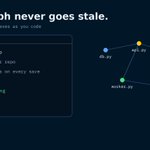
Your repo changes every day. The daemon watches it and re-indexes in the background, so the graph you ask is always the repo you have, not the one from last week.

12
The graph doesn't guess. It shows you the callers, the callees, and the line where it happens. You still decide what to change.
14
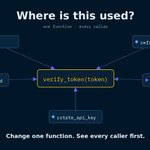
The scariest edit is the one you think is safe. One function can have five callers you never opened. Check the map before you move anything.

12
A repo you can question beats a repo you can only search. The graph knows what calls what — so 'where is this used?' gets an answer, not a pile of matches.
19
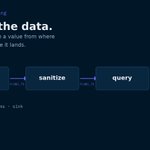
A value enters your code somewhere and lands somewhere else. The graph follows it — source, transforms, sink — so you know exactly what a change touches.

9
Editing code you don't fully understand is how bugs are born. Ask the graph first, edit with a diff preview, and see exactly what changes before it lands.

9
The answer isn't a paragraph. It's three functions, two files, and the exact lines. That's what a graph gives you that a summary can't.

7
Understand any repo with an AI-powered knowledge graph. code-graph-rag parses your code with Tree-sitter, builds a graph of functions, classes and calls — then lets you query, edit and optimize it in plain language.
1
11
4/ Dead code detection walks the call graph from your entry points and surfaces unreachable functions — with a CI-friendly failure mode. Data-flow tracing follows values from source to sink.
1