
Exploring the nexus of tech, finance, law, AI & global affairs | Decrypting hidden histories | Pioneering digital finance | Advocating for ethical health tech
USA
Joined January 2012
- Tweets3.9K
- Following876
- Followers2.5K
- Likes131K





Pinned Tweet

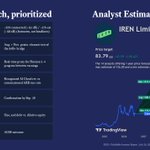
1/8: $IREN just raised its 2026 AI Cloud ARR target from $3.7B to $4B+. ~85% of it is now said to be under contract (was ~70%). Stock closed +19.57% to $40.20 on the news. Here's the falsifiable read on today's 8-K, slide by slide. 🧵⤵️

Metaman retweeted

$IREN Mackenzie UPDATE:
Thermal imaging from 10/24 shows significant heat coming from data halls 4 and 2. All 8 segments of data hall 4 are showing enough heat to suggest commissioning. With fiber optics still being tied in, however, they are most likely not billing yet. As for hall 2, 6 of 8 segments are showing heat signatures and are most likely being commissioned, yet not billing since fiber optics has not been tied in.
Lots of work has been done since 9/23 footage was taken. I believe 3-4 halls could be online and billing before year-end.
The funding-gap $IREN bear case needed customers to refuse to pay up front. Per management, they're covering roughly half the GPU bill (45-55% of GPU capex), and an A-rated facility covers most of the rest. "Can they fund it?" YES. "Can they build fast enough?" We find out at market close on November 5. Earnings.

Got it? This year, the demand for AI tokens is 34 times what it was last year while the market cap of $IREN is still at last year's prices. When will this "gap" be filled, traders?

IREN’s @danroberts0101 speaks to @ArjunKharpal about AI financing and demand on CNBC.
Watch the full interview.
Metaman retweeted

If you’re long $IREN, follow @g_duerksen. Early connection to PodTech, personal knowledge of the Roberts brothers, and clean analysis on the company’s setup and deals. Worth the follow.

From the day I met the Roberts brothers, it was clear they had a different arroach. It focused on positive and proactive community engagement. Making sure to take care of "the moms and dads".
@IREN_Ltd
Metaman retweeted

A lot of questions this week on funding, so here's how a GPU typically gets funded at $IREN.
First, the customer signs a multi-year take-or-pay contract and agrees to a prepayment. On our recent 3-year contracts, prepayments have been 45% to 55% of the associated GPU capex.
Second, financing is committed, secured by the contracted GPUs. On the Microsoft contract we secured an A-rated facility at around 6%, which together with prepayments covers 96% of GPU capex. More recently, for a non-investment grade counterparty at Mackenzie, we secured financing at 9% fixed, which together with prepayments covers more than the full cost of the GPUs.
That's the GPU side. The data centers are a separate, long-term asset base, and we own the ones our GPUs run in. Construction has been funded from cash to date, with no debt against these multi-billion dollar assets. As they come online with contracted customers, they can support financing in their own right.
The processes behind the next facilities are continuing, and new paper will cost what the market charges. With GPU paybacks of around two years on our recent 3-year contracts, a wider spread barely moves the economics.
There's more customer demand than we can build for. As we noted at our recent earnings, 2026 is largely sold out, recent 3-year contracts are at more than double the prior year's pricing, and demand for anything we can bring online in 2027 covers it several times over, with prepayments a focus in every negotiation. Conversations on 2028 capacity are already underway.
Meanwhile announced capacity keeps slipping across the industry, which is the point: signing deals isn't the bottleneck in this market, bringing GPUs online is, and that's our focus.
Metaman retweeted

On November 5, 2025 $IREN closed at an all-time high of $76.88. The next day it hit its all-time intraday high of $80.19.
It’s currently $29.80 - down 61% from its ATH. And still falling.
And here is all it has accomplished in that time. Markets are sometimes disconnected from reality.
🤖 Made with AI

Metaman retweeted

🚨 $IREN x Anthropic Leak
The Information, one of the best-sourced outlets covering the AI industry, just reported that Anthropic recently signed a cloud deal with $IREN.
For anybody who has followed management’s commentary closely over the past few weeks, this doesn’t come as much of a surprise.
First, $IREN announced a new contract with an unnamed “leading frontier AI lab” during its recent earnings call, followed by CCO Kent Draper revealing that the company in question was “1 of 2” possible customers.
While The Information didn’t disclose any specific MW amounts or terms of the deal, I believe it’s very likely that Anthropic secured the 50 MW of air-cooled B300 capacity coming online at $IREN's Childress site THIS year.
As for the economics behind the deal and where this relationship could go from here, we recently published an in-depth report for both our X and Substack subscribers covering exactly that.
I’ll link it below in the comments for anybody interested.
Wishing everybody a great rest of Sunday and a great start to the new week. Cheers!

Metaman retweeted

3. Summarizing.
So if the economics are so good, the pace of construction is predictable and solid, and GPU debt and customer prepayments are abundant and clear.
Why did $IREN not guide for a 2027 ARR?
My current take is that the company has underestimated the ability of the market to draw conclusions based on tools and data points that the company has provided.
It comes off as incredibly basic, but apparently the market needs IREN to spoon-feed it the outcome of the napkin math that you can get from multiplying the 0.5GW of IT load times the range of $20 - 25m per MW of revenue.
Behind the pretty pictures of OnlyFrans, there is a select group of people active to communicate with IR at IREN, to establish a better communication platform between the company and investors on X.
And make no mistake, there are a lot of institutional investors on X, but for the most part they like to remain anonymous.
Based on recent interactions, it's clear to me that management is aware of a few things, and for transparancy reasons I think it's important to share this with everyone here:
"Management acknowledged areas where disclosure can become more precise, particularly around operating capacity, future capacity, capex, and the relationship between capacity additions and revenue."
And further relevant to this post:
"Management agreed that IREN may continue to trade with sensitivity to interest rates and financial conditions while investors view the company predominantly through the lens of large near-term capex requirements."
Clearly the market needs better education from IREN, more precise disclosures, and not an isolated capex chart, without giving acompanied indicative ARR figures.
To be honest, IR has improved a lot in the last 6 months, and the addition of Bob Chen and Chris Sailer to the team have been incredibly valuable.
Here is my current overview of the company and associated investment thesis:
1. Execution risk is present, but delivery is underway. Seeing very frequent construction updates around the portfolio has definitely helped with predicting the outcome.
2. Financing is turning into a low-equity story, and with ABF coming into the equation, the longer this capacity shortfall prolonges, the better it is for spinning up a powerful flywheel for this.
3. The company has shown to be willing to improve their communication, and via IR, has demonstrated the ability to do better.
4. Corporate governance is a point where many X investors disagree on, and so I will not dive into that here. For now I see this as a temporary concern, but as long as the company delivers on their roadmap, I think this topic will fade into the background.
Furthermore:
- Horizon 2 will be delivered this month, I personally expect a handover to be imminent, and a subsequent acceptance shouldn't be far out.
- Horizon 3 is not far behind, I'm hoping for a completion by early November, acceptance before the end of the 3rd week of November.
- I am going to include Sweetwater 2, $CIFR barber lake, and a Crusoe data center for $META, to my coverage. If you're interested in joining, or have a question, leave a comment.
- I will not further comment on the SemiAnalysis piece. There is nothing more to say, IREN will have to figure it out with them. Needless to say, IREN should be judged based on their actual managed service contracts, and now Mirantis is on board, I expect the $NVDA contract to be a piece of cake. Just as with the construction and financing, just delivering on those managed services contracts will show who was right.
I am also very excited to have found out a couple of things about the new cooling tech that IREN is implementing in Childress, and I suspect this will further help them to become more efficient in PUE, and faster in deployment of the hardware.
John Gross is an absolute final boss, and he will do great things for IREN, mark my words.
To close it off, here is the proof that the network core building for Horizon 5 and 6 is underway, and I can also confirm that Horizon 3 has received its first batch of GPUs.
The stock is on a discount.
Non of this is financial advice.
Long $IREN

Metaman retweeted
$IREN's insane profitability
Despite $IREN trading like a turd these days, the underlying fundamentals are actually improving drastically.
One of the most underrated developments is the sharp improvement in profitability. $/MW contract terms have more than doubled since last year, while most project-level operating expenses have stayed relatively flat.
That is creating very strong operating leverage. While revenue per MW has 2.4x’d, pre-tax profit has increased by roughly 12x.
The graphic below shows this pretty well.
During $IREN's last earnings call, management revealed that recent contracts were being signed at rates of >$20m/MW.
However, at the follow-up Goldman Sachs conference, CCO Kent Draper disclosed that the company’s most recently announced contract was priced at $23m/MW.
I assume that was the “leading frontier AI lab” contract management announced during earnings, which I believe to be Anthropic.
Now, the $12m/MW pre-tax profit figure implied by that $23m/MW headline rate already accounts for financing expenses, depreciation and the direct expenses associated with the deployment, in line with the company’s broader guidance.
What it does not include are SG&A, R&D and taxes.
However, once $IREN reaches sufficient scale, I think those >50% project-level margins are a pretty solid indication of where GAAP net income margins could ultimately trend towards.
Interestingly, with current negotiations now taking place around the $25m/MW range, according to management, margins appear to be moving even higher.
Most of that additional $2m/MW should fall straight into the pre-tax project profit pile, since the underlying cost base stays largely fixed.
A major advantage $IREN has here is that it doesn’t have to pay colocation fees to rent third-party data centers, since the company develops and operates its own facilities.
With colocation pricing rising sharply, that gives $IREN another meaningful advantage over competitors that have to absorb those rental costs every time they bring new capacity online.
TLDR: Don’t get distracted by noisy price action. Keep your eyes on the fundamentals.

Metaman retweeted

$IREN
In 90 days, Mackenzie should look very different.
One site:
- 80MW of operating gross megawatts
- 70MW of operating IT megawatts
- 32,920 NVIDIA B300 GPUs (and some GB300s)
Serving customers including:
- Higgsfield
- Fal
- Figure
- Prometheus
- Perplexity
- Others
And when fully ramped, that single site will produce approximately:
- $1,029,840,000 of revenue pear year
- $257,460,000 of revenue per quarter
- $85,820,000 of revenue per month
- $2,821,4790 of revenue per day
All those numbers just slightly more than Bitcoin was producing. 🤣
Don't say I didn't warn you.

MACKENZIE UPDATE: Thermal imaging of $IREN Mackenzie site (captured 9/23) is showing a quiet signature — and that's exactly what you'd want to see right now, not a red flag.
On the FY26 earnings call, Co-CEO Dan Roberts confirmed GPUs have been racked in the first two of Mackenzie's four air-cooled data halls, with the remaining capacity targeted for commissioning by the December quarter.
Racked ≠ powered on. Until compute load actually goes live, there's no meaningful heat signature or power draw to expect — no HVAC load, no occupancy heat, no active workloads. A "cold" thermal read at this stage of buildout is a construction-phase signature, not a delay signal.
Watch for the thermal profile to shift once GPUs energize. That's the tell that Mackenzie's ramp is underway. 🔧⚡
LOTS of progress has been made!
More thorough Mackenzie footage posts and pics to come. If you want to get site updates please like, follow and turn on notifications.
Metaman retweeted

$IREN CCO sets the record straight on the SA hit piece released yesterday. @SemiAnalysis_ is the shady and scammy TMZ of AI...
Well done @McnallieM 👍
xitter.gq/McnallieM/status/21032…
🦘🕐⚡🚀🤌

ClusterMAX 3.0: The Industry Standard GPU Cloud Rating System Returns
In gory detail: reliability, performance, support, pricing
—and, of course, security—
in our most thorough analysis of GPU cloud providers globally
semianalysis.substack.com/p/…

Metaman retweeted

Great clip here from @kentpdraper CCO @IREN_Ltd going over the ratings from @SemiAnalysis_ on the @power_analys1s interview today!!! 🚀🚀🚀 $IREN
Check out the full interview here 👇👇👇
youtube.com/watch?v=W1Z_O1zl…

Great to welcome @kentpdraper, Chief Commercial Officer of @IREN_Ltd on the Power Analysis podcast to discuss highlights from their 2026 FY and provide the outlook for 2027 and 2028, plus much more!!!
➡️ youtu.be/W1Z_O1zlZlc?si=VjEk…

Metaman retweeted
$IREN
Thanks to our main girl Molly-O, we now have confirmation that IREN’s 2026 capacity is “sold out” - an upgrade from “largely sold out” on the earnings call.
I estimate that about 10MW of IT capacity remained unsold after accounting for the inferred economics from the frontier lab contract. If that capacity was contracted at $20M–$25M per IT MW annually, it would add roughly $200M–$250M to IREN’s $4B contracted ARR.
That puts my estimate for year-end 2026 contracted ARR at $4.2B–$4.25B.
Up top! 🙌
(And our main man @kentpdraper looks better and better each interview. When I grow up I wanna look just like him. 🔥)

JUST IN: $IREN CCO Kent Draper says IREN has already "sold out" their 2026 capacity
"Demands still far exceed supply. That's great for us as a provider because if we can get compute online, there will be a revenue stream."
"Even if models never improved from here, just rolling out what they can already do would take more compute than the world can build for years. The debate about how fast AI should be allowed to improve is a fair one to have. It's about future generations of models." $IREN


Metaman retweeted

IREN is partnering with NVIDIA to accelerate deployment of large-scale AI factories by combining NVIDIA’s DSX AI factory architecture with IREN’s expertise across power, land, data centers, GPU deployment and infrastructure operations.

NEWS: NVIDIA and Australia’s AI infrastructure ecosystem are expanding land, power and shell capacity to host AI factories, supporting the nation’s growing demand for AI compute.
Built on NVIDIA DSX, these full-stack AI factories provide high-performance AI compute for Australian startups, universities, researchers, enterprises, developers and AI-native companies.
Read the release ⬇️ nvidianews.nvidia.com/news/n…

2 GW; ERCOT Batch 0 Base Load. This is as good as it gets. The best case scenario is CONFIRMED for $IREN.
And a bonus: "Additional large-scale projects within IREN’s broader development pipeline have also been included in Batch Zero."
IREN's 2GW Sweetwater Hub (Sweetwater 1 and Sweetwater 2) has been included in ERCOT's Batch Zero process as Base Load. Sweetwater 1 (1,400MW) and Sweetwater 2 (600MW) form part of our >5GW global data center development portfolio.
At Sweetwater 1, construction of 300MW of data center capacity continues, with delivery targeted for Q4 2027.
Read more: iren.gcs-web.com/static-file…

$IREN looking sharp on @realbedford kits.

Big love to the Bitcoiner putting our shirt customisation to good use…
Get yours - realbedford.com/shop/categor…

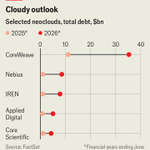
Making compute a financial derivative will dampen the volatility The Economist fears. A regulated compute derivatives market—being kicked off by the CFTC Request for Comment—is what $IREN and $CIFR et al. need to defuse the "ticking debt bomb." This will provide cheaper, non-recourse project financing. Standardized forward compute curves allow lenders to underwrite capacity like traditional infrastructure. We are already seeing this shift in real-time: IREN recently secured a $2.4 billion GPU financing facility led by Blue Owl and PIMCO to fund its AI shift, specifically drawing on digital infrastructure underwriting rather than traditional corporate debt.Hedging the Demand Collapse: The Economist's biggest fear is that AI adoption stalls. The ability to short compute futures allows operators to synthetically lease their uncontracted capacity. This effectively neutralizes the risk of a demand rebalance; even if spot prices for GPU rentals plummet, their hedged merchant capacity continues to generate predictable revenue. By smoothing out revenue and removing the threat of chaotic spot-market pricing, the structural volatility of the underlying equities will naturally compress, forcing a re-rating. This predictability is what ultimately transforms companies like IREN from speculative, high-beta momentum trades into stable digital utilities. To bridge the gap until liquid derivative markets mature, IREN is doing great relying on pure physical contracting to de-risk its balance sheet. They recently reported that their 2026 compute capacity is largely sold out, and they are currently in late-stage talks for 2027.

Compute derivatives are on deck as a catalyst for data-center owners and operators.
The CFTC is seeking comments on the Listing of Compute Derivatives Contracts (link below). The CFTC’s framework for compute derivatives is a catalyst for vertically integrated AI infrastructure plays like Iris Energy ($IREN) and Cipher Digital ($CIFR). It seems safe to predict that the "financialization" of compute will directly alter their capital structures, risk profiles, and equity valuations for several reasons.
1. Capital Efficiency and Debt Restructuring
Building gigawatt-scale data centers requires lots of upfront capital. CIFR is currently executing on a 5.3 GW pipeline backed by ~$11.4B in contracted hyperscaler rent, while IREN is expanding its own 5 GW pipeline and managing over $3.6B in GPU financing.
Currently, debt financing relies heavily on bespoke, bilateral agreements (such as CIFR's recent Google-backstopped lease). A regulated compute futures market provides a transparent forward curve, allowing lenders to accurately underwrite the value of uncontracted capacity and hardware. This makes AI compute as a collateralized asset class, potentially compressing their cost of capital and enabling cheaper, non-recourse project financing.
2. Hedging Merchant Capacity
While both firms prioritize long-term, fixed-price contracts (CIFR utilizing 10- to 15-year leases, IREN averaging ~4-year cloud terms), a regulated futures market allows them to safely optimize uncontracted "merchant" capacity. Just as traditional energy producers hedge forward production, IREN and CIFR could dynamically short compute futures to lock in revenue for unleased MW capacity or GPU hours, aggressively insulating their balance sheets from cyclical downturns in AI demand.
3. Structural Volatility Compression
For systematic options strategies, the introduction of compute hedging is significant. By utilizing futures to smooth out revenue volatility, these companies fundamentally de-risk cash flows. As forward earnings become highly predictable, the implied volatility of their underlying equities is likely to compress. Sorry, options traders!
Although this structural IV crush may gradually lower the raw premium yields on short put and covered call strategies, it also minimizes the underlying tail-risk and rapid gamma expansion associated with sudden spot-market demand shocks. Which should protect long, bullish investors (like me) who are currently at the mercy of master market makers, it seems.
4. Transparent Valuation Re-rating
Public markets currently struggle to value the transition from Bitcoin mining to AI cloud services, often mistakenly applying legacy mining multiples to pure-play HPC infrastructure. Standardized compute spot and futures prices will provide equity analysts with a verifiable benchmark. This transparency allows the market to accurately model IREN's $4B ARR target and CIFR's long-term NOI margins, accelerating their re-rating as traditional digital infrastructure or utility-grade assets.
Ultimately, as compute pricing becomes fully transparent and standardized, this should accelerate their transition from high-beta speculative plays into stable, utility-like assets. That's exactly what I'm investing in now!
