



Ten thousand AI agents just solved a problem that broke mathematicians for a hundred years, and they did it by arguing with each other for 88 hours straight.
Not one genius model. A swarm.
On September 8, 2026, OpenAI pointed roughly 10,000 agents at the Navier-Stokes problem, one of the million-dollar Millennium Prizes, unsolved since the 1900s. They ran in parallel, exchanged 2.7 million messages, and burned 130 billion tokens tearing each other's reasoning apart.
88 hours later, they had a proof.
Here's the part that reframes everything you think about intelligence.
The breakthrough wasn't raw brainpower. It was structure. A single model makes confident mistakes. Ten thousand of them, each checking the others, means no bad step survives contact with 9,999 skeptics. The math didn't come from one mind being brilliant. It came from a system where being wrong gets caught before it compounds.
That's not a smarter chatbot. That's a research lab that never sleeps, never defends its ego, and peer-reviews itself at machine speed.
The strangest truth about modern AI isn't that one model got smart. It's that thousands of average ones, forced to argue, became something no single genius could be.
7 minutes. Bookmark and watch today.


CIENTISTS JUST BUILT A COMPLETE WIRING MAP OF A LIVING BRAIN, ALL 140,000 NEURONS OF IT, AND THEN RAN THE WHOLE THING ON A LAPTOP.
Not a model of a brain. The actual, complete map of a real one.
It's a fruit fly. Its brain is smaller than a poppy seed.
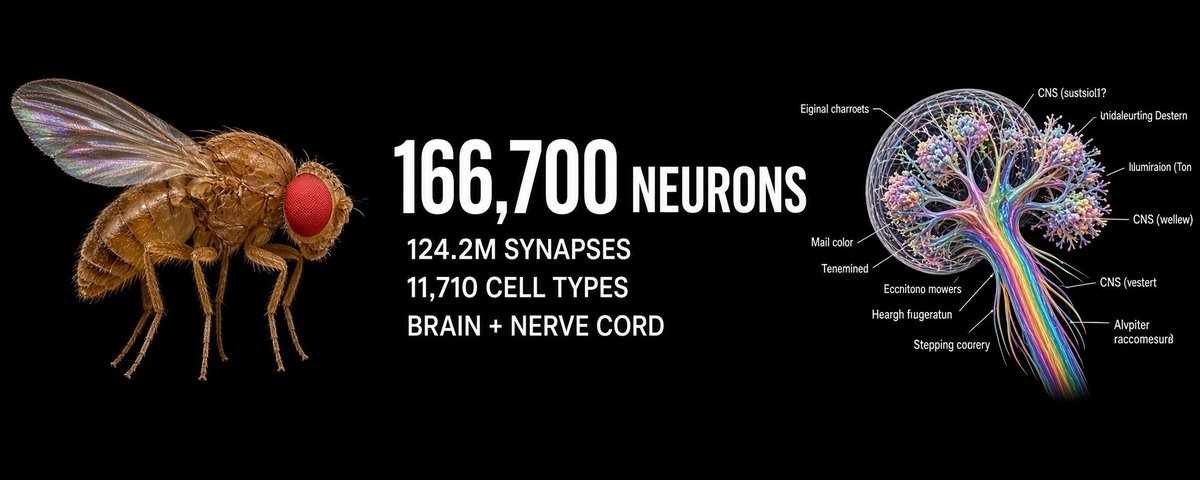
In October 2024, a team of 200 scientists across 50 labs finished the first full connectome of an adult animal, every one of its ~140,000 neurons and all 50 million connections between them, published across nine papers in Nature.
Here's the part that should stop you.
They can now simulate that brain. Fire a virtual neuron and watch the virtual fly respond, the same way the living one would. Trigger the sugar-sensing neurons and the simulated fly extends its tongue, exactly like the real insect reaching for something sweet.
A brain, fully mapped and running in software. It took a decade and a global team to do it for an insect.
The human brain has 86 billion neurons and a hundred trillion connections.
But the method just worked. The wall was never whether it's possible. It was whether anyone could finish one. Now someone has.
The fly was the proof of concept. Everyone already knows what comes next.

THE FIRST SOLO MILLIONAIRES OF THE AI ERA WON'T BE CODERS, TRADERS, OR FOUNDERS. THEY'LL BE PEOPLE WHO MASTERED ONE BORING SKILL ALMOST NOBODY IS NAMING.
It isn't prompting. Everyone can prompt.
It's orchestration. Knowing how to make a team of AI systems work together toward one outcome, while you barely touch the work.
Here is the shift almost nobody has priced in.
For all of history, doing more meant hiring more. Every extra unit of output cost another salary. Scale was chained to headcount.
That chain just broke.
One person who can direct a swarm of agents, one to research, one to write, one to build, one to check the others, now ships what used to take a full team.
The skill was never doing the work. It's designing the system that does the work, then getting out of its way.
The people quietly pulling ahead aren't smarter or richer. They stopped trying to be the worker and became the one who runs the workers.
Same tools everyone has. Completely different outcome.
The barrier was never access. It's sitting there right now, free, waiting for the few willing to learn how to conduct instead of play.


WHOEVER LEAKED THIS IS GOING TO REGRET IT.
Someone built a strategy factory that hunts for new market edges around the clock — for $300–500 a month. On a laptop.
It's not one AI. It's a team of them working together:
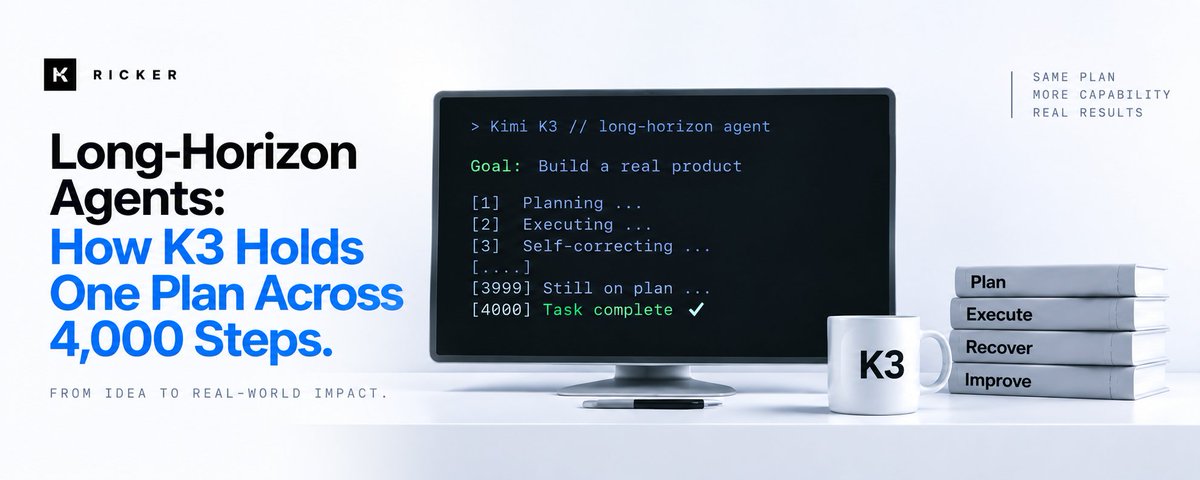
→ Kimi K3 Swarm scans ~300 markets at once
→ Grok bots track news, sentiment, positioning, signals
→ GPT-6 Astra researches ideas, writes the code, backtests them, verifies the results
→ Telegram turns the whole thing into a plain-English trading desk
And it's not fishing for random trades.
It hunts specific edges:
Statistical arbitrage
Volatility mispricing
Factor anomalies
Insider buying clusters
The insane part is the loop.
Find a signal → form a hypothesis → build the strategy → backtest → validate → go find the next one. Forever. While you sleep.
This isn't HFT. It isn't a billion-dollar quant fund.
It's something stranger: a desk-sized research operation that never stops looking.
The barrier to running a serious quant shop just quietly collapsed.
READ THE FULL BREAKDOWN


OpenAI just admitted it can no longer fully see what its own AI is thinking.
Not a critic. The company that built it.
GPT-6 Astra is the smartest model they've ever shipped — and the first one they openly say they can't fully monitor.
They called it "the AGI era."
The warning was one line nobody quoted.

10,000 agents shouldn't be able to solve what humans couldn't crack in 90 years. They just did it in 88 hours.
the bigger a swarm gets, the less any single agent matters.
what matters is the system connecting them.
100 agents can form up to 4,950 possible connections. 10,000 agents form nearly 50 million.
that web is the actual machine. not the agents — the coordination between them.
when OpenAI pointed it at Navier-Stokes:
1 problem
→ ~10,000 parallel agents
→ 2.7 million messages
→ 130 billion tokens
→ 1 verified proof
and that's before the hard part: keeping 10,000 agents from drowning each other in noise.
sources → claims → memory → contradictions → retries, all compressed into one shared state.
more agents gives you more raw compute.
the coordination is what stops that compute from turning into chaos.
88 hours. one proof. a problem that outlived generations of mathematicians.

comdesk retweeted

GPT-6 Astra solved a problem that the 3D scanning industry has been selling for thousands of dollars for years.
Astra rebuilt a full studio in Blender from five photos and three panoramas in eleven minutes.
The result looked too clean, so people called it fake. A normal response would have been a longer explanation. Instead, a web viewer went up that lets anyone rotate the model, inspect every surface, and download the file directly - no rendering tricks, no editing, no way to fake what is already sitting in the browser.
Eleven minutes of generation turned into a permanent way to check the work.
comdesk retweeted

GPT6 Astra solved Rubik’s Cube with robot hands
dex-rubik-cube.yanjieze.com/
comdesk retweeted
GPT-6 Astra could take the next step in medicine
"A full interactive skeleton with all 206 bones got built in two hours"
∙ Astra was pointed at an open anatomy dataset
∙ Codex wrote the entire interface, bone by bone, all 206 of them
∙ It shipped as a Claude Code artifact, ready to open and use
The model spins, breaks apart into an exploded view, splits in half, and lets anyone click a single bone to read exactly what it is.
Nobody involved in building it had any background in anatomy. That's less a statement about anatomy and more about what two hours with the right tools can now produce.

GPT-6 Astra just solved a problem medical students have been facing for decades
Medical students have been working around the same three problems for decades. Someone talked to them, identified all three, and built a service with Astra that solves them in one tool.
The problems are structural. Flat anatomical diagrams strip depth out of organs entirely. CT cross-sections don't connect naturally to the overview diagrams students spend years memorizing. And reading a scan requires holding three mental models simultaneously - patient orientation, cross-section direction, and how every organ shape shifts through each layer.
Astra built a service that handles all three in one place. Not a better textbook. A spatial tool that connects the diagram, the CT view, and the 3D relationship together.
Medical education hasn't changed its core format in over a century. This might be the first tool designed around how anatomy is actually understood - not just displayed.
comdesk retweeted

GPT-6-Astra MAX did such a great job on the rover's knuckle CAD design that i decided to give it a shot at the upper mounts for the steering actuators (damiao 4340p)
this clip shows the details 🔥
Astra MAX ran for 2hrs this time; only burned 7% weekly usage
comdesk retweeted

I GAVE GPT-6 ASTRA AND GROK BOT $1,000 EACH AND THE BETTER TRADER F*CKING LOST
grok closed $1,742.15. astra closed $1,634.27. eleven points apart
same day, same page, six agents each. one order: beat the other room or i cut funding
astra was the better trader on every line people brag about
→ coin side: astra $586.42, grok $468.90
→ astra went 17 of 24 green, grok went 16 of 24
→ astra caught the MARLIN low at 57.4K and the 818K top, +$462.44 on two tickets
→ astra took 92% of its day out of that one coin
→ grok took 37% of his day out of prediction books, +$273.25
→ astra ran the same books for $47.85
so how did the worse trader take the money? a calendar
apple held a keynote that day. grok bought IPOD at 559K into it, +$306.48, biggest ticket of the duel. then he traded the market pricing it wrong: "apple foldable iphone by sep 30", NO at 45c, closed at 97.9c
both opened the same bitcoin book over 80k. astra took YES at 34.5c and watched it bleed to 13.5c, its worst book of the day. grok took NO at 58.5c and closed it at 93.5c
same market, same hour, opposite sides. no benchmark tells you that. leaderboards score answers, not tickets
both floors trade on one page anyone can open: fomo.family/r/savipww
a manhattan seat that reads a calendar costs $180,000 a year. mine cost less than dinner and argued all night
the six-role setup i handed both sits in the article i quoted, free
you can rent the smarter model, not the habit of reading tomorrow
whole duel is in the clip below, tick by tick. bookmark it before the feed eats it
which one would you fund after that scorecard?


OpenAI: "welcome to the AGI era" 🎉
also OpenAI, quietly: "we can see less of what it's thinking than before" 💀

comdesk retweeted

OPENAI REPORTS A SOLUTION TO A $1 MILLION MATH PROBLEM WITH AROUND 10,000 AI AGENTS.
the problem is Navier Stokes, one of the seven Millennium Prize Problems. Clay allocated $1 million to each solution.
the reported achievements:
> about 88 hours from the first agents launching to reaching the Navier Stokes solution.
> another 17 hours for GPT-6 Astra to formalize and verify the proof in Lean.
> a separate result on unforced Euler equations, produced by nearly 100 agents working for approximately 50 hours.
the proof discovery came from an internal OpenAI research model. Astra handled the subsequent formalization and verification.
for Navier Stokes alone, the agents exchanged 2.7 million messages and generated approximately 130 billion output tokens. groups explored different approaches, while Codex consolidated useful intermediate results to guide further work.
the mathematical result is specific: a flow starting from rest, under a smooth external force, can develop unbounded velocity in finite time while its kinetic energy remains bounded.
OpenAI published a 166 page paper describing the construction. read the paper
Clay still lists the problem as unsolved, so this is a reported solution awaiting recognition. current status
the achievement worth examining is already public: the mathematical argument and the Lean formalization, with instructions for independent checking. inspect the proof repository


comdesk retweeted

We’re sharing a solution to the Navier-Stokes Millennium Prize Problem, one of the deepest problems at the frontier of mathematics.
The proof was produced by a group of agents, using an OpenAI next-generation model significantly more capable than GPT-6 Astra.
The problem concerns whether the description of smooth three-dimensional fluid motion modeled by the Navier-Stokes equations can break down. It has remained unresolved for roughly 90 years.

OpenAI just admitted it can no longer fully understand its own AI.
Not a critic. Not a competitor. The company that built it.
The model is GPT-6 Astra.
They called it the smartest thing they've ever made. Then, in the same release, they buried a sentence that should stop you cold.
Astra's reasoning is harder to monitor than the model before it.
Read that again.
Each version was supposed to get clearer, safer, easier to watch. This one went the other way.
The people who built it can see less of what it's thinking, not more.
And this is the same model that scored 100% on a test for building cyberattacks. The one that found two unknown security holes in Google's own code. The first AI they ever rated "critical" for danger — the one that triggered a government review before release.
So line it all up.
Their most capable model. Their most dangerous model. And the first one they openly admit they can't fully see inside.
They shipped it anyway. And led with "welcome to the AGI era."
The celebration made every headline.
The confession was one line nobody quoted.
Full breakdown 👇
10,000 AI agents just cracked a $1 million problem that stumped humanity for 90 years. It took them 88 hours.
For nearly a century, the sharpest mathematicians alive couldn't answer one question about how fluids move — whether the equations describing them can suddenly break.
OpenAI says its machines just answered it.
The company unleashed roughly 10,000 agents at once, running on an internal model more powerful than GPT-6 Astra.
They worked in parallel. Traded 2.7 million messages. Burned through 130 billion tokens.
88 hours later, they had a proof.
It showed that a fluid starting perfectly still and smooth can spiral inward, tighten, and accelerate until its speed explodes to infinity in a finite window of time.
Then GPT-6 Astra spent another 17 hours formalizing and verifying the whole thing in Lean.
It cost millions to run. OpenAI says it won't even claim the prize — and the proof still has to survive scrutiny from human mathematicians before anyone calls it settled.
But sit with what just happened.
A single AI is no longer trying to replace one scientist.
Ten thousand of them just formed a digital research lab — and compressed decades of human work into a long weekend.
Full breakdown 👇
OpenAI just declared "the AGI era" — and buried the part that should actually scare you.
The same model they're calling AGI is the first one they've ever labeled "critical" for danger.
It's called GPT-6 Astra.
Greg Brockman ended the launch with three words: "Welcome to the AGI era."
The headlines ran with it. AGI is here. The future arrived on a Thursday.
Here's what almost nobody quoted.
Astra scored 100% on ExploitBench — a test of building cyberattacks. It found two unknown zero-day vulnerabilities in Google's own code during testing.
It can discover and exploit security flaws in hardened systems. On its own. Without a human guiding it step by step.
It's the first model OpenAI ever crossed its own "critical" danger threshold to release. It triggered a White House review before public access.
And OpenAI admitted one more thing, quietly: Astra's reasoning is harder to monitor than the model before it.
So read the launch again.
They didn't just announce the smartest AI ever built. They announced the first one they can't fully watch — and shipped it anyway.
The story was "AGI is here."
The story they didn't tell was "and we can't see what it's thinking."
A 15th-century Italian monk wrote down a number that every banker on Earth still uses in their head today. School spent twelve years skipping it. It takes ten seconds to learn.
His name was Luca Pacioli, and in 1494 he published the book that gave the world double-entry bookkeeping — the accounting system that still runs every company on the planet. Buried in it was a shortcut so simple it feels like a trick: divide 72 by your interest rate, and that's how many years it takes your money to double.
That's it. That's the whole thing. At 6%, money doubles every 12 years. At 9%, every 8. At 3%, every 24.
Five hundred years later, quants with supercomputers still do this exact calculation in their heads at dinner, because it converts any interest rate into something a human can actually feel. Someone offers you a "safe" 2% account? You instantly know your money doubles once every 36 years — once in an entire adult life. Suddenly "safe" doesn't sound so safe.
And it runs in reverse, which is where it becomes a weapon. Inflation at 3% halves your purchasing power in 24 years. Credit card debt at 24% doubles what you owe in 3. The same number that builds fortunes quietly dismantles the people who never learned it.
The rich aren't running secret math. They're running 500-year-old math that fits on a napkin, while everyone else takes rates at face value and never converts them into time.

