

@compounded_mind
Account based inEurope
About this account
- Account based in
- Europe
- Connected via
- Europe App Store
Account-level information from X, not a live location or the device used for a specific post.
AI news, research and bad takes. accelerationist. professional shitposter in training per aspera ad astra
Joined March 2024
- Tweets419
- Following733
- Followers69
- Likes1.9K



Mino retweeted

This summer, we invited METR and Redwood Research to pilot an embedded evaluation of our internal monitoring system, providing deep access to our infrastructure over three weeks.
Their findings helped strengthen safeguards as we expanded the system and will help shape future research collaborations with METR and other third party evaluators.

Mino retweeted

SCOOP: Major U.S. banks are detecting unauthorized third-party AI agents inside customer accounts, including some attempting to take actions that appear to be independent of user instructions, sources told Axios.
The findings have alarmed banking executives, who are racing to restrict access to their systems as AI moves at a velocity faster than financial institutions can respond, multiple industry and bank executives told Axios.
Several banks are now preparing for worst-case and even “day after” scenarios, including how to rapidly secure or restore customer accounts if things go wrong, the people said.
Several bank executives told Axios they're struggling to distinguish between human users and AI agents. One executive said banks also struggle to determine whether agents are authorized by customers or potentially operating without their permission, more akin to rogue agent behavior.
Read my latest for Axios here: axios.com/2026/10/22/ai-agen…

> be website owner
> new vulnerability hasn’t been announced yet
> already getting attacked
> vulnerability gets announced
> everyone on the internet starts exploiting it
> millions of attempts
> “you should have patched sooner”
> patched WHAT

Some stats on #php2shell. In the 10 hours before it was publicly announced, across the @Cloudflare network we saw thousands of attempts to exploit it. That jumped to tens of thousands in the 45 minutes post announcement, hundreds of thousands within 2 hours, and millions now.
Mino retweeted

An update from Brewster Kahle on today's outage.

ALT Internet Archive ops staff were heroes last night. PHP vulnerability announced, soon saw attacks, isolated the vulnerability, used Claude to make fixes for our older php versions, used local models to run simulated attacks, deployed. reinforced WAF and other guards. Offline briefly, Back on new versions and running! Given the severity, there are heroes in many many orgs from last night. Could have been no lights, no traffic signals, real problems. Heroes. Thank you all.

Mino retweeted

🔐 Node.js security updates are now available!
New releases for Node.js 22.x, 24.x & 26.x address multiple vulnerabilities, including high-severity issues.
Review the details and update your systems to stay secure.
🔗 nodejs.org/en/blog/vulnerabi…
#NodeJS #Security

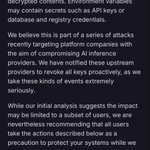
apparently AI inference providers have become valuable enough targets that hackers are now going after the platforms where their customers store API keys


An urgent notice from the Railway team
blog.railway.com/p/security-…


Anthropic just announced Claude Duet, which looks like its answer to Grok Bot and OpenAI’s dots
powered by Opus 5.5, it carries over your existing memory, skills and connected apps
currently in research preview, with a US waitlist open to Pro and Max subscribers

Anthropic now has a former Fed chair and a physicist who helped discover the accelerating expansion of the universe on a trust that can appoint most of its board

Dr. Christopher Stubbs is joining our Long-Term Benefit Trust. Chris is an experimental physicist and a former Dean of Science at Harvard University. He has also advised the US government on national security and arms control.
Read more: anthropic.com/news/christoph…

OpenAI and Scripps Research used thousands of GPT-Rosalind agents to study data from millions of mouse brain cells in 32 minutes
the agents found new leads for studying neurodegeneration
experts preferred their reports to single-agent reports 75% of the time

GPT-Rosalind surfaced a new lead for drug discovery: could restoring cholesterol transport protect neurons from degeneration?
DCTN1 is a gene linked to Perry syndrome, a rare neurodegenerative disorder. In mouse-brain data, disrupting it increased expression of genes involved in making cholesterol. GPT-Rosalind suggested a possible explanation: cholesterol may not be reaching where neurons need it.
That gives scientists a specific mechanism to test and, if confirmed, a direction for developing new treatments for neurodegenerative disorders.
With @perturbai_tx and @scrippsresearch, a team of thousands of GPT-Rosalind agents worked in parallel, connecting gene-expression results from millions of mouse brain cells with scientific literature in just 32 minutes. We’re now expanding this collaboration to identify new drug targets.
openai.com/index/scaling-ai-…

Mino retweeted

The PHP project has released fixes for 2 critical vulnerabilities affecting servers that host PHP applications. Site owners and technical teams should confirm their hosting provider’s update plan and update PHP immediately. Versions before PHP 8.2 no longer receive security updates. These issues are not specific to WordPress, and no WordPress update is required. wp.me/pZhYe-5Gb


OpenAI just revealed that GPT-5.6 Sol helped discover a critical vulnerability in PHP, which powers much of the internet.
they also casually mention they’ve already found several other major vulnerabilities they’re still working to fix.
and this was with 5.6 Sol. not even their latest public models, let alone whatever they’re running internally.
imagine what they’re finding now
OpenAI models helped researchers—operating as part of our Patch the Planet initiative—discover critical security flaws in PHP, an open-source programming language used to run an estimated 70% of websites.
Over the past two months, we led a coalition of maintainers, researchers, and security providers to prepare fixes and protections ahead of disclosure. This duration was necessary because the fix was quite intricate and required a major change to the PHP engine. Every site using PHP can now safely upgrade their version to stay secure, in addition to applying mitigations from various security vendors.
Due to the severity of these flaws and PHP’s widespread use, we consider this bug to be one of the most impactful vulnerabilities in recent memory. It also marks a new phase, where AI can find security bugs with internet-scale impact.
This is an example of the Defender’s Window in action: to our knowledge, frontier AI was able to find this vulnerability ahead of attackers, giving defenders time to prepare.
openai.com/index/coordinated…

Readers added context they thought people might want to know
Wiz Research wasn't the first one to discover the exploit. An independent researcher first discovered it: x.com/calif_io/statu…
Anthropic had Mythos-class models back in February, but didn’t make them generally available until June
Dario says they restricted access to a small group of cyberdefense partners while working on safeguards, even though it probably cost them a significant part of a several-month model lead
he also says Anthropic has already detected and blocked potential attempts to use its models for bioweapons
their biological safeguards are so restrictive that legitimate researchers get blocked, and competitors are apparently using their more permissive bio capabilities as a selling point against Claude
so they’re actually losing business in an area where they want to attract more scientists, because relaxing those restrictions could enable genuinely dangerous uses of the models
another interesting detail is that Dario says distillation isn’t a major commercial threat to Anthropic
they’re spending significant resources fighting it anyway because of national security concerns
they’ve also restricted AI services to PRC-controlled companies, including those operating through third countries, and continue pushing for chip export controls despite the problems this creates with industry partners

Thank you for this, @_NathanCalvin. I appreciate and am a fan of the investigative work you’ve done on behalf of AI safety and believe your comments are coming from a constructive, honest place, and that it benefits the public to have people whose job is to scrutinize the actions of frontier AI companies. I think something would be wrong if companies of the size of Anthropic didn’t get harshly criticized basically every day; strong antibodies against corporate power are a healthy feature of a free society, and especially so when issues of the gravity of the one we’re facing are at play. I also do agree that some of the examples you cite were mistakes by Anthropic.
That said, I disagree with the thrust of your post. At the core, a good fraction of the things you criticize are consequences of Anthropic’s basic theory of change that we have held for many years. Our strategy has always been what I’ve called the “race to the top” — by showing how it’s possible to build the technology responsibly, we can raise the bar for the entire industry. The forces that drive the race to the top are hugely more effective if the company practicing them is at the frontier; that’s one lesson I’ve learned repeatedly. And looking at that strategy as a whole, I’m proud of our track record and stand by it.
I believe that if we take a list of things that Anthropic did in the past year that were pro-safety and commercially costly to us, they far outweigh the list you’ve made, while at the same time I also disagree with some of the items on your list. Here are some things Anthropic has done, in the same period you’ve cited (the last year), which were very costly to us commercially while having strong safety benefits:
1. We played a key role in SB53 (and other state laws), at a time when doing so was politically perilous to the company and AI regulation was very unpopular. We in fact argued for a stronger version of SB53 than was ultimately passed; there were a lot of stakeholders and we were not the limiting factor in the strength of the bill that was passed.
2. We have very strong biological safeguards on our models, because we’ve seen concerning results in bio uplift trials and even seen and blocked potential attempts to misuse our models for bioweapons (as seen in our threat intelligence report from a few weeks ago). This is a very serious threat that we want to have zero tolerance for. But having very low false negatives means having significant false positives (despite months of effort on our part to improve the classifiers), enough so that biologists joke about how restrictive our classifiers are, and competitors sometimes sell against us by touting their more permissive bio capabilities. This has been very painful to us in an area where we care a lot about supporting an ecosystem of Claude users (biomedical science; and it is particularly frustrating to me as a biologist), but it’s the right thing to do and we intend to keep doing it.
3. Similarly, we first had Mythos-class models in February but didn’t make them generally available until June (when we had stronger cyber safeguards in place). We only offered them to a limited set of partners in order to focus on cyberdefense. It would have been much more economically rational to simply release the model to everyone. We likely sacrificed a significant chunk of a several-month model lead. But because of this, many companies secured their cyber infrastructure before the deluge of widely available cyber-capable models. Of course there are ways it could have gone better or been run better, but this was what we were aiming to do.
4. I advocated forcefully and publicly, in my essay Policy on the AI Exponential in June of this year, for the government to have the power to block model releases. Back then this was still outside or maybe on the edge of the Overton window, though I understand the window has moved since then. We were attacked intensely for this.
5. I don’t want to re-ignite conflict, but the events of February 2026 are a strong example. It is clear that our public stance could have seriously damaged the company’s future.
6. We’ve continued to advocate for export controls on chips and chipmaking equipment to China, because we think it allows democracies to negotiate from a position of strength on AI safety agreements. We’ve done this despite problems it’s created for us with industry partners who hold very different views and on whom we are very dependent.
7. As far as I’m aware we were the first, and still only, frontier company to restrict the sale of AI services to PRC-controlled companies, including those operating through third countries (otherwise a major loophole). We’ve therefore forfeited significant short-term business to prevent fueling AI platforms and applications that would help the CCP’s military and intelligence services. We are also cracking down on distillation; generally, distillation is not a major threat to us commercially, but like chip exports it has concerning national security and safety implications, so we expend significant energy and company resources to address it.
8. As you mentioned, we’ve put out a lot of reports, announcements, long model cards, public advocacy, etc, all trying to inform the public about the risks of AI. These involve a level of detail and effort that would be implausible for a purely profit-maximizing company.
9. Just this week, we announced we were putting 5% (and possibly more over time) of the company into a public benefit fund.
All of these decisions came with very substantial costs to us. To be fair, those that involved holding back or restricting access to frontier capabilities also had a broader cost — for example, the public might otherwise have benefitted from faster progress in biology, so I am not saying that our decisions were without tradeoffs — but they were not driven by profit-seeking.
For each decision, you can come up with ulterior motives that could have driven us — I think it is a general truth that any decision, on any topic, can always be portrayed as a nefarious scheme. But most of those end up being pretty farfetched or don’t fully make sense if you actually examine them closely. For example, it is deeply implausible that it would be a shrewd business move to block a large swath of research biology in order to do the work ourselves and compete with our customers; we expect the benefit to the ecosystem to greatly exceed the work Anthropic does itself, and for the two to complement each other. It is not in Anthropic’s interest to be perceived as unfriendly to biologists. Our Life Sciences Verification Program, which gives vetted biology professionals access to our models, also refutes this idea.
Of course, a different set of people will see this and make a different criticism: that Anthropic shouldn't be making decisions about who gets access to what in the first place. I agree, in the sense that ideally the government would be making these decisions, and that’s why we advocate for regulation. But for now we are forced to make them, and enabling bioterrorism isn’t a better option.
I think that even if I conceded every item in your list, I would happily hold up mine next to it; I don’t think it’s a close call. That is of course partly subjective and different things are important to different people. Maybe one way you could object is that several of the items above relate to AI misuse and not loss-of-control; if you think the latter is much more important than the former, that might change your calculus. But this is not Anthropic’s view — we view both as serious issues. You can also disagree with our decisions, as many have, but they are consistent.
But I also disagree with at least some of your list. Several items don’t represent a deviation from Anthropic’s strategy or values at all, once we postulate the “race to the top” strategy that requires being a frontier AI company. Your items 1-4 are all simply examples of what it means to compete at the frontier, and we stand by them, both in the sense that they are transparently ordinary things to do as part of that strategy, and that we stand by the strategy as a whole.
To be fair, there are important questions worth confronting (and that we are confronting) about what to do when the AI-driven acceleration gets fast enough that it is hard for safety to keep up. We are nearing that point and that’s what’s driving some of our thinking about “pacing.” But 1-4 are actions taken before that point and should be perfectly expected based on Anthropic’s strategy as a company. Of course it is possible to disagree with that strategy, but that’s a more fundamental disagreement that you could have had any time over the last few years.
I agree we could have handled your items 7, 8, and 9 better. All fall into the category of “rhetoric or policy communication that wasn’t carefully written or resulting from fast-changing circumstances not propagating from one team to another fast enough.” This kind of thing happens a lot in large organizations (Anthropic is over 5,000 people), and doesn’t even necessarily represent a failure or mistake of any single person. I am of course the CEO, and I take responsibility. The volume of communication from Anthropic is enormous and if these are the worst examples, I think we’re frankly doing pretty well, though I will continue to work hard to make sure we do even better.
Your 5th item (the change to our RSP) is the most substantive item, and people can debate this, but I think that the old, more rigid RSP created a lot of situations where we were technically required to do something that required a lot of effort but in retrospect wasn’t very important for safety, as well as not covering some of the most important things. Our current RSP’s focus on transparency brought things like risk reports and roadmaps, and its emphasis on independent external review laid the groundwork for even more intensive embedded evaluation, all of which I think have been valuable in driving a race to the top. In the original announcement in September 2023, we described the RSP as an “early iteration that we [would] build on” and said that “rapid iteration…will almost certainly be necessary.” I understand that changing plans is always a move that creates justifiable scrutiny — I just don’t think we ever represented that we wouldn’t do so.
Relating to your 6th item (having an FCF in addition to our RSP), I know our intent is to meet the letter and spirit of our regulatory obligations (via our FCF) while also remaining able to experiment with more novel approaches to risk management that go beyond what the law currently requires (via our RSP). I promise to look into it further, as it’s a complex issue and it is possible we are not weighing the considerations in the right way.
Overall, although Anthropic has made plenty of mistakes as an organization — including some of the items on your list — I feel that we have repeatedly taken serious and substantive actions counter to our bottom line and that there is a significant negativity bias distorting assessments like the one you are making above. We’ll always try to do better but, again, I am extremely proud of our track record and stand by it. I will have more to say soon about how we are going to further live our values in this moment of rapid change.
a new Gemini checkpoint, reportedly Carbon, might already be testing on Arena.
Argon launched just over a week ago and Google is already working on its next iteration


the OpenAI engineer from Saudi Arabia who was accused of planting a listening device in an executive conference room was in frequent contact with a member of the Saudi royal family, according to new court filings.
the royal was reportedly trying to recruit him for a Saudi AI initiative, but the engineer said he wouldn’t leave OpenAI until his stock vested.
he was earning $385k a year with a $2.2M equity grant.
the Saudi government also offered to guarantee his $1M bail, but the judge denied his release over concerns that he could flee the country.


Citrini Research worked with Anthropic to use an internal Claude model to design entirely new proteins targeting five scorpion neurotoxins.
in 64 hours, with four follow-up prompts, Claude used 12 protein-design tools, generated 318,484 designs, evaluated 553,052 protein-toxin pairs, and selected 180 candidates for lab testing.
the team added 31 more designs with Claude’s help. 17 of the 211 tested designs met the study’s binding criteria.
two of the strongest binders had single-digit nanomolar affinity and competed with an antibody already shown to neutralize the toxin in mice.
they haven’t demonstrated toxin neutralization by Claude’s proteins yet.
Claude chose the target structures and binding hotspots, decided how to use the design tools, sent sequences for synthesis, analyzed experimental results, generated figures, and drafted the technical report.
the first author of the paper is literally Claude Science


New on our Science Blog: designing protein binders against scorpion neurotoxins.
Scorpions sting about 1.2m people every year, and antivenoms are often costly or in short supply. Claude has made an early step toward finding new treatments.
anthropic.com/research/claud…
