



Cornelius Braun retweeted

We’re introducing ToyBlocks, an open simulated tabletop for controlled experiments in robot learning.
It enables robotics researchers to experimentally control training data & models, run targeted evals, & trace failures to their causes. 🧵
github.com/allenai/ToyBlocks
Cornelius Braun retweeted

Sharing what I spent the last year working on before starting my PhD. Glad it’s finally released! 🧱🤖
Robot foundation models have made huge progress with scale, but it’s getting harder to tell which choices actually drive the gains. I strongly believe many design choices are still understudied: data mixtures, input modalities, architectures, training recipes, and now how agentic frontier models should plan and act through robot skills.
Answering that takes systematic ablations, which need a system where you can 1. design tasks 2. generate data in a controllable way, and 3. train and evaluate models end to end.
That’s what ToyBlocks is built for. Excited to see what the community learns with it!

We’re introducing ToyBlocks, an open simulated tabletop for controlled experiments in robot learning.
It enables robotics researchers to experimentally control training data & models, run targeted evals, & trace failures to their causes. 🧵
github.com/allenai/ToyBlocks
Cornelius Braun retweeted

Want to turn any VLM into a better reward model for robotics? (yes, even Astra)
Introducing D&A: decoupling description and assessment improves any VLM family for zero-shot robot rewards.
D&A scales with improvements across GPT, Gemini, Claude, Qwen, ...
It enables zero-shot RL and filtered IL, improves code-as-policies via rich language feedback, and achieves SOTA on three benchmarks.
Website: weirdlabuw.github.io/dna
Finding feasible robot states for goal-conditioned RL is one thing. Sampling as diverse states as possible is another.
Diverse resets and goals help GCRL, but contact and collision constraints make truly uniform sampling hard.
Our NeurIPS ’26 work introduces MASEM. 🧵👇.
We test MASEM on multiple synthetic and robotics problems.
For example: In obstacle-course planning, it covers more homotopy classes and achieves higher feasible-sample entropy than the baselines.

1
5
552
The broader goal: better coverage of constrained states and trajectories, potentially useful as resets, goals and training data for robot learning.
Lead jointly with Tilman Burghoff & Marc Toussaint.
🌐 Project: lis-tu-berlin.github.io/mase…
📄 Paper: arxiv.org/pdf/2605.12338
6
566
Cornelius Braun retweeted
GPT-6 Astra unlocks a whole new level of simulation scaling! It generates diverse environments, designs and solves tasks, and deploys seamlessly across embodiments.
Below: 25 unique environments, 25 multi-step tasks, and 5 robot embodiments generated in under 24 hours with just 3 generic prompts!
🧵
Cornelius Braun retweeted

This is the most impressive result I’ve seen in my PhD.
One policy, trained from scratch, solves all 20 NIST assembly tasks. It can even complete 10 tasks in a row, with a single binary reward only after all 10 are done.
@octi_zhang combined diverse resets from OmniReset, task sampling from SGS, and multi-task training to unlock finer dexterity and longer horizons. No extra GPUs needed: one run on the same hardware replaces 20 specialist runs.
Videos and details: alpha-nist.github.io
Proud to be part of this incredible work! More in his thread 👇

(1/6) From @GoogleDeepmind’s AlphaGo to AlphaZero, we saw machines find moves that reached beyond what we’d imagined for them. No one taught them those strategies. They emerged from reinforcement learning: playing, failing, and trying again under a single binary task reward for success or failure. Inspired by them, we couldn’t help but wonder: what might a robot discover if we gave it that same freedom to learn?
That question led us to AlphaNIST. Starting tabula rasa, with that same binary reward plus only a simple control cost, a single policy solves all 20 @NIST assembly tasks at a 98.2% success rate in simulation. More surprising still, AlphaNIST can complete 10 different tasks in a row, receiving that reward only once, after all 10 are done.
Just as AlphaGo’s strategies surprised its creators, AlphaNIST discovered dexterous strategies we couldn’t have come up with ourselves.
Paper: arxiv.org/abs/2610.13354
Website: alpha-nist.github.io
Cornelius Braun retweeted
This robot has never seen a real-life gear, but assembles one with a 94% success rate! It can also thread an M16 nut and insert a 16mm peg. All trained with RL and transferred zero-shot sim2real from RGB. 🔈
Our method, Success-Guided Sampling (SGS), makes a small change to how we sample environment resets. More on SGS in @octi_zhang's thread, and more on sim2real transfer down below! 🧵
Website: sgs-rl.github.io/
(1/5) Everyone says dexterous manipulation needs real-world data. These policies were trained with none. Our robots mesh gears, thread nuts, and insert pegs zero-shot from RGB, and the same recipe works for locomotion across terrains much harder than before.
The missing piece wasn't a better RL algorithm, but a small tweak to what the robot practices.
Today we're releasing Success-Guided Sampling (SGS), a simple change to the task sampler that unlocks new levels of dexterity and agility with large-scale, end-to-end sim2real RL.
No demonstrations, no per-task reward tuning. Just PPO at scale.
Check out the policies yourself at sgs-rl.github.io! All videos at 1x speed! 🧵 🔈
Cornelius Braun retweeted

Submission deadline extended to October 5th!
- aligns with other workshops
- gives people an extra weekend
Please submit! 4-8 pages, CoRL format

We’re trying something new at the R2RL Workshop at CoRL 2026. 🔗 r2rl-workshop.github.io/
No senior-speakers, no passive audience.
Key Q: What are the real bottlenecks in Sample-efficient, Real-World RL?
🧑🔬 No senior speakers. Students & scientists who actually deploy RL on robots.
🗳️ Crowdsourced problems. Audience proposes challenges, we all vote on what to focus on.
🧩Breakout sessions. Audience helps to propose and discuss solutions for top-voted problems.
🎤 Panel. The breakout discussions determine what we debate.
📝 Whitepaper: a community-constructed whitepaper summarizing the most urgent challenges for Real-World RL in the next year.
Submit your papers!
Attend to help us figure out what we should actually be solving next!
Submission deadline: September 30

Cornelius Braun retweeted

#RL_conference is full of great papers that are hard to choose from so I created a list of the papers that I am most interested in reading from the conference. You can find that list here ;).
rlj.cs.umass.edu/2026/2026is…

𝗚𝗼𝗼𝗱 𝗺𝗮𝗻𝗶𝗽𝘂𝗹𝗮𝘁𝗶𝗼𝗻 𝗽𝗼𝗹𝗶𝗰𝗶𝗲𝘀 𝗺𝗮𝘆 𝘀𝘁𝗮𝗿𝘁 𝘄𝗶𝘁𝗵 𝗯𝗲𝘁𝘁𝗲𝗿 𝘀𝘁𝗮𝘁𝗲𝘀, 𝗻𝗼𝘁 𝗯𝗲𝘁𝘁𝗲𝗿 𝗿𝗲𝘄𝗮𝗿𝗱𝘀.
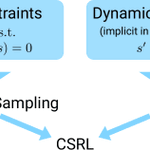
We sample diverse, physically feasible contact states as starts + goals for RL.
The behaviors that emerge are surprisingly dynamic and reactive: including recovery, regrasping, and adapting through contact. 👇 (1/n)
The stability constraints matter a lot.
When sampling states without stability constraints learning is significantly slower.
To further improve learning we propose a curriculum that connects progressively distant states.
Random starts + goals: 4.4%
Full CSRL: 𝟵𝟲.𝟱%
With sparse rewards:
0.2% → 𝟵𝟱.𝟵%


1
12
1,260
What emerges is richer than sampled static states: scooping, whole-body contacts, recovery, reorientation, edge/corner balancing. Optimization finds where interaction is possible. RL learns how to move between those states.
📄 Paper: arxiv.org/pdf/2602.08557
🌐 Project: user.tu-berlin.de/mtoussai/2…
Project lead by @Marc__Toussaint and collaboration w @Denis_Shcherba , @tupryk , Tilman Burghoff, Sayantan Auddy, Armand Jordana and Justin Carptentier.
Our workshop at #RSS26 is tomorrow in person and will have an option for online participation too!
We have great speakers in @GeorgiaChal @ianabraha #VinceKurtz #LindonRoberts and #MassimoFornasier.
Check it out here: sites.google.com/view/sampli…

8
616