

$NPT | NPTStats: https://xitter.cf/t.co/kJr2fa903W
CryptoSign
Joined March 2013
- Tweets3.8K
- Following322
- Followers394
- Likes2.6K





neptune-cash:native #NeptuneCash 💙

So, $NPT is getting interesting.
Imagine a blockchain that doesn't need to carry its entire history around forever.
That's what Neptune Cash is working towards with succinctness, now nearing its final stages.
Think of it like replacing a library of records with a compact mathematical proof.
✅ Major scalability upgrade approaching
✅ Mining infrastructure improving
✅ New Chrome wallet released
✅ Privacy-first, quantum-resistant design
@NeptuneCash is tackling some of blockchain's biggest technical challenges.
Still early. Still risks. But the technology deserves attention.
$XMR and $ZEC and $QTC fans ... I hope you know what this means. The neptune-cash:native is a marvel in itself, and combined with its succinctness, it is truly invaluable! 💙
#NeptuneCash #NPT

🛠️ Dev update: succinctness in its final stages
• Succinctness: set to ship as a soft fork that keeps today's throughput limit. Capacity increases follow later by hard fork, preserving the recursive proof chain.
• Security: research and review continue.
• Mining: Lentern.io builds block proposals in as little as 39 seconds, NPTmining.com finds nearly 15% of blocks, and both major pools pay out time-locked coins correctly.
• Wallets: a new community Chrome extension wallet is out.
Coming this week: the succinctness pull request, with an explainer blog post in the works.
Full update:
talk.neptune.cash/t/dev-upda…
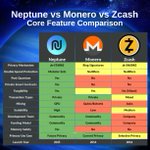
Hey $XMR and $ZEC fans go and check $NPT @NeptuneCash ASAP!!!
You’ll thank me later 🙂
neptune.cash/
nptstats.org/rabbit-hole
#NPT #NeptuneCash
#XMR #Monero #ZEC #Zcash

$NPT !!!
$NPT | Neptune Cash — The Bigger Picture Is Taking Shape.
@NeptuneCash is quietly maturing into something very interesting.
A working, privacy-first blockchain built with quantum-resistant cryptography, zero-knowledge proofs and serious long-term ambitions.
This isn't a narrative I believe will simply come and go. Privacy, security and quantum resistance could become some of the most important foundations of Web3.
Development is progressing, the technology is taking shape, and I believe the market is yet to appreciate the potential.
That's why I've positioned my buy orders on SafeTrade.
I'm looking beyond the next pump. I'm looking at what $NPT could become. 🦁

I completely agree with what has been written!
For me, neptune-cash:native (Neptune Cash) is the most significant innovation since the emergence of $BTC! This project deserves far more attention.💙
#NeptuneCash @NeptuneCash
🦁 NEPTUNE CASH neptune-cash:native — A PRIVACY LAYER 1 THAT DESERVES MORE ATTENTION
Every cycle, thousands of crypto projects compete for attention. Most are fighting over the same narratives.
But occasionally, you come across something that makes you want to dig a little deeper.
For me, that's @NeptuneCash @CodewordNeptune .
I've been researching neptune-cash:native, and the deeper I go, the more interesting the underlying technology becomes.
Here's why I think it's worth putting on your radar.
1. NOT JUST ANOTHER PRIVACY COIN
Neptune Cash is an independent, open-source Layer 1 blockchain built from scratch.
It combines several technologies that could become increasingly important over the coming years:
• Privacy by default
• Post-quantum cryptography
• zk-STARK zero-knowledge proofs
• Proof-of-Work security
• Programmable transactions
• A roadmap towards blockchain succinctness
The ambition is to create private, programmable digital money without sacrificing security or decentralisation.
And importantly, this isn't just a whitepaper. Mainnet launched in February 2025, and development continues.
2. THE PEOPLE BEHIND IT
Co-founder @aszepieniec Alan Szepieniec is a cryptography researcher with an extensive record of published academic work.
In 2020, he co-authored Transparent SNARKs from DARK Compilers alongside Benedikt Bünz and Ben Fisch.
That research forms part of a broader field of cryptographic innovation explored by researchers associated with Microsoft Research and a16z.
To be clear, this does NOT mean Microsoft or a16z have partnered with Neptune Cash.
It does, however, demonstrate the calibre of research associated with one of Neptune's founders.
That's a meaningful distinction in an industry where technical claims are often much bigger than the technology behind them.
Research:
eprint.iacr.org/search?autho…
3. TOKENOMICS — AN INTERESTING SUPPLY STRUCTURE
NPT has a maximum supply of 42 million coins.
• 42M maximum supply
• 1.98% initial premine
• Proof-of-Work issuance
• Approximately three-year halving intervals
• 50% of mining subsidies immediately liquid
• 50% time-locked for three years
That last point is particularly interesting.
Half of each new mining subsidy cannot immediately enter the liquid market.
This potentially reduces short-term miner selling pressure, although those coins eventually unlock and become available.
Of course, limited circulating supply doesn't guarantee price appreciation. Liquidity and demand matter just as much.
4. THE TECHNOLOGY
Neptune uses zk-STARKs to prove that transactions are valid without publicly revealing the underlying financial information.
Its Triton VM provides the cryptographic foundation for programmable transactions.
The network also separates mining into transaction proof upgrading, block composing and proof-of-work guessing.
One of the most ambitious developments is succinctness, which aims to allow participants to verify blockchain history using dramatically less information.
Full succinctness is not yet deployed, and broader smart-contract functionality is still developing.
If successfully delivered, these capabilities could make Neptune a very interesting competitor in the privacy-focused blockchain sector.
5. WHY I'M ACCUMALATING
Financial privacy is becoming an increasingly important conversation.
At the same time, quantum computing is raising questions about the long-term security of today's cryptographic systems.
Neptune is attempting to address both while building infrastructure for programmable financial applications.
That's an ambitious combination.
But let's be clear: this is an early-stage, high-risk project.
The network has previously required important security fixes, and wider adoption, developer activity, liquidity and delivery of its roadmap still need to be demonstrated.
I'm not suggesting any of this guarantees success.
I'm highlighting a project with serious technical ambitions and a research background that I believe deserves more attention.
6. HOW TO GET neptune-cash:native
Access to native Neptune Cash remains relatively limited.
The routes currently worth exploring are:
• SafeTrade: safetrade.com — NPT/USDT market
• Mining: Participate in the network's proof-of-work mining process
• Approved community escrow: Private OTC transactions using a verified, community-approved escrow arrangement
For escrow transactions, independently verify the authorised service or contact through Neptune's official community before sending funds.
⚠️ Be particularly careful not to confuse native neptune-cash:native with XNT (Neptune Privacy) or wrapped neptune-cash:native on Base. These are not interchangeable native assets.
Official website and whitepaper:
neptune.cash
Technical documentation:
docs.neptune.cash
Research rabbit hole:
nptstats.org/rabbit-hole
Network statistics:
nptstats.org
Development discussions:
talk.neptune.cash
I've been around crypto long enough to know that great technology doesn't always result in a successful investment.
But I also believe some of the most interesting opportunities are found before the wider market starts paying attention.
Neptune Cash is one I'm researching closely.
The question now is whether the team can turn that technical foundation into real adoption.
Has anyone else been researching neptune-cash:native? I'd be interested to hear your thoughts.
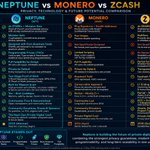
neptune-cash:native VS $XNT
Rabbit hole:
nptstats.org/rabbit-hole
Read and understand the difference between neptune-cash:native and $XNT. Honestly, which one would you choose?
#NeptuneCash VS #NeptunePrivacy

$NPT #NeptuneCash !!!
⚡ Neptune Core v0.19.1 is here!
This release brings important P2P networking and security improvements, including:
• Smarter block requests & faster block delivery
• Stronger protection against oversized network messages
• Improved peer connection management
• New --blocks-only CLI flag
Building a more robust Neptune network, one release at a time.
🔗 Release notes:
github.com/Neptune-Crypto/ne…

It’s a very, very old one, but check out the $NPT rabbit hole!
Did you know that Microsoft cites Alan Szepieniec in the field of cryptography? You do realize that Alan Szepieniec is one of the founders and core developers of $NPT, right? $NPT
@NeptuneCash #NeptuneCash #NPT

The rabbit hole goes deeper than most think on $NPT
Firstly, and to get some perspective even after this recent PA: the price I was quoted 15 months ago was 20 EUR or $23, it's currently sitting just above $7
Check the image attached
With that out the way, the deeper you dig on @NeptuneCash the wilder it gets.
Microsoft's senior researcher Srinath Setty & wider cryptography team is literally building on the same paper that underpins Neptune Cash, and a16'z latest "Lasso/Jolt" systems are derived from it too (1).
Let's go down the rabbit hole 🐰
In 2020, three researchers named Benedikt Bunz, Ben Fisch, and Alan Szepieniec published a paper named "Transparent SNARKs from DARK Compilers" (2). It quietly changed zero-knowledge forever: no trusted setup or logarithmic proofs and real scalability.
Alan took those primitives and turned them into something real with a working system now known as Neptune Cash, built directly on the DARK framework (his own invention).
Then, in 2024-2025, Microsoft's Head of Cryptography - Srinath Setty - published Lasso and Surge. Go read the Lasso paper, it literally cites Alan's paper under ref BFS20 as its core reference for polynomial commitments.
Setty's Lasso = Microsoft Research building on Neptune's underlying cryptography.
a16z Crypto = planning open-source releases of Lasso / Jolt, also citing BFS20, Alan's paper.
You are frontrunning a16z.
To recap:
• Alan Szepieniec co-authors "Transparent SNARKs from DARK Compilers" -> invents DARK compiler
• That tech = the base of Neptune Cash
• Microsoft Research -> exploring it in Lasso
• a16z -> looking to commercialize it
Yet it all stems from @NeptuneCash
___________
Receipts
1. eprint.iacr.org/2023/12162.
2. eprint.iacr.org/2019/1229.pd…

Just so you know, Alan Szepieniec are geniuses!
And yes, Thorkil Schmidiger, who is also an $NPT core developer, is a genius too.
Documents associated with Alan:
eprint.iacr.org/search?q=&ti…
@NeptuneCash #NeptuneCash #NPT

🧠 Alan Szepieniec, Founder of Neptune Cash $NPT
Alan holds a PhD in Cryptography from KU Leuven (Belgium), one of the world’s leading cryptography research institutions, where he worked with the COSIC group, the same lab behind AES and several major cryptographic standards.
Alan’s academic work covers post-quantum cryptography, zero-knowledge proofs, and verifiable computation, with hundreds of citations across research papers and IACR publications.
He has contributed to the design of transparent zk-SNARK/STARK systems, lattice-based encryption, and cryptographic accumulators, which directly inspired Neptune’s Mutator Sets and quantum-safe architecture.
Before launching Neptune Cash, he worked as a research scientist at Nervos Foundation, focusing on scalable cryptographic proof systems.
He often speaks at ZK conferences and shares technical insights under @aszepieniec on X and GitHub.
Deep-dive into Blockchain with University of Zürich
youtu.be/AD1TrlYTMJA?t=98

$NPT the best! #NeptuneCash

This week some researchers warned AI may break elliptic curves before quantum computers.
🔐 Neptune's coins are safe: they rely on hashes.
Its proofs got up to 6.7x faster.
Next: succinctness, verifying the chain from 1 block.
Bulletin #6, 27 Sep–9 Oct: useneptune.org/blog/neptune-…

Dear @Trezor !
Please support native $NPT @NeptuneCash!
Privacy + post-quantum security matter. NPT aligns with @VitalikButerin’s vision for hash-based cryptography and long-term security in an AI-powered future.
Read Vitalik’s post 👇
xitter.cf/VitalikButerin/status/…

I don't recommend anyone scramble to move their funds to new wallets today. But we should take the risks to cryptography from AI-accelerated math seriously, and minimize our exposure to not just quantum-vulnerable cryptography, but also potentially AI-vulnerable cryptography.
The core new area of risk from this viewpoint is, unfortunately, ML-DSA / FHE / lattices.
(and it's also another reason, along with quantum, why ECDSA might fall even faster than expected, hence the "fresh address" recommendation)
So far most people have been in the mode of thinking "elliptic curves broken, hashes safe, lattices safe". But there is a good chance that the concrete security of lattices will take serious hits from the next two years of AI math.
The basic threat model is: factoring is something that naively takes 2^(n/2) time, but over decades smart people have found and optimized number field sieves, and degraded that to 2^O(n^(1/3)), which is why RSA keys and signatures need to be ~400 bytes (and not 64 bytes). What if there are skeletons in the closet like that, both for elliptic curves and lattices, that we are simply not smart enough to discover - but bots soon will be?
This is a major part of the reason why for the past year ethereum's lean roadmap has been going in the "hash-only" direction: no lattices, no ML-DSA, no Falcon, no lattice-based commitments inside ZK proofs, etc. Signatures in lean ethereum are all hash-based, either WOTS or SPHINCS-.
For signatures and proofs, we already know how to go hash-only. The bigger challenge is for *public-key encryption* - and this goes far beyond blockchains. Secure communication, anonymizing protocols, lots of things need public-key encryption.
And unfortunately there are long-standing mathematical theorems showing why public-key encryption cannot be done with hashes alone. You have to have some kind of trapdoor object that has at least one form of usable "structure" - either group theory (incl. isogenies) or lattices or code-based or potentially in the future even more newfangled and spooky things (local mixing?). But for anything that has structure, you should assume that AI will make at least some progress in breaking that structure. Here, one reasonable inference is that if you want to make something plausibly long-term secure, multiply the key sizes by 10.
To me that's a very plausible world and something not at all extreme to predict. If AI will bring us 50 years of math in 2 years, then that 50 years of math may very plausibly include a "naive factoring -> GNFS" level of improvement to our ability to break lattices. In that world, lattices will still exist, but they will have to be significantly bigger to guarantee the same level of safety.
And at those new larger sizes, hash-based constructions will beat lattice-based constructions on concrete efficiency in every use case where hash-based constructions are possible at all.
Theoretically, of course it's possible that hashes are broken too (eg. P = NP would imply that). But I think P = NP is very unlikely. And intuitively, it's much more likely that a mathematical object has exactly no exploitable structure (like hashes are intended to), than that a mathematical object has exactly ~3 forms of exploitable structure (for elliptic curves: associativity, Schoof, pairings) and not some secret fourth form of structure we have not yet discovered that greatly degrades its security (for elliptic curves, ECDLP and pairing security). Similar for LWE, SVP, RLWE and the zoo of lattice problems.
For this reason, we do not yet see any reason to worry and start padding the byte size of hashes (if we start to worry more, we would pad the round count first before doing anything to the byte size).
Concrete TLDR, my own personal views:
* Hash-based > lattice-based, in those situations where hash-based is possible at all
* For anything lattice-based, be much more paranoid on param sizes. Remember that blockchains are only a small portion of the cryptography story; this point goes far beyond blockchains and applies to eg. access to websites, secure messaging, Tor / VPNs ...
* For privacy protocols, strongly favor NOT putting encrypted notes onchain. Instead, send them offchain through some third-party mechanism.
* If it's not difficult for you, keeping your funds in addresses which have not yet been used to make a transaction is a good idea. If it's easy for you, do it. **But be careful about migrations; I personally have lost more money in botched migrations than I have lost in all hacks combined**.
* For multisig wallets, doing confirmations offchain is better than onchain, because this way the signatures of signer wallets do not get exposed to the public, so if ECDSA falls to AI much faster than expected, at least the multisig "gracefully degrades" to a 1-of-1 where the 1 is whoever was gathering the signatures - a much better place to be than "anyone can take the money"
firefly.social/post/x/210783…

$NPT @NeptuneCash the solution!

Today I call upon the blockchain industry to calmly begin planning for "bunker mode". My personal recommendation is to set in motion a controlled mass migration of assets to fresh addresses, i.e. addresses whose pubkeys remain hidden behind a hash.
Holders, starting with large and sophisticated ones, should consider moving the bulk of their funds to addresses that have never signed a transaction. And when they do sign one, they should also move remaining funds to a new address (possibly generated from the same seed phrase).
Don't rush. While I believe there is cause for action a rushed migration would do more harm than good. Don't panic either. Moving assets to protected addresses is a simple, preventative step which does not require new cryptography or new wallets.
IMO it is now reasonable to brace for the possibility that ECDSA breaks before qday, in the worst case in months not years. By "break" I mean fast private key recovery (e.g. in one week) on available hardware (e.g. a large GPU cluster).
Recent days have been humbling for human mathematical intuition. Long-held, unquestioned hypotheses have fallen. This includes the n log(n) bound for integer multiplication and the 3SUM conjecture. In hindsight, May's unexpected disproof of the Erdős unit distance conjecture was our warning shot.
Yesterday's OpenAI drop made it clear that mathematical superintelligence is upon us. They say there are weeks where decades happen. We are about to live through weeks where centuries of mathematical progress happen. Could our magic 64-byte ECDSA signatures be too good to be true? Was it just security through obscurity all this time?
Elliptic curves feel especially vulnerable to superintelligence. Curves carry rich structure, with room for fancy tricks like Schoof, Frobenius, pairings. (By contrast, hashes are designed to minimise algebraic structure.)
Separately, as Ewin Tang can attest, an efficient quantum algorithm sometimes foreshadows an efficient classical one. We should be open to the possibility of a classical counterpart to Shor that breaks elliptic curves and RSA at once.
Also noteworthy is the striking under-representation of cryptographic breakthroughs among the 722 mathematical results OpenAI published. I've witnessed first-hand the US government censoring academic quantum cryptanalysis results. Backroom interventionism is my base case.
I urge large, sophisticated actors to lead by example. Project11's "risq list" (bitcoin-risq-list.projecteleven[.]com) is a great tracker of exposed BTC pubkeys. Binance, Bitbank, Robinhood, Bitfinex, and Tether have an opportunity to harden their cold storage. Next month I'll address institutions in London in a live Q&A (forum.ethereuminstitutional[.]org/london-2026).
Again, please do not rush. Wallets holding under 50 BTC enjoy partial cover from "Satoshi's shield", i.e. his 20K exposed addresses that hold 50 BTC each. Load-bearing signers like oracles and L2 security councils should consider rotating ECDSA pubkeys with every signed message and/or multi-signing with a hash-based schemes like SPHINCS.
Exiting bunker mode safely will require post-AI cryptography. My inclination is to go all-in on hash-based cryptography and avoid structured mathematical assumptions entirely, whether from curves, lattices, or isogenies. A single battle-tested hash (e.g. from the SHA or BLAKE families) yields plausible post-AI security.
The Ethereum roadmap on strawmap[.]org fully embraces hash-based cryptography with end-to-end formal verification as a response to the quantum threat. Those timelines must now be revisited and accelerated in light of mathematical superintelligence. I'll be pushing for maximum defensive acceleration.
One word: $NPT 🤌🙌
Dev update: Neptune's next phase is taking shape 🛠️
More capacity, a smart contract unlock, and proofs built to scale:
• Scaling: trimming the data each block carries so more fits, targeting 5,000 to 10,000 spent coins per block.
• Smart contracts: a key design blocker is solved. Coinbase transactions will accept inputs, opening the door to standing swap orders.
• Succinctness: proof trees keep the chain's proof efficient as blocks get busier, with proving split to run in parallel.
Coming this week: smart contract code for community feedback and new research posts on the forum 👇
talk.neptune.cash/t/dev-upda…

I hope every $ZEC, $ETH, and $XMR fan sees this... but I also recommend it to $QTC fans, since $NPT is built on a foundation that is light-years ahead of #QuantusNetwork.
$NPT hidden 💎 but don't tell anyone.💙
@NeptuneCash @CodewordNeptune
#NPT #NeptuneCash
⚠️ The crypto industry is being told to consider "bunker mode."
Justin Drake: Ethereum Foundation researcher, mathematician and longtime Ethereum protocol researcher:
"Mass migration"
"Cause for action"
"Don't panic"
"Do not rush"
"possibility ECDSA breaks before qday"
"Worst case in months"
"Weeks where centuries of mathematical progress happen"
And:
"My inclination is to go all-in on hash-based cryptography"
Not a prediction. A warning.
Neptune Cash was built for this at launch: quantum-resistant and private from the beginning. No ECDSA. Nothing to migrate. 🛡️
useneptune.org/quantum

$NPT actually brings privacy + utility. $QTC? Pure hype narrative. 🤡 You’re not early if you’re just chasing the green candles. NPT > QTC.
#NeptuneCash #QuantusNetwork
$NPT has a real edge: privacy-focused transactions and a stronger use case than $QTC. Yet people keep jumping on the $QTC hype train. 🤡
#NeptuneCash #QuantusNetwork
This post very true... $NPT the king! Sorry.

Top 5 Undervalued Privacy Coins 🕵️♂️
With $ZEC having likely topped and privacy narrative still strong, I think we could see a rotation to these projects soon 👇
$NPT / @NeptuneCash 🌊
Layer-1 peer-to-peer privacy-preserving cash protocol featuring scalability and post-quantum security.
$NOCK / @nockchain 🏦
Programmable sound money that scales with top holders inlcuding some of the loudest Zcash voices like @cobie and @mert.
$XEL / @XelisCurrency 🔋
The world's first BlockDAG with Privacy, Speed, Scalability and Smart Contracts.
$ZERA / @ZeraLabs 💵
A single, unified ZK pool enabling shielded balances, private transfers and offline P2P with seamless hooks into DeFi.
$ANYONE / @AnyoneFDN 🛜
Decentralized communication network (new implementation of onion routing) built on anonymity, privacy, and global accessibility.
Whats you favorite? Which one did I miss?
Let me know 👇

CryptoSign retweeted

influencers are dead.
ask chatgpt to create a character sheet from a reference pic or video
download a viral tiktok
replace the person with your character
use seedance 2.5 with references
this account got 55.4M views in 4 days.
someone is gonna sell you a $299 course for this next week.


dead internet theory is real.
you can actually create an AI character and get 200k followers in 1 week.
please don’t buy a $299 course.
> create a realistic character sheet
> swap your character into viral videos
if you’re skeptical, i’m gonna recreate these videos with people who comment.

