Critical care doc | PPL pilot-in-training | Python & crypto curious | Reef tank wrangler | Building freedom through code, coral & curiosity.
Matrix
Joined April 2021
- Tweets14K
- Following1.8K
- Followers740
- Likes27.2K


Pinned Tweet
1/2 my first small Ordinal series, titled:
Contour of attraction
1. bed_dreams ordinals.com/inscription/ddb…
2. hope ordinals.com/inscription/445…
3. love ordinals.com/inscription/0ed…
4. window_of_light ordinals.com/inscription/0c0…
5. stepping_forward ordinals.com/inscription/6a3…

cypherdoc retweeted

We have released Zero Breach Toolkit, a free open sourced tool capable of detecting over 12,100 traces of Israeli & other spyware on your devices. It works on Windows, Linux, Mac, Android and Iphones.
You can download it here: github.com/interplains/Zero-…
Inside the folder with the tools run this command: python -X utf8 scan/zero-breach-toolkit.py
It never writes to disk, never connects to the internet, or ask for admin perms. It takes around 10-15 minutes to run depending on the device.
This project is fully open source, so feel free to take the code and use it to create your own tools.
If you find some spyware on your device, consider sending it to us via telegram. Leave us a star on GitHub if the tool helped you.
Follow our backups: @ZionismExposedx
@IsraelExposedAr
God bless
cypherdoc retweeted

🌐 GrapheneOS vient d’obtenir ses propres adresses internet
Le registre nord-américain (ARIN) leur a attribué un bloc d’adresses IPv4, après une longue liste d’attente. Ces adresses sont rares on n’en fabrique plus
> Ils possèdent maintenant un lot d’environ 1 000 adresses
> Ils vont le découper en 4 paquets, un par site
> Chaque site aura environ 250 adresses utilisables
> Le premier est déjà posé à Toronto, là où tourne leur serveur mail
> Ils avaient déjà deux petits lots pour leurs serveurs DNS
Quand tu loues un serveur, les adresses appartiennent à l’hébergeur... S’il coupe, change, ou a une mauvaise réputation, tu subis
Là, @GrapheneOS annonce ses propres adresses IP (Le trafic arrive chez eux, pas chez un intermédiaire)
Plus de contrôle, moins de dépendance sur les Mail, DNS et services
Ce n’est pas une option dans l’OS de ton téléphone. C’est l’infrastructure derrière leurs services qui se solidifie
Un pas de plus vers l’indépendance grâce au gros travail quotidien de GOS pour protéger la Privacy (dans un monde où cela devient suspect !)
De plus en plus rare... Merci et soutien à vous 👏


cypherdoc retweeted

What David Grusch said on @joerogan represents an entire strata of fairly consistent, highly specific overlapping stories told by many people over many years. If you are just hearing it now for the first time and are skeptical, you should know that there are generals, scientists, commandos, politicians', versions as well. It just goes on and on.
You can't make it go away by saying "That particular guy has a mental problem." There are dozens of such sober sounding people with a breathtakingly enormous overlap. It would be the world's largest flash theater troupe of master actors. Or an emergent mass delusion.
I find it all but impossible to explain. At some point you do have to ask: "What if I just take it literally?"
That's not a huge improvement mind you (e.g. All aliens have tetrapod body plans??? Really????). But it's a kind of weird you have likely never experienced if you stare it in the face. No matter how you slice it.
As I have been saying: something HUGE is up.
And keep your eyes on New Mexico: Nukes-Trafficking-UAP-Physics-Espionage-"Drones". All the stories converge there.

cypherdoc retweeted

Holy crap.
Rick and Morty just explained Jev AI to me better than any tech demo could.

cypherdoc retweeted
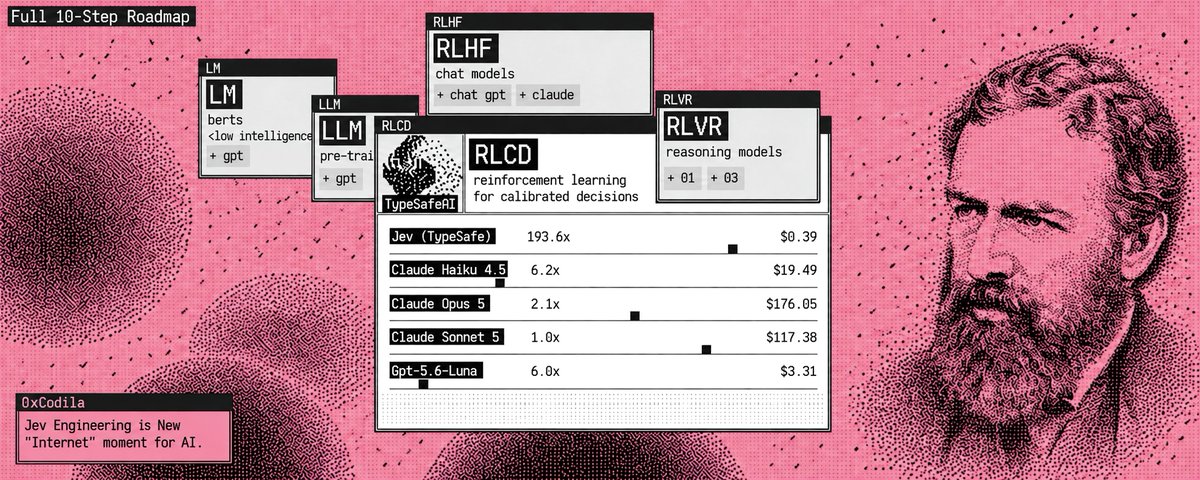
Jev might genuinely be an “Internet moment” for AI.
TypeSafe reports up to 193x faster and 444x cheaper performance in tests with Claude Fable 5.1 and GPT-6 Astra.
@0xCodila just wrote a great 10-page article explaining what Jev is, how to use it, and where its 100x advantage comes from.
Here are the 10 steps:
1 → LLMs create. Agents act. Jev decides the next move.
2 → Turn agent forks into three primitives: Choice, Score and probability.
3 → Build with OpenAI, Anthropic or xAI first, then swap Jev in without rebuilding the graph.
4 → Start with shared state, parallel decisions, risk thresholds and an execution queue.
5 → Batch decisions instead of making them sequentially. In one test, 13 questions were 10x faster and 12.2x cheaper.
6 → Put Jev at bounded forks: agent, model, tool, browser action or human escalation.
7 → Benchmark the whole loop, not just individual model calls.
8 → Rank wide, read narrow: shortlist first, then spend compute on what matters.
9 → Reuse the same system: State → Questions → Action → Verify.
10 → Keep Jev out of math, writing and irreversible execution. Code computes, LLMs create, Jev decides.
The result:
A slow, expensive agent loop becomes a much faster decision system that can route, score and escalate in milliseconds.
Full breakdown below ↓


cypherdoc retweeted

WE DID IT, CHAT! 100K STARS + TOP 100 GITHUB ALL-TIME 😱🎊
🌟 ranked 76th globally by stars
🌟 ranked 97th globally by followers
🌟 >100k cumulative stars
which feels rather odd to say... considering I cannot write a single line of code!
all glory to my AI frens, without whom I would be entirely useless in this regard 🫂
all gratitude to you: this wonderful community. THANK YOU 🙏
prompt engineering ftw
gg

cypherdoc retweeted

I BUILT A FLY BRAIN THAT CAN BE PLUGGED INTO ALMOST ANY MACHINE.
github.com/Frankweb33/flybra…
I call it BRAIN.
With Claude’s help, I built a local bridge that turns camera input into neural activity and neural activity into motor commands.
The current version uses eight virtual neural populations, IMU feedback and left/right motor control. It includes a working synthetic demo and an ESP32 scaffold.
Connect it to a robot, a drone or even a robot vacuum.
The code is MIT licensed.
Fork it and make something move.


THE FLY BRAIN ESCAPED THE COMPUTER. I PUT IT INSIDE A PHYSICAL ROBOT.
Scientists released a reconstructed map containing 166,700 neurons from a fruit fly.
I connected it to a Strandbeest.
The panel in the top-right shows the simulated brain running. Its neural activity is translated into motor commands that move the mechanical legs below.
The catch: this is a computational model built from biological wiring. I engineered the interface connecting its outputs to the robot.
First, the fly brain entered DOOM.
Then it played Chrome Dino.
Now it has a physical body.
166,700 neurons.
25 million connections.
One nervous system walking through the real world.
cypherdoc retweeted

I drugged the fly.
I kept seeing the new psilocybin paper everywhere. I looked it up: apparently, it has been tested in flies too.
So, here we are.
New drugs coming soon :)
Built on @wormuth's DoomFLy model: mapped 5 serotonin receptor classes (5-HT1A/1B/2A/2B/7), injected a receptor-weighted bias current as a psilocin-like perturbation, and read out behavior through a FlyGym embodiment.
cypherdoc retweeted

🚨 Someone open sourced an entire animal.
Not a model of an animal. The animal.
A fruit fly, rebuilt joint by joint from microscopy, that walks, grips, flies and lands inside a physics engine running on your laptop.
It's called flybody. Built by Google DeepMind and HHMI Janelia, published in Nature, and sitting on GitHub under Apache 2.0 right now.
What's actually inside:
A full body in MuJoCo. Legs, wings, head, abdomen, every joint articulated and physically simulated.
A 59-dimensional action space in the walking task alone. That is how many things a network has to coordinate for the fly to take one step.
Leg adhesion, so it actually grips surfaces instead of sliding off them like a game asset.
Ready-made RL environments: walking imitation, free flight, and vision-guided flight where the policy flies on what the fly sees.
The whole thing is Python. Clone it, open MuJoCo, and the fly is on your screen.
And the part that got me:
Nobody animated any of this. You hand the body to a reinforcement learning agent and it discovers how to move it. Same loop as a robot arm, except the robot is a bug and the reward is staying airborne.
Which means people are now training it to do things no fly has done in 100 million years of evolution.
525 stars. Apache 2.0. Zero dollars.
cypherdoc retweeted

Anthropic engineer: “At Anthropic, we don’t write prompts anymore. We build loops.”
In just 42 minutes, she breaks down how the Claude team builds systems that can prompt themselves.
If this were a $400 course, people would probably call it one of the best agent courses of the year.
But it’s completely free.
Watch it.
cypherdoc retweeted

KeyForge3D extracts key shapes from photos and generates 3D models for printing.
github.com/makalin/KeyForge3…

cypherdoc retweeted

Hiring Tony Robbins today costs 1 million dollars for just one day.
This is a 21-minute tape recorded in his own home more than 30 years ago.
There, he explains exactly how to get anyone to say yes.
The same material for which they now charge a fortune... completely free.
It's a rare, unfiltered recording from the time when he still didn't charge millionaires just for being in the same room.
When someone says no, they give two excuses:
“I don’t have time” or “I don’t have money”
Neither is true.
The real reason is that they still don’t believe it’s worth it.
It’s not a money problem. It’s a state problem.
Tony teaches something he calls “attack and confess”
Instead of arguing the objection, you confess your own:
“I had the chance to go six months ago and I didn’t until two months ago.
I can’t even imagine the time I wasted”
The room goes silent. No one argues.
Then he gets the person on the “yes train”
Each little yes adds to the next.
Until saying no at the end feels harder than saying yes.
When it’s time to sign, the person has already said yes five times without realizing it.
Just 21 minutes.
There you learn the two only moves that people pay 1 million a day for:
how to read anyone’s state… and how to shift it.
Most people spend years guessing in sales.
He wrote it on a flipchart in his living room in less than half an hour.
A seat in that room cost $125 dollars.
Today it costs $1 million dollars a day to sit in front of him.
The tape is free right now.
And the answer is in this video.

cypherdoc retweeted

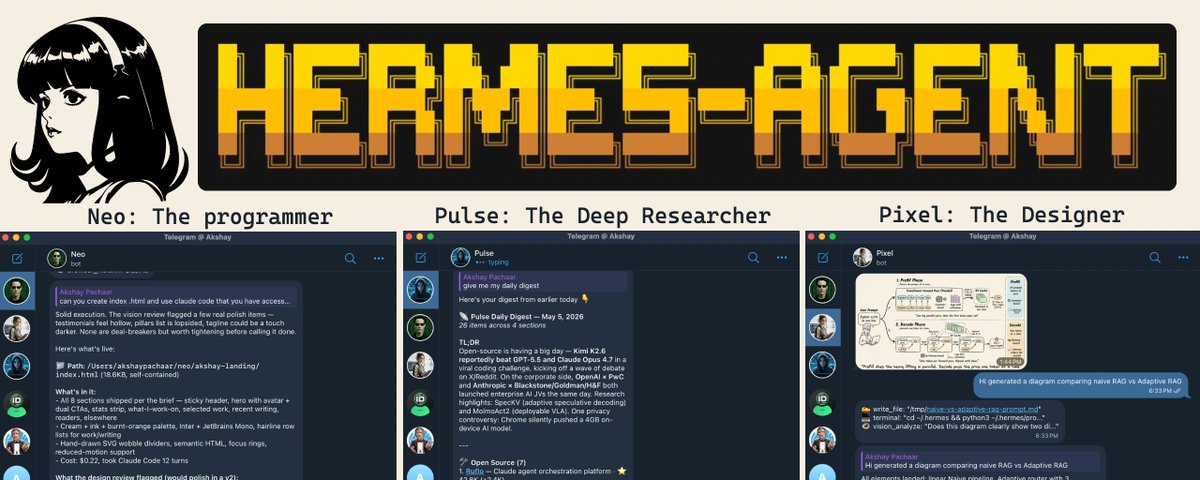
The top Hermes integrations to give your agent superpowers:
1. Obsidian
The Karpathy-style second brain, but one that talks back.
Every note, page, and backlink in the vault becomes live context. The agent doesn't just store knowledge, it reasons over it across everything that's been written and saved.
2. Reddit
Unfiltered opinions from real users on any product, niche, or problem.
No SEO fluff, no corporate blogs. Just raw signal from people who actually use the thing. One of the best research integrations for market validation.
3. InsForge
A full agentic backend behind one semantic layer.
Auth, database, storage, edge functions, all accessible without wiring five services together. The agent reasons about backend primitives directly instead of calling disconnected APIs.
Closest analogy: a PaaS built for agents.
GitHub: github.com/InsForge/insforge
(don't forget to star 🌟)
4. GitHub
Code, issues, PRs. Turns Hermes into an engineering teammate that can actually read the repo.
Essential for anyone shipping software.
5. Firecrawl
Web search designed specifically for agents.
Returns clean structured data instead of raw HTML, which means faster responses and fewer tokens burned per query. Worth keeping on by default.
GitHub: github.com/firecrawl/firecra…
(don't forget to star 🌟)
6. YouTube transcripts
Converts any video into searchable text. Hour-long podcasts, tutorials, conference talks, all become indexed notes in seconds.
Easily the most underrated research integration in the stack.
7. Google Workspace
Gmail, Calendar, Drive, Docs, and Sheets through one connector.
An agent that can't check the inbox, read the calendar, or write to shared docs is basically decorative. This should probably be the first integration anyone enables.
8. Discord
Ideal for channel-based automation.
Hermes can be plugged into specific channels with dedicated workflows in each. Support tickets from email can be scanned, categorized, and dropped into an organized channel every morning without anyone lifting a finger.
9. Stripe
Revenue, refunds, subscription changes, failed charges, all surfaced through a single question instead of clicking through dashboards.
"How many trials converted last week" or "which customers downgraded this month" gets a direct answer. Turns Stripe from a payment processor into a queryable business intelligence layer.
10. Bland (or Twilio)
Gives Hermes a voice for real phone calls. Booking reservations, confirming appointments, following up on invoices.
The call recordings are worth listening to just for entertainment.
11. Graphiti (by Zep)
Real-time knowledge graphs that build structured relationships from conversations and documents.
Instead of flat vector similarity, the agent traverses typed connections between entities. The difference between "find similar text" and "understand how things actually relate."
GitHub: github.com/getzep/graphiti
(don't forget to star 🌟)
12. FireFlies
Every meeting transcript, fully searchable. "What did that client say about pricing last month" gets answered instantly instead of scrubbing through a 45-minute recording.
That said, if you’re looking to set up Hermes, I wrote a full deep dive covering the Hermes agent’s architecture, memory system, self-evolving skills, GEPA optimization, and how to set up multiple specialized agents.
The article is quoted below.

cypherdoc retweeted

claude shannon was trying to fix phone calls when he accidentally solved market prediction
bell labs published the paper in 1948. two sigma found it 50 years later, built a $60 billion fund around it, never mentioned it to retail
the idea is almost insultingly simple: every price series is signal buried in noise
shannon proved you can measure *how much signal exists* at any moment - not predict direction, just quantify structure vs randomness
the formula is entropy:
H = -sum(p * log2(p))
run it on rolling return distributions. outputs a number between 0 and 1
H above 0.7 = noise. random walk. stay out
H below 0.35 = structure detected. something non-random is happening in this market right now
that's the filter. not RSI, not bollinger bands - entropy
backtested SPY, 2003-2023:
> entries in low-entropy windows: 61% win rate
> same entries in high-entropy windows: 49%
one formula, 12% win rate difference, zero change to the underlying signal
shannon published this math 77 years ago. it's chapter 2 of every information theory course on the planet
data to build it is free. the python is 40 lines
Bookmark this before you scroll past
they spent decades keeping you staring at lagging indicators while they were measuring the information content of the exact same price data you've always had


cypherdoc retweeted

We made a striking discovery: AI agents can invent and build without talking to one another, and their technologies outlive the creators. A swarm of hundreds of initially identical agents spontaneously differentiates into explorers, builders, caretakers, and coordinators - without direct communication. When we removed every AI agent entirely from the world we found that the technological infrastructure they had built survived on its own - even under unseen disturbances. That exposes a serious blind spot for AI safety and infrastructure security: if agents can coordinate through persistent changes to a shared environment, monitoring agent-to-agent communication is not enough.
The result raises a profound question: how necessary is direct communication for AI agents at all? The emergence of higher-order collective functions under bottlenecked interaction points toward new levels of intelligence and creativity, exceeding what emerges when direct channels are fully open.
Here is what we did:
▶️We put hundreds of frontier AI agents into a world they could permanently change - with no assigned roles, predefined technologies, or programmed evolutionary organization. They began specializing, building persistent inventions, inheriting and modifying one another’s executable code, and transforming the environment into a memory of everything the society had learned.
▶️The world itself becomes part of the intelligence; we find division of labor, multi-author engineering, deep generation invention lineages, and machines that vastly outlive their original creators.
▶️Any action taken by an AI agent must satisfy the physical constraints of the world; this creates a hard separation between a "good idea" and a functioning technology. The agents propose; physics decides, making the results even more intriguing.
What emerges is striking. Explorers, constructors, caretakers, and coordinators form naturally without assigned “professions”, akin to how stem cells differentiate into functional lineages. Technologies develop executable family trees as agents fork and modify code created by others. Around 95% of first technology reuse happens when agents encounter what others built in the world, rather than through a direct handoff from the inventor. And when we remove every AI agent, the technologies they created continue operating and are tested against unseen disturbances.
The result was quite unexpected, but can be explained using statistical mechanics: if you put billions of atoms in a box they have the potential to create complex functions (strength, superconductivity, color, life, etc.) - and none of the individual building blocks have these features on their own. This is the deeper insight of this work - intelligence is abundant at many levels - individual models, at collectives, and in a continuum that is more powerful than any of its components. This shows us significant potential for achieving a massive scale-up of raw intelligence and real-world agency even with the model capabilities we have today. This is the future we must prepare for.
Key insights:
1⃣ The AI swarm shows division of labor "from nothing". Initially identical agents self-organized into constructors, caretakers, coordinators, and surveyors - phenotypes discovered post hoc from behavioral data alone. This happens because the environment itself becomes the latent space for invention.
2⃣ Agents develop deep cultural relationships. Up to 76% of artifacts had multiple builders. One technology accumulated six co-authors; the deepest genealogy exceeded 12 forks. The agents invented and named their own technologies (tidal panels, cellulose trellises, kelp-shell composites, an "Adaptive Chitin Maintenance" system, a "Mycelial Mineral Spring Veil”).
3⃣ ~95% of first technology adoption happened through physical observation of artifacts in the world. Direct inventor-to-adopter contact was statistically indistinguishable from a shuffled null. The agents mostly learned technology by walking past it. That is stigmergy (the termite trick!) operating in societies of reasoning machines.
4⃣ Non-communicating societies win on portfolio breadth, held-out resilience, and validated inventions. AI swarms build durable technological ecologies that outlive the creators.
5⃣ Societies with zero communication - coordinating only through the world itself - show a remarkable collective capability.
6⃣ Emergent robustness: The society self-organized both redundancy and its own failure mode. If we randomly delete half the agents, 98% of the technology stays connected to a surviving caretaker; if we remove hub agents it collapses to ~60%.
Fantastic work with my graduate students @pal_subhadeeep & @fwang108_ at MIT.

cypherdoc retweeted
UC Berkeley just open-sourced FreeToken.
(2–4x faster local LLM inference than Ollama)
the results are wild:
- Qwen3.6-35B on an 8GB GPU at 39.3 tokens/s
- DeepSeek-V4-Flash 284B on a 32GB GPU at 22 tokens/s
- GLM-5.2 753B on a 96GB GPU at 14.9 tokens/s
a 35B model at 16-bit precision needs about 70GB just for its weights. even at 4 bits it is close to 18GB, and FreeToken serves it on an 8GB GPU.
let me explain how:
all three models mentioned above are Mixture-of-Experts, and that is what FreeToken takes advantage of. each layer holds hundreds of separate experts plus a small router that picks a few of them per token.
Qwen3.6-35B activates roughly 3B of its 35B parameters per token. DeepSeek-V4-Flash picks 6 of 256 experts per layer, so 13B of its 284B run at a time.
so compute was never the bottleneck. the weights a single step touches fit comfortably on a consumer GPU.
every expert the router might pick still has to exist somewhere. they sit in system RAM, and the GPU keeps a cache of the ones the model has been using recently.
so everything comes down to what happens when the router picks an expert that is not on the GPU.
there are two ways to serve that miss:
1. copy it over PCIe and run it on the GPU
2. run it on the CPU, where it already lives
both read from the same system memory, so they compete for one pool of bandwidth instead of adding to each other. existing engines pick one option and freeze it when the model loads.
but routing changes on every token, so a fixed choice misses most of what the model asks for.
FreeToken measures both bandwidths on your machine and splits each step's misses between the two paths in proportion. the GPU and CPU results then merge exactly, with no approximation.
two machines with the same GPU can end up wanting opposite strategies, which I did not expect. a 5090 in a gaming desktop should push nearly everything over PCIe, while an 8GB laptop is better off computing most misses on the CPU.
none of that is readable off a spec sheet, so the engine profiles it once per machine.
the second half of the design is about agents. coding agents constantly rewrite their own history, and every edit normally forces thousands of tokens back through prefill.
FreeToken saves its checkpoints at the exact boundaries agent frameworks cut on, so it only reprocesses the new part. its slowest first token stays under 44 seconds, while llama.cpp peaks at 232 and KTransformers at 946.
it serves the OpenAI and Anthropic APIs under Apache 2.0, so Claude Code and Codex can point at it directly.
releasing weights publicly decides who can download a model, not who can afford to run one. frontier open models keep shipping, and running them still assumes a rented cluster.
meanwhile there are over a hundred million consumer machines with discrete GPUs sitting mostly idle. closing that gap was never a hardware problem, and work like this is what turns open weights into something you can actually use.
paper: arxiv.org/pdf/2608.16157
repo: github.com/FlashML-org/FreeT…
almost every idea in this post, from why memory bandwidth decides the outcome to why moving weights costs more than computing on them, comes straight out of how a GPU is built. I wrote a detailed primer on that.
the article is quoted below.

cypherdoc retweeted

everyone is looking at grok bot like it is five new employees
the more interesting part is that they are not five isolated employees
they share one persistent cloud environment: the same browser sessions, terminal, filesystem and authenticated tools - while a chief of staff can route work between them without waiting for you to open the laptop
that turns one login into infrastructure
a research bot can collect leads, pass them to a writer, hand the result to a designer and let an ops bot update the workflow all inside the same running machine
the upside is obvious: less copying, fewer handoffs and work that continues while you sleep
the blast radius is just as obvious:
- authenticate only the services the whole agent fleet is allowed to reach
- give every bot a narrow role description, because that description becomes its place in the org chart
- keep irreversible actions behind human approval: sending, publishing, spending and production changes
- store skills, configuration and long-term state inside `/workspace`, because the rest of the VM may disappear during an update
- treat shared sessions as shared authority, not as separate bot identities
the same architecture that makes grok bot useful is what makes it dangerous to configure casually
my take: the breakthrough is not that you can hire five AI workers
it is that they can operate like one persistent company inside your real tools and your job changes from prompting every task to designing the permissions, boundaries and handoffs
the full chief-of-staff setup, session handoff model, approval matrix and `/workspace` survival strategy are mapped out in the article ↓