

Data science, compchem, and structural biology. I turn numbers into other numbers to make digital arts and crafts.
Durham, NC
Joined September 2009
- Tweets3.6K
- Following1.9K
- Followers661
- Likes12.2K





Underrated contribution to the AI for proteins explosion.

My little Blender plugin I started 4.5 years ago is literally the face of an entire Biotech industry / research sector 🥹
#b3d #GeometryNodes #MolecularNodes
Daniel Saltzberg retweeted

I am hiring a scientist in influenza virology to set up and run the wet lab in Memphis, where my group starts at @StJudeResearch in 2027, and to develop their own research line within the lab's work on infection: nature.com/naturecareers/job…

Fixing a small numerical inconsistency in AlphaFold 2 can meaningfully improve structure prediction.
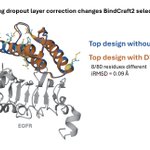
During model training, AlphaFold2-style models randomly zero out some features (Dropout) at each step before normalizing (LayerNorm) to help prevent overfitting. Charlotte Deane's group at Oxford realized that during structure prediction, Dropout is turned off; this results in the model seeing about 5% larger average signal than it did during training. They also showed this inconsistency meaningfully degraded results; adding a simple scaling fix (Dropout LayerNorm Correction - DLC) improved prediction in multiple AF2-class models.
I observed a small, but meaningful effect in my own work.
I patched DLC into BindCraft2 and re-scored 10 accepted design trajectories from my @adaptyvbio EGFR binder competition project. In one of the trajectories, the AF2 scores and resulting BindCraft2 ranking changed enough to select a different sequence.
Overall, the difference is small (8/80 residues, backbone is essentially the same), but this correction changed an actual decision in my workflow.
Is the DLC-corrected design better? I don't know! But this is a very simple change grounded in a real mathematical inconsistency in AF2.
Paper: arxiv.org/pdf/2609.32062v1Gi… with DLC patch: github.com/oxpig/DLC

Daniel Saltzberg retweeted

ʙɪɴᴅᴄʀᴀꜰᴛ2 is out, and we're not waiting for the paper. The full code drops today, free for academic and industry use.
We're releasing it early so you can start designing right now, and bring its full power to the current Adaptyv competition.
github.com/PacesaLab/BindCra…
Huh. So inside you there actually are two wolves.

Spoiler alert: you have two brains. The front of your brain and the back of your brain were never the same organ. They start as two different cells, in two different places, and they have been separate lineages for something like 550 million years.
doi.org/10.1038/s41593-026-0…

Daniel Saltzberg retweeted

I've attempted to map everything in oncology in a public website and open source repo for all.
The site is trying to get all cancers, products, technologies, bottlenecks, people, startup opportunities with 1000+ ideas for upgrading the field.
If you have a loved one with cancer and you are technical or can engineer, go take a look, file improvement requests or bugs or help with the open repo and make this the best open and free info resource for individuals, researchers and educational use.
This should save people time, aid AI oncology projects and generate positive action. If you are not technical just complain in this thread about broken or annoying or things you want and I'll fix them live.
Some of the interesting pages:
Treatments: onco.cc/drugs
A gallery of the molecules being used onco.cc/molecules/
And targets: onco.cc/targets/
The technologies in oncology: onco.cc/technologies/
1100 ideas for helping oncology: onco.cc/ideas/
Bottlenecks on oncology: onco.cc/bottlenecks/
Open questions (LETS GO RESEARCH PEOPLE) onco.cc/open-questions/
Startup requests (LETS GO STARTUP PEOPLE) onco.cc/startup-requests/
Mechanics of cancer: onco.cc/mechanics
Battlefronts: onco.cc/fronts/
Isotope supply: onco.cc/isotopes
Key papers: onco.cc/key-papers
Pipeline funnels: onco.cc/pipeline
Cancer by type: onco.cc/cancers/
Institutional rankings: onco.cc/institutions/
The startups: onco.cc/startups/
Heros and heroines : onco.cc/heroes/
Key medical people: onco.cc/people/
Here is the project roadmap: onco.cc/roadmap/
Models and data sets: onco.cc/models/
There are other views as well, take a browse.
Try making a PR if you have an upgrade to this on the repo here: github.com/judegomila/OnCo
If you are biologically/medically minded and something is wrong, file a bug as well or say on the thread and we will get it fixed live.
If this is a useful project star the repo and help get it calibrated.
I've tried to add some other languages but I cannot speak them so tell me if that doesnt work well.
I believe we will crack oncology and having total information dominance is key to the problem.
Let the feedback flow!


Fun paper: METALICA - METAdynamics + repLICA exchange to steer diffusion models towards rare states.
arxiv.org/html/2609.17823v1
Be the master of puppets and steer diffusion models with collective variables. Escape from being trapped under ice in metastable basins. Seek and destroy unsampled areas of conformational space. Ride the lightning between diffusion levels, letting the energetic memory remain in the metadynamics bias. Wherever BioEmu may roam, keep exploring until rare states no longer fade to black. Then restore justice for all through statistical reweighting. One caveat: the resulting ensemble is the model's, not the true free-energy landscape. Sad but true!
Another demonstration that protein-ligand structure prediction is not solved - only substantially solved where training data is dense. OpenFold3 dramatically improved when trained on additional private structures from pharma.
This makes me cautious about claims of broad generalization in other bio foundation models - most do not have the unusually good data curation, labels, physical constraints, and well-defined representation of protein structure.
Structure prediction models are a revelation, but their success is contingent on the data...and how that data is turned into biologically meaningful representations. I imagine the same is true in other domains.


Why I'm bullish on biotech based on generating lots of coherent, high-quality data that measures meaningful biological states. @AAlphaBio, @Terray_Tx, @OctantBio,@Precigenetics, @RecursionPharma, @insitro, @EikonTX and others (who did I miss?)
I love this. Efficiency FTW.
While foundation models and infinite scale are hyped, the smart move in biology, IMO, is leveraging the many decades of work used to establish core principles like "these two organisms are related"

We are thrilled to share that our GPN-Star manuscript is now published and freely available:
doi.org/10.1038/s41586-026-1…
(1/n)

Isn't AI coming for AI research before biology?
I see the "bitter lesson" cited towards biology and science - how general models trained on enough biological data will eventually outperform specialist human insight.
But...AI research and implementation is substantially more automatable than biology. AI has fast feedback loops with cheap verification. Biology does not. Bio data is expensive, noisy, ambiguous, incoherent, and most often only indirectly measures what we care about.
With expensive and messy data, I think, the value of good human judgement is enhanced.
Put in Bayesian terms, if you want to assess a hypothesis you use data and a human-derived prior about that hypothesis:
P(Hypothesis | Data, Human prior)
When data are cheap, abundant, and highly focused on the objective, the evidence can quickly overcome any human prior knowledge. When data are sparse, and variably informative, as in bio, the value of a quality human prior is significantly higher.
My take is that the value of good scientific judgement and taste will persist for a long time. Including:
1) Defining the right objective or endpoint for the scientific problem
2) Knowing what information can actually be collected and how those measurements relate to those endpoints and latent states
3) Formulating these into a closed loop so that AI can efficiently optimize.
Basically, who can choose and formulate the right problem and also understands how each data source actually constrains the biological question.
Chatting with @kris_saves reminded me that we took an entire damn semester of separation processes in undergrad.
I don't regret pivoting from ChemE to structural biology, but man we learned some cool stuff. Gave me a healthy respect for how complicated chem manufacturing is.


While Mark Twain originally wrote this about the complex and continually changing Mississippi river bottom, clearly he also was thinking about late 2020s applied AI research.

Super excited to talk tomorrow about my experiences trying to wrangle one of the most difficult structural biology targets - PXR.
Register here for the webinar!
docs.google.com/forms/d/e/1F…


The challenge organizers provided 184 crystal structures of PXR with new ligands. I benchmarked multiple cofolding models against this set - generating 100 poses for each.
One method was head-and-shoulders above the rest. Which one do you think?
33%Boltz-2
0%Chai-1
50%ESMFold2
17%OpenFold3
6 votes • Final results