

No Sides. No Agenda. Only Truth.
Earth
Joined November 2013
- Tweets661
- Following1.5K
- Followers106
- Likes601





SuperED retweeted

I'll just leave this here.
PS The person who was nabbed was Febrie Adriansyah btw. The top anti corruption persecutor
youtu.be/XxpvOAoMGZI?is=Lrc5…


SuperED retweeted

Why do so many companies prefer to establish their regional headquarters or holding companies in Singapore rather than Indonesia, even when Indonesia is their largest operating market?
The answer goes far beyond corporate taxation. It comes down to institutional credibility, legal certainty, capital efficiency and the overall cost of doing business.
Here are some of the most important considerations.
1. Lower corporate income tax. Singapore's headline corporate tax rate is 17%, compared with Indonesia's 22%, with additional exemptions and incentives available to qualifying businesses. For multinational corporations, the difference can become significant over time, although effective taxation also depends on international minimum-tax rules and the structure of their operations.
2. Ease of doing business. In the World Bank's final Doing Business 2020 report, Singapore ranked 2nd globally with a score of 86.2, compared with Indonesia's 73rd position and score of 69.6. Although the rankings have since been discontinued, they illustrate the historical gap in regulatory efficiency, administrative procedures and business facilitation.
3. Legal certainty and regulatory predictability. Corporations value jurisdictions where contracts can be enforced, commercial disputes can be resolved efficiently and regulatory changes are reasonably predictable. Singapore's established common-law framework, independent judiciary and international arbitration infrastructure provide considerable advantages, particularly for cross-border transactions.
4. Access to global capital. Singapore offers access to international banks, private equity, venture capital, sovereign wealth funds, institutional investors and sophisticated debt markets. For companies planning to raise substantial capital, execute acquisitions or eventually pursue an international listing, this ecosystem can materially reduce financing and transaction costs.
5. More sophisticated corporate and financial structures. Singapore provides established legal frameworks for holding companies, investment funds, joint ventures, employee stock options, convertible securities, shareholder agreements and cross-border acquisitions, making it easier for international investors to structure and execute complex transactions.
6. Greater currency and capital mobility. Singapore's open financial system and internationally convertible currency make it easier to manage multicurrency treasury operations, cross-border payments, foreign-exchange hedging and regional liquidity. For multinational corporations, efficient capital allocation across subsidiaries is an important competitive advantage.
7. Stronger investor confidence and corporate governance. International investors generally place considerable value on transparent ownership structures, reliable financial reporting, minority shareholder protections and predictable enforcement mechanisms. These factors can influence the valuation investors are willing to assign to a business and the return they demand on invested capital.
8. Access to international talent. Singapore has a deep ecosystem of experienced investment bankers, lawyers, accountants, fund managers, technology professionals and regional executives. Its international business environment also makes it relatively attractive for companies coordinating operations across multiple countries.
9. Extensive international connectivity. Singapore's position as a global financial, aviation and commercial hub allows companies to coordinate Southeast Asian operations efficiently while maintaining close relationships with investors, customers, suppliers and financial institutions around the world.
10. Tax treaties and international investment structuring. Singapore's extensive network of double-taxation agreements can help qualifying businesses manage cross-border withholding taxes and reduce double taxation, although treaty benefits depend on genuine economic substance, beneficial ownership and applicable anti-avoidance rules.
11. Lower institutional friction. Perhaps the most underrated advantage is the amount of management time saved by operating in a predictable regulatory environment. Every unnecessary approval, inconsistent interpretation, administrative delay or unresolved legal dispute represents an economic cost, even when it does not appear directly on a company's income statement.
12. Potentially lower cost of capital. When investors perceive lower legal, governance, regulatory and operational risks, they may demand a lower risk premium. Over time, even a modest reduction in the cost of equity or debt can have a substantial impact on corporate valuation, investment capacity and shareholder returns.
Of course, Singapore is not universally superior. Indonesia offers a much larger domestic consumer market, substantial natural resources, a large workforce and opportunities that cannot simply be replicated elsewhere. Singapore also has significantly higher labor and office costs, while establishing a holding company there does not eliminate Indonesian taxes or regulatory obligations on Indonesian operations.
But this is precisely why many businesses choose to separate their corporate headquarters from their operating footprint, maintaining substantial commercial operations in Indonesia while locating their regional holding, treasury or investment functions in Singapore.
The bigger question is why Indonesia, despite having a domestic market of more than 280 million people, continues to struggle to compete with a city-state of roughly six million people as a preferred jurisdiction for regional corporate headquarters.
And I think the answer ultimately comes down to something more important than taxation.
Capital does not simply flow toward the largest markets or the highest potential returns. It also flows toward jurisdictions where investors trust the rules, institutions and enforcement mechanisms protecting their money.
Until Indonesia materially improves regulatory predictability, legal enforcement, institutional credibility and the overall efficiency of doing business, Singapore will likely remain the preferred regional headquarters for many internationally oriented businesses.
Why is Singapore strategically important to Indonesia's government and its people?
Because the economic relationship delivers far more than commodity trading.
- Investment: Singapore was Indonesia's largest recorded foreign investor in 2025, contributing US$17.4 billion.
- Employment: Singapore-sourced investments have contributed to over 820,000 jobs in Indonesia over five years.
- Trade: Bilateral goods trade reached S$75.7 billion in 2025.
- Banking: Singapore connects Indonesian businesses with global capital, USD financing and international payment networks.
- Exports: Its trading ecosystem helps Indonesian producers reach international buyers.
- Tourism: Singaporean visitors support Indonesian hotels, restaurants, transport operators and local businesses.
- Manufacturing: Singapore-linked industrial investments create factories, supplier opportunities and skilled employment.
- Technology: Joint ventures facilitate industrial expertise, innovation and workforce development.
- Energy: Cross-border renewable-energy cooperation creates opportunities for new investment in Indonesia.
- Government revenue: Legitimate business activity generates potential tax revenue through companies, employment and domestic spending.
Singapore benefits from Indonesia's natural resources, workforce and market. Indonesia benefits from Singapore's capital, financial infrastructure, international connections and investment.
This is economic interdependence, not exploitation by default.
Indonesia should strengthen its institutions, combat corruption and build its own financial capabilities while preserving mutually beneficial international relationships.
The goal should be to create more prosperity for Indonesians, not undermine economic partnerships that already contribute to their livelihoods.
Singapore and Indonesia should strengthen their friendship, not their rivalry. 🇸🇬🤝🇮🇩
We are neighbours, economic partners and friends with a shared future.
Singapore benefits from Indonesia's resources, workforce and vast market, while Indonesia benefits from Singapore's investment, financial infrastructure and global connectivity.
Neither country needs to weaken the other to become stronger.
Instead of blaming one another, let's build greater trust, mutual respect and economic cooperation.
A stronger Indonesia benefits Singapore, and a stronger Singapore benefits Indonesia. Our future prosperity is better built together than apart.
#IndonesiaSingapore
40
Why do Indonesian companies choose Singapore? It's called international business, not exploitation.
Singapore offers:
1. Global banking: Easier access to USD financing, international payments and trade credit.
2. Global buyers: Direct connections to multinational commodity traders and international markets.
3. Financial security: Letters of credit, insurance and reduced payment risks.
4. Price protection: Currency and commodity hedging to manage market volatility.
5. Legal certainty: Strong contract enforcement, transparent regulations and international arbitration.
6. Trade efficiency: Established shipping networks, logistics expertise and efficient supply-chain management.
7. Business confidence: Political stability and a predictable commercial environment.
Indonesia benefits too: Its exporters gain access to financing, international customers, risk management and potentially larger sales volumes.
Nobody forces Indonesian companies to use Singapore. It's a commercial decision made because the services provide value.
A Singapore trading subsidiary's resale margin is not automatically net profit or evidence of tax evasion. Legitimate costs, risks and services must be considered.
If Indonesia believes transactions are undervalued, investigate the companies and enforce transfer-pricing laws.
The bigger question is: Why do businesses find Singapore's trading ecosystem more attractive, and what can Indonesia do to build the same capabilities?
Indonesia to dos :
1. Strengthen Indonesian banks — Offer competitive USD trade financing, letters of credit and currency hedging.
2. Build a global commodity trading hub — Make Jakarta an attractive destination for international traders, investors and buyers.
3. Develop direct export relationships — Connect Indonesian producers directly with American, European and Asian customers.
4. Improve legal certainty — Strengthen contract enforcement, regulatory transparency and investor protection.
5. Enforce transfer-pricing regulations — Audit related-party transactions, identify beneficial owners and penalise proven tax evasion.
6. Expand value-added industries — Produce higher-value refined oils, oleochemicals and specialty products instead of relying on raw commodities.
7. Improve governance and infrastructure — Reduce bureaucracy, corruption, logistics costs and unnecessary regulatory uncertainty.
Singapore became a global trading hub through decades of investment in financial infrastructure, institutional credibility and international business relationships — not because it owns plantations.
Indonesia already possesses enormous natural resources. The challenge is to build an equally competitive ecosystem around them.
Stop asking why businesses choose Singapore. Start asking what Indonesia must improve so businesses choose Indonesia.
That is how economic competitiveness is built.
44
What if Indonesia entered a 30-year joint governance arrangement with Singapore and Malaysia, focusing on economic reform, anti-corruption, transparency, infrastructure, education, and fiscal discipline?
Once Indonesia achieves an AAA sovereign credit rating and sustainable economic independence, full governing authority would be returned to the Indonesian people.
The question is simple: Would you accept 30 years of shared governance in exchange for the prospect of a stronger, more prosperous Indonesia?
🇮🇩 Indonesians: YES or NO?
Ragebait : Buzzers are welcome too 😝
40

SuperED retweeted

➕
-Anyone ever see a 100k mcap get this exposure? 👀
-Working product I'm actually using to make pretty funny and innovative stuff
-15k voices
-Likely next deliver text to speech functionality
-AI generated original music on the roadmap
➖
-5% tax

🤖Funny little AI project, with 100k MC! Always DYOR!
🏆The two best voice generations using t.me/music0x_bot, will receive 50,000 0xM tokens each, generously offered by some of the early whales!
Post below your voice generations!

SuperED retweeted
Another example of what could be done combining $FAKEAI and $0xM
SuperED retweeted

It's out: sec.gov/news/statement/peirc…
SuperED retweeted

Introducing @FantomFDN Sonic: What are the key features and innovations?
🔹Fantom Sonic is the latest iteration of the Fantom network, replacing the previous Opera stack without requiring a hard fork.
🔸Sonic is designed to handle over 2,000 transactions per second with an average finality of around one second.
$FTM


SuperED retweeted

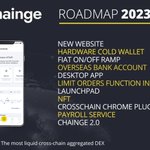
🏗️ We build, we build & then we build some more
Where we're at
▪️ The most liquid cross-chain aggregated DEX
▪️ The most advanced interoperability solution
▪️ & more: linktr.ee/Chainge.Finance
Coming soon
▪️ Virtual credit card + Hardware cold wallet
▪️ New website + Desktop Dapp

SuperED retweeted

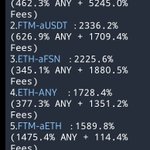
Very good day!
And congratulations @FinanceChainge earned 14K USD from below three pairs in 24 hours. Great profit!
Thank you all Chaingers! Keep the momentum


SuperED retweeted
Good idea! here is my 5 cents: for every likes plus retweets by Dec 31st 2022, I will buy 100$ worth of $CHNG on Jan 1st 2023!

SuperED retweeted
💻 "In code we trust" - Oanna Batran, Chainge CBO
🔥 In light of recent events, the rise of DeFi is imminent
🧵 We dedicate this thread to the impregnable @FUSIONProtocol tech powering the decentralized Chainge app
#DeFi #cryptomarket #blockchain #fintechnews #CHNG #FSN

SuperED retweeted

Total cross-chain trading volume on #Multichain has reached $90B!⛳️
How far away is the next $100B milestone?
- It's just around the corner!
