

Tokenized deposits · Exclusive ADI Chain partner in MENA & Africa · SWIFT's partner program member
London, The UK
Joined June 2023
- Tweets166
- Following54
- Followers191
- Likes34






Pinned Tweet
We’re excited to announce our exclusive strategic partnership with @ADI_Foundation — bringing together @dcm_systems banking technology and ADI’s institutional blockchain infrastructure to make tokenized deposits more accessible to banks across MENA and Sub-Saharan Africa.
Under the agreement, DCM will serve as ADI’s exclusive provider and implementation partner for Tokenized Deposit Solutions across MENA and Sub-Saharan Africa, while ADI will act as DCM’s exclusive distribution and referral channel for these solutions on @ADIChain_ in the same territory.
Together, we’re creating a practical path for financial institutions to adopt blockchain capabilities while continuing to operate on the core systems and controls they already trust.
A major step forward for the future of bank-grade digital finance.
Read the full press release to learn more about the partnership and what we’re building together: dcm.systems/blog/adi-dcm-tok…

New @BIS_org research asks a simple question: do stablecoins and bank deposits compete for the same money?
Based on US weekly data from 2019 to 2025, the answer is yes.
When US banks raised deposit rates by just 0.01%, net new stablecoin issuance over the following ten weeks slowed by about a fifth. The market kept growing, only more slowly.
Two details stand out:
- The effect is strongest for USDC, used mainly by US institutions, and much weaker for USDT, which is held largely offshore.
- It is visible in larger balances and extends to term deposits.
Paying more is one way for a bank to keep these funds, but an expensive one, because it reprices the whole deposit book. The other is to offer those clients what they came to stablecoins for, without them leaving the bank.
Which of the two will banks reach for first?
Source: Ahmed & Aldasoro, “Are stablecoins and bank deposits substitutes?”, BIS Working Paper No 1382, October 2026. Link in the comments.
#TokenizedDeposits #Stablecoins #Banking


Our partnership with @ADI_Foundation is part of a broader shift toward digital financial infrastructure that works with the banking systems already in place.
As ADI Foundation’s exclusive Tokenized Deposit Solutions provider across MENA and Sub-Saharan Africa, we are enabling banks to issue, manage and settle tokenized deposits on ADI Chain while preserving existing core systems, compliance processes and operational controls.
The latest @ADIChain_ recap brings this work together with other developments shaping the next phase of institutional digital finance.
Now, the focus is on turning that work into live deployments.


When a bank evaluates new infrastructure, the hardest questions rarely come from the technology team. They come from risk, compliance and vendor due diligence.
Can this provider show how information security is governed, not just implemented? Who is accountable for which controls? What changes inside our own control environment?
That is why @dcm_systems is certified to ISO/IEC 27001:2022. For us, that certification matters more than any list of encryption standards, because it gives a bank’s risk team a framework it already knows how to assess.
It also shapes how we build. Side-Core runs alongside the existing core, so a bank can add tokenized deposits without rebuilding the controls it already relies on.
We are extending our ISMS to ISO/IEC 27017 and 27018, covering cloud security and the protection of personal data in the cloud.

Tokenized deposits are moving from individual bank implementations toward shared interbank infrastructure.
SWIFT’s shared ledger is bringing tokenized deposits into the interbank conversation, while regional settlement networks and new tokenized payment rails are developing in parallel. ISO 20022 is becoming part of the connective layer.
The question for banks is increasingly not whether this infrastructure will exist, but how to connect existing systems to it.
That is the role of @dcm_systems Side-Core.
Side-Core acts as the connectivity and orchestration layer between existing banking systems and tokenized-deposit infrastructure — handling transaction orchestration, on-chain accounts, issuance and redemption, multi-signature controls, callbacks to the core, and reconciliation.
The core remains authoritative, while Side-Core provides the layer needed to participate in new tokenized settlement models.
The video shows six of the platform’s modules — part of eleven domains and more than fifty features.
The market is building shared infrastructure for tokenized bank money. Side-Core is how banks connect to it.
Learn more: dcm.systems/side-core-bankin…
#BankingInfrastructure #TokenizedDeposits #DigitalFinance #Payments #DCM
As @Sibos brings tokenized deposits to the forefront of the banking conversation, the discussion is moving from “why” to “how”.
Tokenized deposits are often discussed as a single model. In practice, the architecture can look very different.
In its new Tokenized Deposits for Banks primer, @tempo outlines three approaches: Tokenized Deposits, Deposit Tokens, and Tokenized Central Bank Reserves — each with a different relationship between the bank’s core, the blockchain ledger, and settlement.
The key distinction is where the authoritative record lives. In most live implementations today, the bank’s own books remain the source of truth, while blockchain operates as a programmable layer above the core. More advanced models move the authoritative record itself on-chain.
For banks, this makes tokenized deposits less of a “token” question and more of an infrastructure design decision — involving reconciliation, controls, liquidity, and ultimately interbank settlement.
At @dcm_systems, we see this as a critical part of the next stage of tokenized banking: introducing programmable financial rails without losing continuity with the infrastructure and controls banks already rely on.
Watch the video for a quick breakdown of the three models.
#sibos #SIBOS2026
@dcm_systems has officially joined the SWIFT Partner Programme.
Following the successful completion of SWIFT's onboarding and due diligence process, DCM is now part of its partner ecosystem.
This is an important step for us as we continue expanding our work at the intersection of traditional banking infrastructure and emerging financial technologies.
From ISO 20022-native payments to tokenized deposits and blockchain-based settlement, our focus remains on helping regulated financial institutions connect new capabilities with the systems they already use.
Joining the SWIFT Partner Programme gives DCM access to a broader ecosystem of knowledge, industry collaboration and future integration opportunities — and strengthens our engagement with one of the key infrastructures in global finance.
This is a meaningful step in bringing tokenized-deposit and ISO 20022-native infrastructure to the banks that need it.
Read more: dcm.systems/blog/dcm-joins-s…

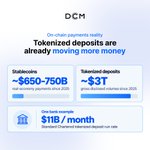
Stablecoins dominate the headlines. But tokenized deposits may already be moving far more money.
Since the beginning of 2025, we estimate real-economy stablecoin payments at roughly $650–750 billion. That includes around $390 billion in 2025, with monthly volumes running at more than $30 billion throughout 2026.
Over the same period, disclosed tokenized deposit volumes have reached approximately $3 trillion gross.
And that’s only based on institutions that actually disclose their numbers — including Kinexys, @Citi Token Services, @StanChart on mBridge, and @Ant_Intl Major players such as @HSBC, @dbsbank, @UBS and @PartiorOfficial do not publish comparable volumes.
The gap becomes even more striking when you look at individual banks.
Standard Chartered recently disclosed that its tokenized deposit activity has reached an $11 billion monthly run rate.
One bank. A relatively narrow set of corridors and use cases. $11 billion every month.
The comparison isn’t perfectly like-for-like: institutional treasury, liquidity and settlement flows differ from many stablecoin payment use cases.
But the direction is difficult to ignore.
While much of the market conversation is still focused on whether stablecoins will reinvent payments, banks are already moving trillions through tokenized versions of the money they use today.
Perhaps the next generation of payments will not require replacing bank money.
It may simply require upgrading it.
@ADI_Foundation @ADIChain_
#stablecoins #TokenizedDeposits #banking

DCM retweeted

Your money moves slowly for one reason: the core banking system underneath it is too old to move fast and too risky to replace.
Our partnership with DCM is built around that constraint.
DCM's Side-core platform is designed to operate alongside a bank's existing infrastructure, sitting between the core and ADI Chain so that institutions can issue, manage and settle tokenized deposits on-chain without rebuilding what they already run.
DCM will serve as ADI's exclusive Tokenized Deposit Solutions provider across MENA and Sub-Saharan Africa, and ADI will serve as DCM's exclusive distribution channel for those solutions on ADI Chain in the same region.
Both sides are building toward the same outcome: tokenized deposits that a bank can put into production using the systems it already runs.
Full release: globenewswire.com/news-relea…

More than a year ago, we were already making the case that tokenized deposits could become strategically important for banks.
Back then, this was still largely a forward-looking discussion. Today, the market is starting to put it into practice.
Stablecoins are moving deeper into institutional infrastructure. Open USD brought together more than 140 companies around a shared stablecoin model, while Visa launched infrastructure allowing financial institutions to mint, move, and manage stablecoins.
At the same time, tokenized deposits have moved well beyond isolated experiments. The Clearing House is developing infrastructure for interbank clearing and settlement of tokenized commercial bank money, while Swift has banks preparing to pilot cross-border payments using tokenized deposits.
Project Agorá is an especially interesting example. The BIS-led initiative brings together eight central banks and more than 40 regulated financial institutions to explore a shared programmable platform combining tokenized commercial bank deposits with tokenized central bank reserves.
And in July, it went beyond prototype testing. Twenty-eight financial institutions and central banks across Asia, Europe and North America completed real-value transactions in a controlled environment, covering 17 transaction scenarios and approximately CHF 800,000 in total value. The test demonstrated that real-value, multi-currency settlement using tokenized deposits and reserves can work on shared programmable infrastructure.
Even the broader institutional conversation has changed. In July, the IMF described tokenized bank deposits, stablecoins and tokenized central bank reserves as emerging components of a new financial architecture, while highlighting interoperability as one of the key challenges ahead.
A year ago it was: Why should banks care about tokenized deposits?
Today it is increasingly: How will tokenized deposits, stablecoins and traditional bank money operate together?
The strategic case for tokenized deposits is becoming clearer. The next infrastructure challenge is making all these forms of money interoperable.

July 2026 showed how quickly new financial rails are moving into the operational core of banking.
Stablecoins expanded into institutional distribution. Tokenised assets moved further into production. Cross-border payments became more real-time, while AI agents began initiating transactions and regulation started influencing infrastructure choices directly.
These developments may look separate, but they point to the same broader shift.
Financial institutions are not moving towards one blockchain, one stablecoin or one payment network. They are entering a multi-rail environment in which traditional accounts, tokenised deposits, stablecoins, public blockchains and existing payment systems must operate side by side.
In our latest article, we examine six developments that shaped July:
• institutional stablecoin distribution
• production-ready tokenisation
• interoperability across financial networks
• real-time cross-border payments and FX
• agent-initiated transactions
• regulation embedded into infrastructure design
The central challenge is no longer simply choosing a new rail. It is connecting several rails while preserving control over compliance, liquidity, reconciliation and settlement.
At DCM, this is exactly the infrastructure problem we focus on: helping financial institutions connect new payment and digital-asset rails to their existing core systems without rebuilding the core itself.
Read the full analysis: dcm.systems/blog/july-2026-f…
#FinancialInfrastructure #Banking #Stablecoins #Tokenisation #Payments #FinTech

SWIFT's shared ledger is ready for initial use.
One detail worth noting: SWIFT operates the shared layer, but each bank operates its own tokenized deposit environment — issuance against core balances, key management, integration with existing payment applications.
At DCM, we've built Side-Core for exactly this: a tokenization layer that runs alongside your existing core — no replacement, no migration — synchronized with core balances and ISO 20022-native, the same standard SWIFT chose for tokenized-value instructions.
Access to the ledger will open in waves. Readiness is what you can build now.
If that question is on your agenda — let's talk.

Implemented in 9 months. Global from day one.
Swift's blockchain-based ledger is ready for use, with ANZ, BNP Paribas, BNY, Citi, DBS Bank, First Abu Dhabi Bank (FAB), FirstRand, HSBC, Itaú Unibanco, Lloyds Banking Group, Mashreq, MUFG, OCBC, Standard Chartered, UBS, UOB and Wells Fargo preparing to pilot 24/7 tokenised cross-border payments.
This is a significant step towards scaling tokenised finance powered by the standards, security and global reach the industry relies on. By combining distributed ledger technology with Swift’s secure messaging network, the ledger:
-Enhances liquidity efficiency
-Improves cash flow visibility
-Enables seamless token recognition
What’s next? This is the first use case. The ledger creates a foundation for future innovation in areas like programmable money and agentic commerce, and we're continuing to explore more use cases with our community - helping to take tokenised money closer to scalable, real-world adoption.
Find out more: lnkd.in/eAucE_cJ
#Ledger #Tokenisation #CrossBorderPayments

How long it actually takes to build blockchain payment infra in-house:
JPMorgan: 3+ years HSBC: 2+ years Santander: 2 years
Legacy cores weren't built for 24/7 wallets, and ISO 20022 doesn't map natively to blockchain.
Side-core deploys alongside an existing core in 3–5 weeks instead.
@StellarOrg @ADI_Foundation

We’re glad to share that DCM will support integration with @openstandard and Open USD for our banking clients.
Open USD is another strong signal that stablecoins are moving from crypto-native use cases toward real business payment infrastructure.
For banks and financial institutions, the opportunity is clear: new rails, faster settlement, broader connectivity, and more flexible digital money flows.
But adoption still requires the right infrastructure.
DCM’s Side-Core platform allows banks to connect existing core systems to blockchain and stablecoin rails without core replacement or migration. Banks keep control over accounts, compliance, payment messaging, clearing, settlement, and reconciliation, while gaining access to new digital asset capabilities.
Stablecoin infrastructure is becoming part of the banking stack. DCM is built to help banks connect to it safely and at production scale.


The EU Parliament's Economic Committee just advanced the digital euro framework — and the requirements attached to it are worth reading carefully.
Banks operating under this framework would face 24/7 processing obligations, integration with the Digital Euro Service Platform, and continuous compliance monitoring. A 2027 pilot and 2029 launch are now on the table.
The issuance side of this story tends to get the most attention. But the harder question may be what sits behind it: can existing banking infrastructure actually support always-on, programmable settlement at institutional scale — without degrading the governance and auditability requirements that regulated institutions cannot compromise on?
That tension points to something structural. Core banking systems were not designed around continuous programmable flows. They were designed around batch cycles, end-of-day reconciliation, and sequential processing. Adding a wCBDC rail on top of that architecture is not simply a technical integration — it may require a coordination layer that operates in real time, maintains full auditability, and can interface with both legacy core systems and new tokenized rails simultaneously.
This is where the infrastructure framing starts to matter more than the product framing. The digital euro is not just a new instrument — it could become a live test of whether bank infrastructure can sustain the operational model that programmable money implies.
The settlement layer, the custody model, the interoperability between tokenized deposits and wCBDC flows, the permissioning logic that keeps compliance controls under institutional authority — these are not details to be resolved after launch. They may need to be in place before a pilot is credible.
For banks beginning to assess readiness, the question worth asking is probably not 'do we support the digital euro' but 'does our infrastructure support what the digital euro operationally requires of us' — and whether that gap can be closed without replacing the systems that still need to remain the system of record.
That is the problem space DCM is built around.

Most bank CTOs will tell you their core needs to change. Very few will tell you when.
The hesitation is understandable. Replacing a core system while the bank is running feels less like a technology project and more like open-heart surgery. The risk calculus rarely favors action — until external pressure makes inaction feel riskier.
What's worth examining is whether the choice is actually binary. Full replacement carries years of execution risk. But standing still may mean watching real-time settlement, tokenized deposits, and blockchain-based interoperability become table stakes — built by competitors who didn't wait.
A third path seems to be emerging: layering new capabilities alongside the existing core rather than underneath it. The core stays as the system of record. The new infrastructure connects to it, extends it, and runs modern flows without requiring a migration at all.
The question banks may want to sit with isn't "are we ready to replace?" — it's "how long before the window to modernize on our own terms starts to close?"