

B2B YouTube @decimalabs Create with AI @decimavault
New York, NY
Joined May 2023
- Tweets10.3K
- Following982
- Followers4.9K
- Likes26K





Alex | Video Marketing retweeted
we are switching to 90% agentic editing. we have unlimited data, workflows and proj files to train our model.
the key is, if you can train humans you’ll be very good at training AI

A few thoughts on agentic video editing I’ve had over the last few days:
1. 99% of ads should be edited agentically now. If your editors are still editing in the timeline, they’re falling behind. I got a message from my senior VE saying that he’s putting out 5x edits/day now at the same quality he was before.
2. The conversation with video editors will be uncomfortable because the timeline is all they’ve ever known. Some will be hesitant and some will be fearful for their job. I think the best way to address this is head on. The tech is inevitable, but having taste is still going to be incredibly valuable to train and give feedback to agents. Those who have this will become more valuable, those who don’t will struggle.
3. Opus 5.5 can natively edit all of your ads without needing any MCPs or plugins. I’ve tried the alternatives and couldn’t find anything that was significantly better than doing everything inside of Claude.
4. Have your senior editor(s) build skills for each style of edit (e.g. mashups, UGC, AI animations…). You can build these by feeding 4-5 inspo edits to Claude and tell it to make a skill out of it. I prefer building lots of mini-skills to one big video editing skill, so that the context stays as relevant as possible.
5. Once you have a base skill (e.g. ugly ads edits), the best way to train it is through feedback loops. Have the skill re-edit the last 25 ads each senior edited then put them in an artifact, and have the senior VE give feedback on each. Keep doing this until the skill is refined and it understands what a good edit is.
6. If you do this, there’s no reason why you shouldn’t be able to make edits that need little/no feedback. Most of ours are approved after v1 or v2, sometimes v3.
7. Only A-player editors should be training the skills.
8. Re adoption in the team, the AI champion builds the v1. Then get out of the way. I’m not the best editor on my team, so my job is to build the harness that lets the best editors train the skills, not build the skills myself.
9. If you want to supercharge this process, have your top editors record their screen as they edit. Turn on Gmeet or loom and get them to narrate the reasoning behind their process. E.g. why they chose this cut, pacing or b-roll clip…this is all context that gets fed into your skills.
10. It takes time to build, train and refine these skills. You have to go through the dip to get out the other side. Budget time in for senior VEs to work on this - otherwise you’ll end up with skills that put out subpar edits and don’t save you much/any time.
11. Operate under the assumption that this is the worst video editing is ever going to be. Opus 5.5 can do most of our editing today…what will Opus 6/Fable 6 be able to do? The editing skills you build are only going to become more valuable as the tech evolves.
I still don’t think people realise how big video editing being unblocked is. Things that I thought were 3-6 months away are now on the table.
Will continue to share more as I learn. CRAZY, crazy times.
Alex | Video Marketing retweeted
ohh boy ai editing is here and it’s over

If you'd rather skip the 11 rounds...
I've teamed up with @decimablack and ΔMΞN (one of the best editors I know), to launch @DecimaVault, a community on becoming an AI-assisted creator.
ΔMΞN's course on agentic editing drops this week. Get in early:
skool.com/decima-vault-7793/…

Alex | Video Marketing retweeted

If you'd rather skip the 11 rounds...
I've teamed up with @decimablack and ΔMΞN (one of the best editors I know), to launch @DecimaVault, a community on becoming an AI-assisted creator.
ΔMΞN's course on agentic editing drops this week. Get in early:
skool.com/decima-vault-7793/…
we are switching to 90% agentic editing. we have unlimited data, workflows and proj files to train our model.
the key is, if you can train humans you’ll be very good at training AI
A few thoughts on agentic video editing I’ve had over the last few days:
1. 99% of ads should be edited agentically now. If your editors are still editing in the timeline, they’re falling behind. I got a message from my senior VE saying that he’s putting out 5x edits/day now at the same quality he was before.
2. The conversation with video editors will be uncomfortable because the timeline is all they’ve ever known. Some will be hesitant and some will be fearful for their job. I think the best way to address this is head on. The tech is inevitable, but having taste is still going to be incredibly valuable to train and give feedback to agents. Those who have this will become more valuable, those who don’t will struggle.
3. Opus 5.5 can natively edit all of your ads without needing any MCPs or plugins. I’ve tried the alternatives and couldn’t find anything that was significantly better than doing everything inside of Claude.
4. Have your senior editor(s) build skills for each style of edit (e.g. mashups, UGC, AI animations…). You can build these by feeding 4-5 inspo edits to Claude and tell it to make a skill out of it. I prefer building lots of mini-skills to one big video editing skill, so that the context stays as relevant as possible.
5. Once you have a base skill (e.g. ugly ads edits), the best way to train it is through feedback loops. Have the skill re-edit the last 25 ads each senior edited then put them in an artifact, and have the senior VE give feedback on each. Keep doing this until the skill is refined and it understands what a good edit is.
6. If you do this, there’s no reason why you shouldn’t be able to make edits that need little/no feedback. Most of ours are approved after v1 or v2, sometimes v3.
7. Only A-player editors should be training the skills.
8. Re adoption in the team, the AI champion builds the v1. Then get out of the way. I’m not the best editor on my team, so my job is to build the harness that lets the best editors train the skills, not build the skills myself.
9. If you want to supercharge this process, have your top editors record their screen as they edit. Turn on Gmeet or loom and get them to narrate the reasoning behind their process. E.g. why they chose this cut, pacing or b-roll clip…this is all context that gets fed into your skills.
10. It takes time to build, train and refine these skills. You have to go through the dip to get out the other side. Budget time in for senior VEs to work on this - otherwise you’ll end up with skills that put out subpar edits and don’t save you much/any time.
11. Operate under the assumption that this is the worst video editing is ever going to be. Opus 5.5 can do most of our editing today…what will Opus 6/Fable 6 be able to do? The editing skills you build are only going to become more valuable as the tech evolves.
I still don’t think people realise how big video editing being unblocked is. Things that I thought were 3-6 months away are now on the table.
Will continue to share more as I learn. CRAZY, crazy times.


Alex | Video Marketing retweeted
If you want to get consistent leads by 2027 Q2, i am looking to onboard 1 more client by the end of this year.
If you’re looking for a business expense that will generate more business before the end of the year
click the link below:
decimalabs.com/youtube
ohh boy ai editing is here and it’s over
If you'd rather skip the 11 rounds...
I've teamed up with @decimablack and ΔMΞN (one of the best editors I know), to launch @DecimaVault, a community on becoming an AI-assisted creator.
ΔMΞN's course on agentic editing drops this week. Get in early:
skool.com/decima-vault-7793/…
If you want to get consistent leads by 2027 Q2, i am looking to onboard 1 more client by the end of this year.
If you’re looking for a business expense that will generate more business before the end of the year
click the link below:
decimalabs.com/youtube
This is the exact scorecard we use at DecimaLabs before a YouTube idea makes it into production.
I’m giving you the framework so you can use it on your own channel.
Here’s how to use it ↓
Take the exact video topic you’re thinking about making.
> RUN IT THROUGH ALL 7 FILTERS
Give it a score from 1 - 5 for:
- Buyer intent
- Differentiation
- Audience size
- ICP relevance
- Proof available
- Discovery potential
- Business relevance
1 = weak
3 = workable
5 = strong
Don’t overthink the number. The goal is to spot where the idea is weak.
> USE THE WEAK SCORES TO IMPROVE THE IDEA
Low discovery potential? → Change the angle or packaging.
Low ICP relevance? → Make the topic more specific to the buyer.
Low proof? → Add a case study, example, screenshot, or real result.
Low buyer intent? → Tie the topic closer to a problem people actually pay to solve.
Low differentiation? → Add a stronger opinion, new framework, or different point of view.
Low audience size? → Broaden the topic without losing relevance.
Low business relevance? → Ask whether this video would actually help attract, educate, or convert the kind of client you want.
Then score it again (that second score matters more than the first one).
> THEN MAKE THE CALL
28 - 35 → Record it
The idea is strong enough to move into production.
21 - 27 → Rework it
There’s something good there, but one or two parts still need work.
20 or below → Drop it for now
Don’t spend hours scripting, recording, and editing an idea that still has obvious weaknesses.

a lot of ai is mindfuck. stuff you shouldnt be wasting time & money in the first place.
install ai, do what you are already doing with ai, that’s it. unsubscribe from all the stuff because of marketing hype
just because ai can do something, doesnt mean that it should.
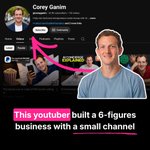
Corey Ganim walked away from a $16M e-commerce business.
Now he’s publishing YouTube videos that often get a few thousand views to sell AI consulting.
And it’s working.
His content is ridiculously specific:
→ How to sell a $999 AI assessment
→ How to build an “AI Concierge” retainer
→ How to audit a business for AI opportunities
→ How to save teams 5+ hours per week with AI
→ How to turn those assessments into implementations
That specificity does a lot of the qualification for him.
Someone watching a 20-minute breakdown on how to audit their company for AI opportunities already has a real operational problem in mind.
They’re trying to figure out:
→ Where AI can actually help
→ Which processes are worth automating
→ What implementation would look like
→ How much outside help they need
Corey’s videos answer those questions before the sales call.
That means the content itself starts building trust, showing his process, and making the offer easier to understand.
The production is simple too.
Mostly screen shares, real workflows, and Corey talking through exactly how he does the work.
For this type of B2B content, that format gives prospects something very useful: proof of how you think.
They can see the decisions you make, the steps you follow, and how you approach a real business problem.
The business behind those videos is where it gets interesting.
His $999 AI Assessment leads into $3K–$10K implementation projects, with Corey saying roughly 40% of buyers move into implementation.
He’s also built an AI Concierge offer doing around $8K/month, with clients paying roughly $1.2K–$2K/month.
This is a good example of why I don’t care if every video gets 100K views.
Corey is speaking directly to business owners already thinking:
“I know AI could help my company. I just have no idea where.”
By the time one of them books a call, they’ve already seen:
→ How he thinks
→ How he diagnoses problems
→ What he recommends
→ What the first offer costs
→ What working with him actually looks like
The video is already doing part of the sales process.
It attracts the right problem, educates the buyer, builds trust, and makes the next step feel obvious.
Follow me for breakdowns on what’s working (and d*ing) on YouTube right now.


understanding the demands (capital, talent, resources) of a business model is so underrated i wish i knew before i started out.
you can have the most talented engineers to build a superior product and still lose to a VC backed operation, simply because they have the distribution before you could.
or if you’re trying to sell creative services to enterprises but wondering why they’re going with a more expensive productized service with an inferior output instead of you… you don’t understand the business model.
i listened to @awilkinson story of how he poured $10M into a project management software and thought he could compete against a meta co founder who raised a bunch of money & started Asana with $100M + VC money.
learning from others mistakes has been my superpower. consuming every podcast i can about business kept me from starting a bunch of useless delusional side projects that would never go anywhere.
not a surprise after Atlassian acquired it

We've decided to sunset Arc on December 22, 2026.
That's not an easy sentence to write. We spent years building Arc and celebrating each and every release along the way: we have so much pride and love for what we made alongside the Arc community.
Our priority is to deliver best-in-class security for our members. Keeping a browser secure takes constant, dedicated work that is only increasing in the age of AI. Dia was built from the ground up to meet today’s security standards, so that's where our engineering and security teams will focus moving forward.
We've worked to make switching to @diabrowser as easy as possible for Arc members. Here's how:
· Your passwords, bookmarks, extensions and history come over to Dia seamlessly.
· Spaces, Folders, and Tab Groups are in Dia and import over with your data intact.
· Dia now surpasses Arc benchmarks in stability, speed, and security.
· The browser features you use in Arc are free in Dia, and the AI is optional.
Thank you for using Arc, for pushing us to make it better, and for building alongside us. The team that made Arc is the same team behind Dia, and some of our most ambitious work is just ahead. We'd love for you to be there with us when it lands.


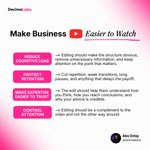
You are over editing your videos and it is k*lling your reach
1. Reduce cognitive load
Sometimes there is just too much happening on screen.
A zoom. Then a graphic. Then text. Then another sound effect.
At some point, the viewer stops listening to the actual idea.
The edit should help them focus, not give them more things to process.
2. Protect retention
Overediting can get tiring very quickly.
If the music is too loud, the cuts never stop, and something changes every few seconds, the viewer has no room to breathe.
You still want good pacing. Just not so much movement that it becomes exhausting to watch.
3. Make expertise easier to trust
Business content performs better when the viewer can clearly follow your reasoning.
The edit should help them understand how you think, how you reach conclusions, and why your advice is credible.
4. Control attention
Editing should be a complement to the video and not the other way around.
The viewer should still be focused on the person speaking and the idea being explained.
Use zooms, graphics, text, and sound only when they add something.

