

The fast, secure infrastructure of digital economies.
Joined October 2019
- Tweets1.3K
- Following85
- Followers1.1K
- Likes1.2K





1/3 Deepbase has achieved ISO/IEC 27001:2022 certification and SOC 2 Type 1 and SOC 2 Type 2 attestation
This is a verified security milestone that confirms our controls for managing infrastructure, access, data handling, and node operations across the @chainlink network

7/7 The biggest change is where Chainlink enters the development process
Instead of integrating CCIP and ACE after building a token, devs can add them with a checkbox
OpenZeppelin makes these Chainlink services part of its standard development workflow
1
23
6/7 OpenZeppelin and Chainlink are preparing 3 institutional reference solutions combining smart contracts with CRE workflows
They'll include deployable code, architecture docs, threat models, and security reviews
Institutions will be able to evaluate complete implementations rather than start from scratch
1
1
22
5/7 There's also Chainlink CRE
OpenZeppelin Defender, which automated contract monitoring and transactions, shut down in July 2026
Existing users now have a migration path to CRE, where workflows can run across decentralized oracle networks instead of a centralized automation service
1
1
19
4/7 For CCIP, the Wizard generates the mint/burn functions and permissions needed for cross-chain transfers
For ACE, it adds hooks connecting token operations to a Policy Engine
That means compliance rules can change without redeploying the token itself
1
2
17
3/7 OpenZeppelin has added CCIP and ACE to Contracts Wizard, AI tools, Skills, and documentation
Devs can now generate ERC-20, stablecoin, and RWA token code with cross-chain support and compliance hooks
Previously, adding these capabilities required separate integration work
1
2
27
2/7 DeFi devs commonly import audited OpenZeppelin contracts instead of writing from scratch
Its contracts have handled over $40T in transfers, with Aave, Uniswap, Lido, and Ethena among users
That's the scale of the developer ecosystem Chainlink can now reach

1
2
50
1/7 OpenZeppelin contracts are used by 9 of the 10 largest stablecoins and all 10 leading tokenized money market funds
Now @chainlink CCIP and ACE are integrated into its developer tools
This puts Chainlink directly into the process of creating new DeFi and tokenized assets

ALT Chainlink integration with OpenZeppelin $LINK
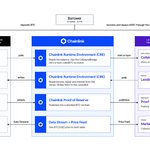
2/2 Fulcrum combines CRE, CCIP, and Data Streams to coordinate repo trades, collateral transfers, pricing, and repayment across public and private blockchains
How does it work, and how is it different from DeFi lending? Deepbase explains in its latest article: deepbase.org/blog/chainlink-…

1
23
1/2 Repo, a $30+ trillion financial instrument most institutions use daily, is finally available onchain thanks to @chainlink
Chainlink Fulcrum is infrastructure to facilitate cross-chain repo trades and similar operations with digital assets, making full use of RWAs ⬇️

Deepbase retweeted

NEW: @moodysratings, the global credit ratings provider with 125+ years of experience, completed a Chainlink-powered testnet pilot to extend its credit ratings infrastructure across the tokenized economy.
Using CCIP, Moody’s Ratings successfully demonstrated multi-chain deployment of credit assessment data, establishing a foundation for bringing its ratings to the networks where tokenized assets and capital are moving.
As assets move onchain, the credit intelligence institutions rely on must move with them.

Deepbase retweeted
LIVE: @CharlesSchwab clients can now access the LINK token on Schwab Crypto.
Schwab is the largest brokerage platform in the U.S. with over 40 million accounts and $12+ trillion in client assets.


As of today, Schwab Crypto™ clients can buy and sell solana (SOL), avalanche (AVAX), and chainlink (LINK), in addition to bitcoin and ethereum. These new tokens are part of Schwab’s plans to thoughtfully expand its digital asset offering.
Learn more: spr.ly/6019BHFa25
7/7 $15B in migrations is a clear signal that CCIP's security is growing stronger and more leading protocols prefer it over alternatives
Once traditional finance starts issuing RWAs en masse, they'll stick to CCIP by default
We'll see trillions flow through CCIP
1
15
6/7 CCV got traction already:
- Lombard protocol has already adopted custom CCV verifications for LBTC and BTC.b worth $1.1B
- Three protocols started developing CCV infrastructure for institutions
- Google Cloud and AWS started supporting CCV deployment through the cloud
1
1
20
5/7 Chainlink Cross-Chain Verifiers are designed for:
- Banks to apply internal verification to tokenized deposit transfers
- RWA issuers to add checks for tokenized bonds and securities
- DeFi protocols to add attestations for large transfers
1
1
14
4/7 A large security improvement in CCIP 2.0 was Cross-Chain Verifiers or CCV
In short, CCV enables independent cross-chain tx security checks by external entity that allow institutions to integrate their own security practices for their RWA transfers

1
1
12
3/7 The reason behind the wave of migrations is top-level security provided by CCIP compared to other solutions
KelpDAO migrated to CCIP after a $292M bridge exploit involving its rsETH, while Wyoming Stable Token Commission switched to CCIP after a security review
1
1
15
2/7 The largest protocols migrating to CCIP from legacy bridges were BitGo with $7.7B+ of WBTC, Mantle with $2.5B+ of MNT, and KelpDAO with $1.5B+ of rsETH
BitGo is the most notable case: the company stated that WBTC and future BitGo-issued assets will use CCIP exclusively
xitter.gq/chainlink/status/20860…

$15,000,000,000 in value is migrating to Chainlink CCIP as top protocols deprecate their legacy cross-chain providers.
Industry leaders making the move ↓
• @BitGo
• @Mantle_Official
• @KelpDAO
• @Lombard_Finance
• @SolvProtocol
• @Virtuals_io
• @Re
• @Krakenfx
• @PleasingMarket
• @Tenbinlabs
• @YuzuMoneyX
• @Commertize
Just use Chainlink.

1
1
30
1/7 Over $15B in token value migrated to @chainlink CCIP in 2026 with a shift in the cross-chain solutions landscape
We'll probably see more institutions switching to Chainlink, especially after CCIP 2.0 introduced new security feature, Cross-Chain Verifiers ⬇️

8/8 So, last week we got:
- S&P VRA for $10B+ in lending vaults
- Chainlink 24/7 for $8B+ in RWAs
- CustodySync to unlock $700B for DeFi markets
- Plus more tech-oriented announcements
Billions in potential markets, trillions next
@chainlink
3
27
