

Building @VoiceMOAT, the Personal Brand OS for LinkedIn and Twitter. One system to build, engage and grow. Try it here: https://xitter.cf/t.co/s8hNCpR4H8
Remote
Joined April 2020
- Tweets26K
- Following1.6K
- Followers14K
- Likes14.2K







Pinned Tweet
AI made posting faster. It also made everyone sound the same.
The creators who win are the ones who read like themselves. Generic posts don't build an audience, they build a feed full of noise.
So we built @VoiceMOAT: the Personal Brand OS for Twitter and LinkedIn.
Write, schedule, engage, analyse. One system, built around your voice.
Replies grow your account. Keeping up with them doesn't scale.
The @VoiceMOAT Chrome extension sits on every post on Twitter and LinkedIn. Reply, comment, remix and draft posts as you. You still press Reply.
Replies grow your account. Keeping up with them doesn't scale.
The VoiceMoat Chrome extension sits on every post on Twitter and LinkedIn. Reply, comment, remix and draft posts as you. You still press Reply.
chromewebstore.google.com/de…

the dangerous part of AI coding isn't when it fails
it's when it works for the wrong reason
the usual culprits:
wrong database
wrong assumption
wrong permission
wrong customer
wrong definition of "done"
syntax errors are loud
bad assumptions are quiet
and quiet bugs are the ones that reach production
the more capable coding agents get, the less i worry about whether they can write the code
i worry about whether they understood the system well enough before they started writing it
because a confident agent with the wrong mental model is way more dangerous than one that just throws an error
Your app makes $8K a month.
Google offers you a $200K/year job.
But you have to give up the app to take it.
Are you taking the job?
Try it for $1 for 3 days at voicemoat.com/
Or DM me and I'll set it up with you.

I'm guilty of this too.
AI made building so cheap that a new idea turns into a new project the same day.
New idea? Build it.
No customers? Build something else.
No revenue? Start another project.
Coding isn't the scarce skill in 2026.
Knowing when to STOP building and start selling is.
Everyone in my feed is asking how to grow without ads, and the answers are all tools.
The tactic I'd bet on is the boring one: go find 20 people who already have the problem and talk to them before you build anything else.
It seems Be10x team ran a paid LinkedIn campaign last week, everyone posting same AI image, with same template upgrade your AI skills.
They went out used LinkedIn influencer who write in there BIO's Keywords like "HR", "AI & Tech Content", "Content Creator", "Helping founder write better content", "AI & Tech".
My real question to there team your target audience to learn AI marketing is the same folks who have these keyword, and if you are paying them for a paid campaign.
Then who your real target audience is?
Cause next thing I know in your marketing campaign this is going to show up on Insta, and you'll lure in college kids, "looking for job" professionals to buy your 1k course.
Like what's the ROI of this campaign.

I used to feel guilty hanging up on cold callers.
My logic was simple:
“If I’m going to say no anyway, why waste 30 seconds of their time?”
Then AI cold calls arrived.
Now, I hang up guilt-free.
Turns out, robots are great for my mental health.
How to vibe code from anywhere:
→ Get the $200 Claude Max plan
→ Install the Claude Mac app and open Claude Code
→ Create a repo and plug your laptop in
→ Install the Claude app on your iPhone and sign in to the same account
→ In Claude Code, run /rc (or claude remote-control) and scan the QR code
→ Open the Code tab on your phone and pick the session
→ Turn on voice dictation
Your laptop does the work. Your phone is just the window.
Now go for a walk, hit the gym, buy groceries, watch Netflix, or sit in the jacuzzi.
All while vibe coding.
Rest those fingers, frens.
Codex has its own phone control now, but Opus 5.5 is better. Fight me.
Sam Altman said in 2025 that customer support jobs would be "totally, totally gone."
This year he admitted entry-level white-collar hiring hasn't dropped as fast as he thought.

Three security incidents landed in the last 48 hours.
Here is what actually happened, and what needs to be done.
1) The certificate incident
An Indian certificate authority, eMudhra, generated weak private keys for 8 of its intermediate certificates during a key ceremony in April 2025.
Anyone could recover those keys from the public certificates.
Chrome, Firefox, Apple and Microsoft have now blocked them.
2) The iPhone Bluetooth flaw
Apple has patched a Bluetooth flaw that could let a nearby attacker run code on iPhone 11 and later.
The patch is already out, in iOS 27 and 26.7.
Apple has not confirmed anyone exploited it.
3) The PHP bug
Two flaws in PHP itself allow remote code execution with no login. Every PHP version back to 5.4 is affected.
Patches landed yesterday. Attack attempts started before the patch did.
Chrome also shipped version 156 this week, with 353 security fixes.
What needs to be done:
→ Update your browser first
→ Update your phone and computer OS
→ iPhone 11 or later: update iOS now. Keep Bluetooth off only until you do
→ Update desktop apps like Slack, Cursor and Discord
→ Avoid untrusted Wi-Fi until your devices are updated
→ Ignore any email offering a "certificate fix". That is the phishing wave this incident creates
→ Developers: update pip, uv and npm, and update PHP. Updating is the only complete fix
AI doesn't make you 10x faster on its own
It makes you faster at whatever you were already doing, including the mistakes
Speed only helps if the thinking came first
I don't think Anthropic rushes Fable 5.5 this week
Opus 5.5 is already way ahead, so they have no real reason to
If Fable ends up costing twice what Opus does, I'd be more hyped for Opus 5.6, especially if the 50% Fable limits stay
Happy to be wrong on this one
Vibe coding gets you live in a weekend.
Speed is what makes people stay 👇
20 things to fix in your vibe coded app:
→ Measure first: run Lighthouse and PageSpeed on mobile
→ Compress every image to WebP or AVIF
→ Lazy load images below the fold
→ Serve static files from a CDN
→ Remove packages your AI added but never used
→ Split your JavaScript so pages load only what they need
→ Preload your main font, and use only 1 or 2 fonts
→ Add database indexes on columns you filter by
→ Fix N+1 queries
→ Paginate lists instead of loading everything
→ Cache API responses that rarely change
→ Stream AI responses instead of waiting for the full answer
→ Show skeletons and loading states, not blank screens
→ Move heavy work to background jobs
→ Put your server close to your users
→ Kill cold starts on your main routes
→ Debounce search inputs
→ Remove third party scripts you don't need
→ Test on a cheap Android phone on 4G
→ Ask your AI: "What makes this app slow?"
Users don't wait.
Every extra second of load time costs you signups.
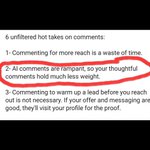
Someone on LinkedIn said AI comments are everywhere, so your thoughtful comments carry less weight.
I think that's backwards.
He's right about one thing. Commenting isn't the most valuable move on this platform.
→ Posting content is worth more
→ DMs are worth more
→ Connection requests probably are too
But that's a ranking of actions. It says nothing about whether comments still count.
Here's the logic:
AI comments flood the feed.
They all sound the same.
Generic praise. A neat restatement of the post. A polite question at the end.
When most of what you scroll past is that, a comment with a real opinion in it is easy to spot.
It's supply and demand. The more filler there is, the more a comment that sounds like an actual person is worth.
AI didn't make thoughtful comments worthless.
𝗜𝘁 𝗺𝗮𝗱𝗲 𝗴𝗲𝗻𝗲𝗿𝗶𝗰 𝗼𝗻𝗲𝘀 𝘄𝗼𝗿𝘁𝗵𝗹𝗲𝘀𝘀.

Teaching an AI your voice is mostly a sourcing problem.
Most people paste in 20 random posts and wonder why the output sounds like a stranger doing an impression.
Here's how I'd do it instead.
1. Pick the posts that sound most like you
Not your best performers. The ones where you read it back and think "yeah, that's exactly how I'd say it." A post can do well and still sound like someone else. Skip those. A handful you'd sign your name to beats a pile of average.
2. Point out what matters, leave the rest alone
Tell it what you actually care about: how short your lines run, the words you keep coming back to, how you open, how you land. Don't explain every quirk. Over-explaining makes it exaggerate the quirks. A few clear patterns are enough, and it'll find the rest in your posts.
3. Run the check
Take a draft and remove your name from it. Then ask: if this showed up in my feed, would I know it was mine? Better yet, mix it in with 3 of your real posts and see if you can still tell which one the AI wrote. If you can spot it in seconds, the source posts were wrong. Go back to step 1.
It's slower than pasting and hoping.
But the draft that comes out is one you only have to edit, not rewrite.
I still write my first drafts by hand.
Before any tool touches the post.
Not because the tools are bad. Because the first draft is where I find out what I actually think.
When I start with a generator, the post comes out smooth, and smooth is the problem.
The rough edges are where my real opinions live. A generator sands them off.
So the draft stays messy. I say the thing plainly, then tighten it.
That's what keeps the post mine.
The biggest AI builders are putting hundreds of billions behind it.
Plenty of investors think they're making a mistake
Odd part is most of those investors have struggled to beat a plain index fund for years, and now they're second guessing the people building the models
Maybe the investors are right
Maybe the builders are
Never seen the stakes this high with the two sides this far apart