
Pharmacist-turned-entrepreneur & co-founder of Customertimes, a bootstrapped global digital engineering and technology consulting company.
Boca Raton, FL
Joined January 2008
- Tweets29
- Following280
- Followers243
- Likes153


Technology is ready. People are not.
The same is true for FSD and AI agents. If you check every action, there is little benefit. The real value starts when you let go of control.
The bottleneck is no longer technology. It is trust.

ALT Cybertruck FSD 96% of my driving journey
My latest experiment: a virtual investment fund trading stock options with no employees, only AI agents.
For now, I’m CEO/CIO. The goal is to eventually replace myself too.
Research: fundamentals, SEC filings, analyst views and live options across 54 stocks.
Earnings: 1,048 earnings events analyzed over 5 years.
Transcripts: detects changes in management tone quarter to quarter.
Insiders & 13F: tracks large insider trades and 25 investors.
X Sentinel: scans financial X plus macro and geopolitical news every 30 min. Cost: ~$9/month.
X Ideas: collects options ideas from X and tests them against our rules.
Quant: checks every idea against the live chain: price, liquidity, spread, delta, downside and return.
Vol Board: finds where the market is paying unusually well for taking risk.
Then every trade has to pass 26 automated risk gates before execution.
The interesting question isn’t whether AI can help an investor.
It’s whether you can build a fund where agents do everything, including eventually replacing the fund manager.
Sat for a robot portrait today. It studied my face with the intensity of a senior engineer reviewing a pull request for a second - then spent another 40 seconds drawing me like I owe it money.
No filter. No Photoshop. Just a mechanical pencil with zero emotional attachment to my feelings.
10/10 would let a machine judge my bone structure again

This is massive.
Salesforce is basically saying the future user of enterprise software is not a human, it’s an AI agent.
If that’s true, UI stops being the moat.
Headless 360 is not just a product launch.
It’s a signal that enterprise software is shifting from screens humans click to infrastructure agents operate.
That’s a far bigger change than most people realize.

Welcome Salesforce Headless 360: No Browser Required! Our API is the UI. Entire Salesforce & Agentforce & Slack platforms are now exposed as APIs, MCP, & CLI. All AI agents can access data, workflows, and tasks directly in Slack, Voice, or anywhere else with Salesforce Headless 360. Faster builds, agentic everything. 🚀
#Salesforce #Agentforce #AI
venturebeat.com/ai/salesforc…

Jensen Huang said coding is a solved problem. I run an enterprise tech company. He's right — and everyone's drawing the wrong conclusion.
AI agents write production Salesforce Apex, SAP ABAP, Java. In hours, not weeks. But every line still ships under a human's name.
Why? Agents don't know WHY that SAP transaction exists. They can't judge if the solution solves the actual business problem. They have no idea what breaks downstream.
In pharma, a wrong mapping = compliance violation. In CPG, a misconfigured flow = lost revenue. No agent signs off on that.
Developers who write code? Abundant. People who set direction, judge the output, and own what ships? Scarce and getting scarcer.
Code is a commodity. The people who wield it wisely are not.
516 hours. $66,400. 4 months. 5 people.
That's what a traditional team would need to build my CRM.
Did it in 20 hours with Claude Code on OpenClaw. $200/month.
Replaced HubSpot + Monday + Notion + Zapier. 47 features. 13 AI tools. Vector knowledge base. LinkedIn enrichment. Telegram bot interface.
Not a prototype. A production system I use every day.
Pings me about contacts I haven't spoken to in 90 days. Suggests who to meet before I fly to a conference. Auto-enriches LinkedIn profiles into structured data.
Integrated with voice recordings, email, and my full knowledge base.
Knows my entire professional context because everything lives in one system, not scattered across 4 apps that don't talk to each other.
No SaaS product does this. They're built for everyone. Optimized for no one.
The SaaS moat was always distribution + switching costs + "good enough."
Claude Code attacks all three. One subscription instead of a procurement process. Your code instead of someone's proprietary database. A system shaped around your workflow, not theirs.
Solo lawyers replacing Clio + Notion with a custom AI legal assistant. Small agencies dropping Monday for a system that thinks the way they work. Consultants building a CRM and a second brain in one tool.
These people don't have IT departments. They have a credit card and a problem. $200/month to replace $2,000/month in SaaS is a no-brainer - especially when the replacement is smarter.
The $50B SMB SaaS market just got a new competitor. It's not a startup. It's the customer.
The biggest software bet Jensen Huang has ever made: NemoClaw.
He called OpenClaw "the most popular open source project in human history." NVIDIA just made it enterprise-ready.
Jensen has 50+ direct reports. He personally approves junior engineer offers that go $1 over the standard band. One word email: "approved."
His obsession: "Speed of Light" — everything benchmarked against the theoretical max of the hardware. Not competitors. Physics.
Every decision is lightning fast. Hundreds of millions approved in hours, not quarters.
Headcount? Technically limited. Practically unlimited. The only real constraint is the hiring bar — harder than Google, Amazon, or Microsoft.
Engineers make every decision. HR just records them.
NemoClaw is the logical next move: one team, one stack, AI agents on your own hardware. No dependency on someone else's cloud.
Jensen compared it to Windows for a reason. Windows gave everyone access to a computer. NemoClaw gives every enterprise access to AI agents.
Knowing how this company operates — I wouldn't bet against it.

🥊 Built an AI boxing analyst while driving to the gym.
Voice-dictated a task to Claude Code: study boxing books, find video analysis tools, overlay on fight footage.
By the time I parked, it had downloaded a fight, mapped punches & movement, and reassembled the video with full analysis.
No code. Just a car ride.
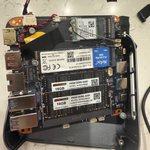
My Magace mini PC burned last night. 32GB RAM, NVMe SSD, running AI agents 24/7.
Had to crack it open and extract the SSD to recover files.
Lesson: if you're running local AI infra — back up your drives. RAID or cloud sync. Not "I'll do it tomorrow." (1/2)

We’re hiring a Salesforce Enterprise Architect at Customertimes.
Not a “just implement the spec” role. You’ll own the full journey:
• client discovery & presales
• enterprise architecture & roadmaps
• hands-on Salesforce design
• governance across complex programs
Ideal: Salesforce Architect certs + industry experience.
Remote: USA, Canada, Poland, Brazil
Know someone great? Tag them or DM me. 👋
Set up OpenClaw in Docker on a Linux box. Wired it into Telegram. Fed it my channel content so the agent could learn my writing style. Ran local TTS instead of ElevenLabs — quality surprised me.
What I built isn't a chatbot. It's closer to an operating system for agents.
Thank you @Tesla for an absolutely seamless and amazing customer experience while ordering my Model X! 🚀
From the online configurator to delivery scheduling, everything was smooth, transparent, and actually enjoyable.
@elonmusk & team, you’ve set a new standard. Grateful and beyond excited! ⚡️
#Tesla #ModelX #TeslaExperience
🤖 Made with AI
Max Votek retweeted

How to Price Your AI Product: Actionable Lessons from @MadhavanSF bulaev.net/p/how-to-price-yo…

Max Votek retweeted
While GLP-1s help preserve human memories from one side, we in AI are working on enhancing and storing them from another! From digital memory banks to emotional RAG systems, we're creating tools to help humans remember more and better. Together, medicine and tech are revolutionizing how we protect our memories

GLP-1 Receptor Agonists: A Potential Breakthrough in Alzheimer's Treatment
What can't Ozempic actually cure?
New evidence is emerging that GLP-1 receptor agonists—widely known for their role in treating type 2 diabetes and obesity—might hold promise for Alzheimer's disease. Recent studies and clinical trials have indicated that these drugs, such as semaglutide (marketed as Ozempic and Wegovy), could potentially modify the course of neurodegenerative conditions.
The key mechanism driving this potential lies in GLP-1's ability to reduce inflammation and improve insulin signaling in the brain. Chronic inflammation and impaired insulin pathways are believed to contribute significantly to Alzheimer's pathology. In preclinical studies, GLP-1 receptor agonists have shown the ability to clear amyloid-beta plaques, a hallmark of Alzheimer's, while also reducing tau pathology and improving cognitive function.
Notably, a Phase 2 trial of Novo Nordisk's semaglutide demonstrated early signs of slowing cognitive decline in patients with mild cognitive impairment and early-stage Alzheimer's. Though the data is still preliminary, the results are encouraging enough that large-scale Phase 3 trials are underway to further investigate these effects.
If successful, this could mark a major breakthrough in Alzheimer's treatment, offering a new path for disease modification beyond the traditional focus on amyloid plaques alone. The dual benefits of addressing metabolic dysfunction and neurodegeneration position GLP-1 receptor agonists as a potentially transformative approach.

Max Votek retweeted

Read the full paper here: arxiv.org/abs/2411.10109
