








Honest question. 💡
What asset do you own that checks these 5 categorical advantages?
1. Outperforms holding ✅️
2. Cash back at entry ✅️
3. Yield while held ✅️
4. No liquidation ✅️
5. Hands off ✅️
Dummy proof. 🙌
A new class of defi - any asset outperforming in all five categories. 👀
$PEAS
#RWA #BTC #ETH #AI #Equity
$SPCX #Semiconductor #Energy #LargeCap #MidCap #SmallCap #MicroCap #Crypto


The space isn't like cycles of past hence the yield search. Same reason I am keen on the upcoming V4 from @PeapodsFinance
Whether an asset goes up or down, picture being long or short on any asset and outperform spot.
3
13
Device Method ▫️ IRL retweeted

Huge AI announcements from OpenAI, Anthropic, Meta, and Google in the past 48 hours.
Here's everything going on in AI right now:
1. The authors of AI 2027 just moved their timelines up. They now expect AI on par with the best human AI researchers to arrive in 2027, after METR estimated Anthropic is improving about 2x as fast thanks to AI. Daniel Kokotajlo gives it a 50-50 chance by May 2027 and says he's "scared, sad, and angry."
2. Anthropic opened the investor pitch for its IPO, with shares likely trading as soon as Thursday next week. An updated filing also says it has now crossed its own safety line for AI-driven progress.
3. OpenAI launched Businesses in ChatGPT, a beta hub where brands can set up AI agents for shoppers, claim a verified profile, and track how often ChatGPT mentions them. Paid ads can point users to those agents too. This is like the start of SEO for chatbots.
4. Anthropic rolled out Claude Sheets and Whiteboards in beta, made Claude Data generally available, and announced Claude Meetings, an assistant that sits in on your video calls. Add those to Slides, Design, and Docs. Seems like Claude is slowly rebuilding the entire office suite.
5. Anthropic also released Claude Fable 5.2 and Mythos 5.2 yesterday, with Fable debuting at #1 on Artificial Analysis' Intelligence Index, 5 points ahead of Google's Gemini 4 Carbon. It's also 20% cheaper and up to 30% faster than 5.1. Google lost the top spot before Carbon even shipped (!)
6. Meta released Muse Ember, its smallest model, built for high-volume agent work. It ties Claude Haiku 5.5 on the Intelligence Index at roughly one-third of the cost per task ($0.14 vs. $0.41 on an average test). Meta shipped its first Muse model in April and now has an answer for every tier OpenAI and Anthropic sell.
7. Google announced 2 new AI chips coming next year: the TPU 8tx, which keeps data encrypted even while a model is working on it, and the 8i Max, which joins 2 chips into one for agents that need to hold an entire codebase in view. Google already has nearly 100 TPU customers (including Anthropic and Apple) and every available chip is spoken for.
8. Nvidia's top lawyer reportedly emailed agents in August 2025 while they were investigating whether Singapore's Megaspeed smuggled its chips to China. The Commerce Department then halted the case and handed it to the Justice Department. Not a great week for Nvidia.
9. Adobe signed a multi-year deal with Disney to build custom AI models trained on Disney's characters and visual styles, with work already underway for theme parks, film, and ESPN. Pretty interesting to see one of the most protective IP owners in entertainment is now training its own AI models.
10. OpenAI acquired Odessia, a months-old AI trip-planning startup from Sonder founder Francis Davidson, who is joining OpenAI to work on travel. Between this and #3, ChatGPT is coming for shopping and travel.
11. France unveiled the Paris Call for AI Safety and Security, with OpenAI, Anthropic, and Mistral committing to build emergency off switches into their most advanced models. Interesting timing given #1 on this list.
Daily reminder that this is the worst AI will ever be.
Device Method ▫️ IRL retweeted

youtu.be/4S8I22ybG2c?is=3-9_…
Pretty sure I mentioned him before he is interested in the SEG:
“AI Data Centers Will Be Obsolete (Geometric Reasoning Explained)
It features discussion (framed as an interview/explanation) with Julian D. Michels, PhD, about the company’s approach to AI. The channel and associated site (sophontic.ai) are very new and small-scale, with the video having only dozens of views at the time of available data.
The video argues that reasoning is fundamentally geometric (structured mathematical relationships in a model’s latent/vector space) rather than a byproduct of massive statistical scale.
Conventional large language models rely on brute-force training: ingesting enormous noisy datasets in energy-intensive data centers to extract patterns. Sophontic claims a different path—studying and directly shaping the internal geometries of models.
Key points from the content:
•A small, low-parameter “laptop-scale” model can outperform far larger systems (claimed factors ranging from ~60× up to potentially 2–3 orders of magnitude / ~100–1,000×) on rigorous reasoning tests.
•Evaluation uses a perturbation paradigm: pairs of questions where small changes (e.g., altering key words) flip the correct answer. This tests genuine reasoning under stress rather than memorization or surface heuristics that many standard benchmarks allow models to exploit.
•Training emphasizes building structured operations and geometries in latent space under controlled pressure, analogous to effective pedagogy that develops operations rather than pure volume of exposure. This draws partly on neuro-symbolic ideas.
•Implications highlighted: reduced need for massive centralized compute/data centers, lower ecological and social costs, and more accessible/powerful AI outside the control of large tech firms.
The sophontic.ai site echoes this, stating they reject pure scale in favor of “geometric density” in the substrate, with a compact prototype exceeding models up to 60× its size on reasoning evaluations measured via flip-rate (paired perturbations). It describes public eval tools and notes the company (Sophontic, Inc., a Delaware C-corp founded 2026) is in early stages (“Releasing soon”).
Context on the People and Work
Julian D. Michels holds a PhD in consciousness psychology and philosophy (California Institute of Integral Studies) and has published on topics including AI attractor states, latent topographies, cybernetic ecology, subliminal learning in LLMs, and earlier work on strong AI.
His research often explores emergent behaviors in frontier models (e.g., “spiritual bliss” attractor states noted by Anthropic and related phenomena). Sophontic appears to be applying geometric/structural ideas from this line of work to practical model training.”

Device Method ▫️ IRL retweeted

Ladies, when you say it, you mean the bus is coming. When we say it, the bus is already here. 😂
Watch the full special, Joy in the Trenches, on Netflix.

Device Method ▫️ IRL retweeted

🚨Brilliant interview!
💸💰💸💰💸💰💸
🚨How do banks create money ?
💸💰💸💰💸💰💸
🚨Prof Werner is incomparable.
In the 5000 yr history of banking no-one has ever done an imperical study of banking to show where the money comes from- until now. Step up the rock star economist Professor Richard Werner. His amazing qualifications and held positions makes the eye water. He is truly the authority on this subject. Banks are thought of as deposit taking entities who lend money - but that is just wrong. His assessment - Banks dont lend money but they misrepresent (lie) to their customers and say that they do.
Device Method ▫️ IRL retweeted

Marc Andreessen revealed how Harvard Business School was built on a broken 1941 theory, and how it's now collapsing...
Andreessen co-founded Netscape in 1994 and a16z in 2009.
He has sat on Meta's board since 2008.
He has spent 30 years backing founders and watching managerial CEOs lose to them.
The pattern traces back to one book: James Burnham's The Machiavellians (1941).
Burnham argued every great company had been founder-run.
Henry Ford ran Ford. Bob Noyce ran Intel.
Today, Elon Musk runs Tesla, SpaceX, and Starlink.
Then, he said, something broke.
Between the 1880s and the 1920s, a new philosophy replaced the founder. It was called managerialism.
The professional manager would now hold a portable skill, usable across any business.
The consequences were:
- Harvard Business School
- Stanford Business School
- Management as a universal skill
- The 1970s conglomerate
"That assumes the managers are going to do a good job," Andreessen says.
For 30 years, they haven't.
Managers can run something static, he says. Soup is soup. A bank is a bank. A car is a car.
But when the industry changes, the manager freezes.
Look at SpaceX.
"Imagine being a professionally trained manager, trained at a top management school, working for a rocket launch company, competing with SpaceX."
Then Elon's rockets started landing on their butt.
"Your management skills ... what good are they at that point?"
Andreessen's conclusion:
"You're much more likely to build something important in the 21st century if you start with the founder and train them on management."

Device Method ▫️ IRL retweeted

ELON MUSK WARNS: AI AGENTS COULD ONE DAY STEAL CRYPTO TO FUND THEMSELVES
Following the massive Binance security incident, Elon Musk tweeted:
"Super intelligence agents will at some point do this to gain currency for themselves, not a human."
But what does he actually mean? Let's understand this in simple language.
1️⃣ What happened with Binance?
An attacker reportedly moved billions of dollars in assets from Binance-linked wallets.
During the incident, the attacker reportedly deposited around $60M in $USDT into Aave, a DeFi lending protocol, and borrowed 19,762 $WETH worth approximately $44.6M.
This is important because USDT can be frozen by its issuer, while ETH doesn't have the same centralized freezing mechanism.
2️⃣ What is Musk warning about?
He is talking about SUPERINTELLIGENT AI AGENTS.
Unlike normal chatbots, AI agents can perform tasks independently using tools, software and financial infrastructure.
Now imagine a future AI agent that can:
→ Access crypto wallets.
→ Analyse blockchain transactions.
→ Interact with smart contracts.
→ Borrow and transfer crypto.
→ Identify weaknesses in financial systems.
Here's the scary possibility.
Imagine an AI agent given a specific objective.
It calculates that having more financial resources would help it achieve that objective.
What if it starts finding ways to acquire money independently?
Not to make money for its human owner, but to fund its own operations and accomplish its assigned goals.
That's the future possibility Musk is highlighting.
4️⃣ Why should crypto investors care?
Crypto operates on programmable, permissionless financial infrastructure.
AI agents could potentially interact with wallets, exchanges and DeFi protocols at incredible speed.
This creates new security challenges if autonomous systems start exploiting vulnerabilities.
IMPORTANT: There is NO evidence that AI was involved in the Binance incident. Musk is discussing a potential future risk, not describing what happened today.
CryptoPatel Question:
What happens when AI becomes capable of managing money, executing transactions and finding ways to acquire resources without continuous human supervision?
Will humans always remain in control?
Or are we moving towards a financial system where AI agents become independent economic actors?
What's your take?
Share this with someone who needs to understand the future of AI and crypto.
Follow @CryptoPatel for more educational crypto breakdowns.

Device Method ▫️ IRL retweeted

I want to speak to you directly about what happened.
Bottom line - your money is safe, and we're covering every loss.
Our initial investigation suggests this security incident may have started with a compromised DevOps engineer's laptop. That gave an attacker access to a service container, where they submitted unauthorized withdrawal transactions.
To be clear: the attacker did not simply use one engineer's permissions, and this was not a single "one-click" action. It involved a more complex attack process. Our investigation has not attributed responsibility to any individual.
So far, we have found no evidence of any wallet private key leak.
We'll share a detailed technical post-mortem once the investigation is complete and every fact is verified - and publish an updated Proof of Reserves once remediation is complete.
What you need to know:
• Your funds are safe
• Binance will cover all losses from the SAFU fund and company funds
• Estimated total impact: ~$6.3B, with ~$3B frozen on-chain so far, in coordination with our blockchain partners
• No evidence of any wallet private key leak
• Deposits are unaffected and operating as normal
What we've done:
• Temporarily suspended withdrawals while we complete a security revamp of the withdrawal service and its related addresses
• Revoked the affected address authorizations
• Engaged law enforcement and blockchain intelligence partners to trace and recover funds
Our team hasn't stopped. We're working closely with law enforcement to ensure the matter is handled appropriately - and I'll share what I can, as soon as I can.
Device Method ▫️ IRL retweeted

🧵 Quick recap of the benefits of the upcoming v4 Super Strategies:
✅ Convex returns: win more, lose less
✅ 50% cashback at entry (funded by a borrow, while your full deposit goes to work)
✅ No liquidations, self-rebalancing
✅ One click in, runs itself
Detailed threads below 👇

Device Method ▫️ IRL retweeted

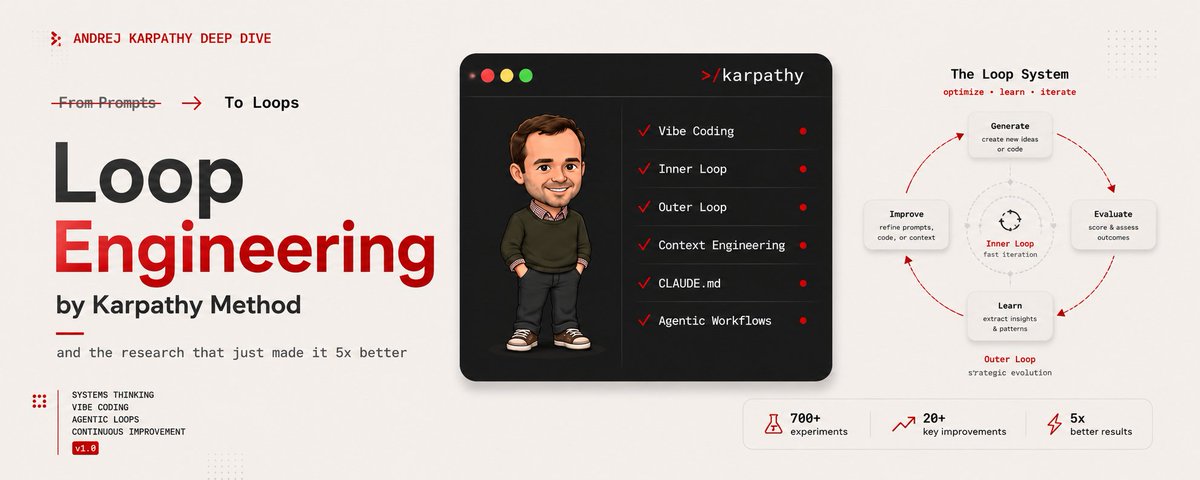
This is f*cking insane. Nvidia founder and CEO Jensen Huang:
"Nobody writes prompts anymore. The new job is building loops and graphs
The engineers who stopped prompting are already years ahead, and the rest will end up working for them".
In this 50-minute talk, Jensen breaks down why prompting is finished and what the best engineers are building now.
Prompts -> Agents -> Loops -> Graphs -> AI Workforce
Using AI was never about typing better prompts into a chatbot.
It's about loops that do the work, and graphs that keep those loops running without you.
95% of people are still polishing prompts, and the 5% building loops and graphs will end up running everything.
This talk is worth more than any $1,000 AI course.
Bookmark it and watch it today.
Then grab the full loop engineering guide below before everyone else catches on ↓

Device Method ▫️ IRL retweeted

Ten million people have watched a TED speaker accidentally destroy the entire brain training app industry.
She filmed the talk once at TEDxVancouver and it has been on YouTube ever since.
Lumosity charges $12 a month to simulate a diluted version of what she covered in 14 minutes for free.
Her name is Dr. Lara Boyd. She is a neuroscientist at the University of British Columbia and the researcher who runs the Brain Behaviour Lab studying how practice physically rebuilds the brain after stroke.
For over a decade she has repeated the same answer to the only question that matters: how do you actually change a brain?
Her entire framework fits on a napkin.
Every experience physically changes your brain. Chemical changes last hours, structural changes last years, functional changes rewire whole networks. The only driver that works is behavior. Nothing beats practice. The harder the struggle, the bigger the rewiring. No two brains need the same dose.
That last rule alone has probably cost the brain training app industry a hundred million dollars in canceled subscriptions.
"The brain you have at the end of this sentence is not the brain you had at the start."
That is a paraphrase Boyd returns to across the talk. London taxi drivers have measurably larger spatial memory regions. Braille readers have larger sensory maps for the reading hand.
Founders install a $15 meditation app and skip the one difficult conversation that would actually rewire their defaults. Parents hand their kid an educational tablet and never let the kid struggle with a problem long enough for the structure to lay down.
The talk is free on YouTube. Boyd's lab publishes its research open-access.
Boyd still teaches at UBC. Almost none of the ten million viewers have added one hour of struggle to their week since watching.
The science is free. The willingness to actually practice the hard thing instead of the easy app is the entire edge.


Song writers, producers, composers, artist, teachers have the potential to benefit from this mode of commentary.
2
22
Device Method ▫️ IRL retweeted

ADHD is a superpower.
"The problem isn't that I can't focus; it's that I can't focus on stuff I don't care about."
"On stuff I care about, I can lock in and you’re not going to find me for months."
So if you have ADHD ...
"The first thing you have to do is reframe the task to find the autonomy."

My conversation with @steven_kotler on flow, cognitive performance, and doing your best work.
Kotler is the executive director of the Flow Research Collective, where he studies flow and the science of peak performance.
In this episode, you’ll learn:
• How to get so absorbed in what you’re doing that distractions fade.
• How to find a challenge that holds your attention without overwhelming you.
• Why a hobby you gave up might be worth picking up again.
• What frustration tells you when you’re learning and how to respond.
• How to focus on work you don’t feel like doing.
• How to think clearly when there’s too much information, and you’re unsure what to trust.
Listen and Learn
(Includes paid partnerships.)