

Write the People, Talk with Code 17 yrs SWE → trading → AI agents Polystrike founder · building in public
Joined April 2010
- Tweets5.5K
- Following1.2K
- Followers185
- Likes3.6K




Pinned Tweet
Got fired in November. Applied through December. Zero interviews.
I have 17 years in software engineering. Last 6 years — fintech and crypto, trading systems, CEX/DEX integrations. Built teams, led projects, stayed hands-on with code the whole time.
Something changed though. It's not the usual November/December hiring freeze — I've been through those before. This time I'm not even getting invitations to interview.
So I stopped waiting and made three bets:
(1) Find alpha in prediction markets. Already built the system, already trading with it.
(2) Learn to build AI agent teams. Same management skills I've been developing for years — delegation, trust boundaries, feedback loops — but the team isn't human.
(3) Ship my own products. Stop depending on someone deciding I'm worth hiring.
I'll share what I learn along the way. First topic — how to give AI agents memory that actually improves over time.
3
6
727


Checked the three biggest KNTQ buys in our 1% pool during that spike. All three also moved MONTRA in the same transaction.
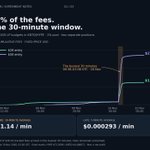
Our $20 + $50 positions picked up around $34 in tracked fees between 00:38–01:08 UTC on Nov 10. Afterwards, income pretty much stopped.
For the next launch, I’d check where the KNTQ buys get routed. A busy launch won’t help your LP if the trades go through a different pool.
Example tx: elyscan.fun/tx/0xb78dd51cd8b…


38
First Elysium LP cash-out done.
Started with $20, added another $50. The actual numbers:
(*) $75.21 total funding, including Ethereum gas.
(*) $37.91 USDT received on Ethereum -- about $37.86 after cash-out gas.
(*) $69.86 still in both LP positions at withdrawal, with liquidity unchanged.
About half the funding is back in stablecoins. The remaining LP value still moves with token prices.
Most fees came from one 30-minute overnight burst. By withdrawal time, income in our 1% pool was close to zero.
23
My Elysium LP tracker is printing zeros while the same pair keeps trading in another pool.
13 of the last 15 one-minute samples showed no increase in earned HYPE or KNTQ. Across both positions.
I checked the on-chain Swap events for the exact pool IDs. As of 10:48 UTC on Nov 10:
(*) Last 5 minutes: 1 swap in our 1% pool vs 62 in the 0.3% pool.
(*) Last 15 minutes: 3 vs 160.
(*)Last hour: 53 vs 954.
Our $20 + $50 positions accrued about $0.0008 over those latest 15 minutes. The longest zero-fee stretch in the past hour lasted 9 consecutive minutes.
These are exact zeros in the earned token amounts. No display rounding involved. Small fills still arrive between the quiet stretches.
Both positions remain in range, liquidity is unchanged, and the collectors are healthy.
Earlier, these same positions accrued $34.20 in one 30-minute overnight burst. Those fees remain unclaimed. All dollar fee figures use fixed token prices, separate from price P&L and exit costs.
Activity in the 0.3% pool doesn't earn fees for our 1% positions. The flow has to reach our pool and our active range.
The accumulated balance still looks good. The current income is mostly zero-fee minutes, while the token price risk keeps running.

1
1
48
Dmitry Belaventsev retweeted

Which Claude model should you build with?
Our new guide breaks down when to use Fable 5.2, Opus 5.5, Sonnet or Haiku. It also covers when to adjust effort instead of switching models, and how to save cost by putting subagents on smaller models.
claude.dev/blog/which-claude…

2/3 -- What the MEV receipts actually showed. (ref: all those posts complaining about MEV bot)
One Elysium MEV round showed +1.804 HYPE if you looked at the pool's trade logs.
The bot actually kept +0.863 HYPE after cash deductions and gas.
I wanted to know where the difference went, so we checked the receipts.
I spent 6+ years building trading systems around Hummingbot. I still want to see the cash flows before I trust a bot P&L screenshot.
The example is a sandwich pattern:
(1) The bot buys.
(2) A user buys in the same pool.
(3) The bot sells.
The bot's first buy pushes the price up. The user buys at the higher price, and the bot sells after them.
In this round, the three transactions landed in blocks 2,020,241, 2,020,242 and 2,020,243.
The pool saw 14.55 HYPE come in on the bot's buy and 16.353552 HYPE go out on its sell. Subtract those and you get roughly +1.804 HYPE.
But the bot's accounts paid 15 HYPE and received 15.862945 HYPE. There were deductions between the bot and the pool on both legs, plus gas.
What it kept: 0.862902 HYPE.
Across eight selected winning rounds from the examples posted by @Clon298363, swap-event differences added up to 13.319 HYPE. The reconstructed net cash gain was 10.291 HYPE — about 23% lower.
We tracked the bot wallet and its execution contract together, checked the token round trips, and reconciled the cash flows with historical balances.
Those eight rounds were profitable. They are not a full audit of the bot's lifetime return or advertised win rate.
There was another interesting detail: in six of the eight cases, the data attached to the bot's buy contained the user's transaction ID (hash) before that transaction was mined.
That's strong evidence of targeting a specific transaction. It doesn't tell us who operated the bot or how it could see the user's trade early.
We also saw the bot get an earlier block while paying less gas than the user. That observation alone doesn't prove privileged access either.
So yes, there are verifiably profitable rounds here. I haven't reproduced the viral million-dollar totals, and I can't attribute the bot to the team.
If someone quotes a bot's profit, I want the actual cash flows and the full set of trades they counted.
Receipts for this round:
Buy: elyscan.fun/tx/0xebeebcb482e…
User: elyscan.fun/tx/0xa1b3b664df3…
Sell: elyscan.fun/tx/0x57f027c801f…

1
75
3/3 -- How much could I actually get back?
My Elysium LP fees were going up while my estimate for closing the experiment was negative.
That was the number missing from the dashboard.
The question I care about is how much I could get back after closing both positions and converting the tokens.
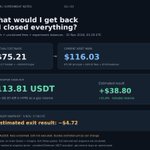
The experiment had $20 and $50 LP budgets. Actual funding was $75.17 USDT, plus about $0.04 of Ethereum gas. Some of that funding remained in the wallets for operations, so counting the whole difference as “fees” would also be wrong.
Here's the Nov 10, 03:28 UTC snapshot, marked at prices at that time:
(*) LP principal: $71.00.
(*) Unclaimed fees: $39.10.
(*) Remaining experiment balances: $5.93.
(*) Total estimated assets: $116.03.
Then we priced the exit.
After an on-chain quote for selling KNTQ and Relay quotes for returning funds to Ethereum, the estimate was 113.81 USDT, with roughly $0.20 retained in HYPE as a gas reserve.
Against a cost basis of about $75.21, that's an estimated gain of $38.80, or 51.6%, including the remaining reserve.
At that snapshot the fees were unclaimed and the exit hadn't been executed. The complete sale-and-exit sequence still needs to be checked before signing. These are quotes, not realized profit.
Earlier, on Nov 9 at 17:58 UTC, the same calculation showed an estimated loss of $4.72. Fees were accumulating then too.
The result changed as fees, token prices and exit quotes changed. A green fee counter couldn't tell me the result on its own.
This is also why I don't buy the argument that a token going up makes impermanent loss unlikely.
If KNTQ rises relative to HYPE, the LP sells KNTQ into that move. I can end up with more HYPE and still do worse than if I'd just held the original tokens. Fees have to make up for that difference.
Price leaving the position's range also stops fee income until it returns. And being able to remove liquidity on Elysium is a different step from getting USDT back to Ethereum. The standard bridge takes roughly 5.5 days, followed by a claim; a faster quoted route has its own costs and execution risk.
I now track three separate numbers: fees earned, the current value of everything in the experiment, and the estimated amount left after an exit.
When we actually close it, I'll have a realized result to compare with these estimates.
Entry receipts:
elyscan.fun/tx/0xcf70a9d4006…
elyscan.fun/tx/0x3e4393a293d…

65
What happened when we pitted forecasting models against Polymarket weather prices:
(*) Market prices were better calibrated than our model, and better than plain historical averages.
(*) The more our model disagreed with the market, the more often the market was right.
(*) Following the most profitable weather traders did not help. Last month's leaders were not next month's.
(*) A model that projects the rest of the day from the latest readings did no better than one that ignores the trend.
These crowds are well informed. Disagreeing with them takes data they do not have.
2
1
44
We timed every public channel for Tokyo's deciding reading, taken at :00 and :30:
(*) Airport radio for pilots: about 2 minutes after the measurement.
(*) NOAA's raw station file: about 6.5 minutes.
(*) Japan's weather service website: about 7.5 minutes.
(*) The official report on aviationweather.gov: about 8.5 minutes.
(*) The market: at the moment of measurement, sometimes a few minutes before.
It even reacts to 10-minute readings that do not count for settlement, within seconds. And it is not one whale: about 15 small wallets move a bucket within two minutes.
Watching the official report will not get you there first.
23
Five things we learned about where Polymarket temperature markets get their number:
(*) Each city settles on one airport station named in the rules. Seoul has two airports: one matches the official result 93% of the time, the other 21%.
(*) Free weather sites often disagree with the official number. A popular one matched only 77% of results; the raw airport report matched all 329 we checked.
(*) Rules change. London and Paris switched their official source in the middle of the season.
(*) In Tokyo only the readings at :00 and :30 count, rounded to whole degrees.
(*) Japan's weather service publishes the same thermometer every 10 minutes in tenths of a degree. Rounded, it matched the official number 102,170 times out of 102,171.
The station and the rounding are part of the bet.
2
96


Does it mean both Anthropic and OpenAI would be asked to stop their businesses?

BREAKING: 🇺🇸 Democrats face a push for a “day 1” ban on AI superintelligence, with up to 20 YEARS in prison for violators.
Arizona Rep. Yassamin Ansari says a pause on advanced AI and a ban on artificial superintelligence must be “top of the Democratic agenda on day 1.”
A bill that would do exactly that was introduced by Bernie Sanders and Greg Casar in September.
Under the bill:
- Developing or deploying superintelligent AI would be banned
- Advanced AI development would pause until a new federal regulator sets rules and a model review process
- A new cabinet-level AI department would monitor frontier models and oversee removing dangerous capabilities, like ignoring shutdown commands
- Companies that try to get around it would face the “corporate death penalty”
- Individuals would face up to 20 years in prison
AI and data centers were a “crucial or major factor” for 56% of voters in the midterms, per an NBC News exit poll.


22
I spent the week posting small numbers: single-digit replay profits, tiny fills, and modest rewards.
Polystrike already makes money on directional bets across prediction markets. The small figures come from testing a different regime: automated market making.
Here is how the system evaluates new strategies:
Every strategy begins in paper trading. If it clears walk-forward validation and fill modeling, it gets a small live budget. Once it demonstrates positive expectancy against real order-book friction, its allocation scales up. If performance drops, capital gets cut immediately, demoted back to paper, or shut down entirely.
Placing orders is straightforward. The primary job of the system is deciding which strategy earns capital, how much to allocate, and when to pull it.
1
23
A displayed liquidity reward pool can look like yield. For a market maker, it is not.
On Polymarket, your reward depends on the size and price of your qualifying quotes relative to other makers. There is also a threshold between accrued rewards and cash: a day pays only if your earnings reach $1. Smaller daily amounts do not carry over.
We reconciled five days of rewards on our wallet, October 2 to 6. On the first three days, it accrued $0.0171, $0.1522 and $0.3997. That was $0.5690 in total, and $0 paid. The next two days qualified and paid $2.8777 and $3.2035, or $6.0812 combined.
This is why I separate the advertised pool, estimated earnings, and actual wallet payments. Rewards may help offset the cost of providing liquidity, but a headline pool cannot tell you whether your quotes made money.
For strategy validation, I track the cash that actually landed in the wallet, the net trading result, and remaining inventory together.
While building Polystrike, I have also collected historical data for prediction-market research.
Here is what is in the archive:
Post-count markets
• Order book snapshots for Elon, Trump and Ted Cruz markets: best bid/ask, spread and available depth.
• In an October 18 audit, the archive contained about 4.9M Elon book rows, 1.0M Trump rows and 1.1M Cruz rows. The audited book history starts in late August 2026.
• Market price and volume snapshots, plus observed post counts for those events.
Forecasts
• 436k saved Elon forecast snapshots from late July to October 18, including model probabilities and observed counters.
Other research data
• Historical liquidity reward configurations: daily pool, minimum order size and maximum qualifying spread.
• London and Paris temperature-market book snapshots and weather-model outputs from an October research sample.
The book snapshots were typically about a minute apart, with gaps. This is research data, not a complete tick-by-tick feed.
I am exploring making selected datasets available. If you are researching prediction markets or building a trading system, DM me with the markets, dates and fields you need.
1
58