

Investment research on AI and semis for individual investors. Follow for more earnings calls, deep dives and our reads on Semis and AI. Not investment advice ⚠️
Marina Bay, Singapore 🇸🇬
Joined October 2022
- Tweets1.7K
- Following413
- Followers785
- Likes779





Pinned Tweet
Kioxia sees AI inference NAND demand growing 56% a year to 2031, 5x training. Data centers pass smartphones as the biggest NAND market in 2026. Our read: KV cache puts NAND on the compute path, and SSDs become "token batteries". $SNDK

Dolphin Sonar #4 · Asia AI: chips & models · Fri, Nov 27
Six things from Asia's AI chain today.
1. Taiwan's packaging can't build fast enough for AMD
One of Taiwan's big packaging houses plans to take its CoWoS-style capacity from about 7,000 interposer wafers a month now to 15,000 by March and 40,000 by the end of 2028, and that already counts its newest capex. People there say $AMD's own forecast calls for close to 100,000 a month by 2028. The limits are tool deliveries and how fast new buildings go up.
2. Top-grade laminate gets pricier, the cheap grades get cheaper
Board makers have been told M8-and-above copper-clad laminate, the grade AI server boards use, goes up another 8–10% at the end of November. The shortage has eased from a 40% gap to about 20% as new lines from Doosan in Changshu and EMC in Zhongshan and Kunshan come up. Ordinary FR-4 is going the other way. Kingboard has already cut prices, and with everyone adding capacity, a board maker expects a crowded 2027.
3. Google and Amazon trim AI board orders
At a board maker that supplies both, $GOOGL's orders are down about 15%, more than the roughly 10% of materials it is short. AMZN's AWS cut about 10% on demand alone, with no supply problem. Gold Circuit and Compeq are seeing similar cuts. Google's next TPU was due to start volume production in March, and that ramp is on hold while its new switch board is revised.
4. Liquid cooling's smallest parts get a bigger bill
A GB300 rack uses 252 pairs of quick connectors for its liquid cooling, up from 108 in GB200, so each rack carries more of them and at higher value. Asian suppliers are taking share in China's AI data centers: Taiwan's AVC more than doubled its share to 11.7% in the first half, while the two Western leaders, Staubli and PH, both lost ground.
China models
5. ByteDance builds a domestic chip bench for inference
Iluvatar CoreX's Tiangai 300, launched in July, has finished testing at ByteDance and scores about 90–95% of an H200, people at the chipmaker say. ByteDance plans to put it on prefill, the step that reads the prompt, in a split setup, with decode likely on Huawei's Ascend 950. ByteDance may take about half of the roughly 100,000 cards Iluvatar expects to ship in the second half, and Iluvatar has already stocked HBM for 100,000 Tiangai 300s.
6. Hygon splits the work to stretch domestic chips
Hygon and Tsinghua spinoff Qingcheng showed a setup serving Zhipu's GLM-5.3 with Hygon's DCU cards on prefill and higher-end cards on decode: 32 Hygon cards plus 8 high-end ones across five servers. They claim over 3x the end-to-end inference of an all-high-end setup at the same build cost. It only works with 90–97% of the context already cached, so it suits agents and long documents, and decode still needs the high-end cards.
Dolphin's read: China's inference is going mixed-fleet. Domestic chips take the prefill side and the scarce high-end cards stay on decode, and into 1H27 more Chinese model companies serve this way. Across the hardware chain, the top grades of materials and packaging stay tight while everything a grade below keeps getting cheaper.
Watching:
- Early Dec: whether the 8–10% rise on M8-grade laminate sticks
- March: Google's next TPU volume ramp, now on hold
— Dolphin Research · Sonar runs every US trading day before the open


2
206
AI and reshoring could add 105–180 GW of US peak load by 2030, yet reliable generating capacity barely grows and grid hookups take ~5 years. Our read: the shortage is structural; for $NVDA's customers, power, more than chips, may now set the pace of AI.

NVDA told DELL and SMCI to stop shipping servers to Malaysia, Singapore, Thailand and Indonesia. OpenRouter: token volume up 44x this year, spend only 7.6x. Our read: export controls now track who uses the chips, and AI unit prices keep sliding. $NVDA

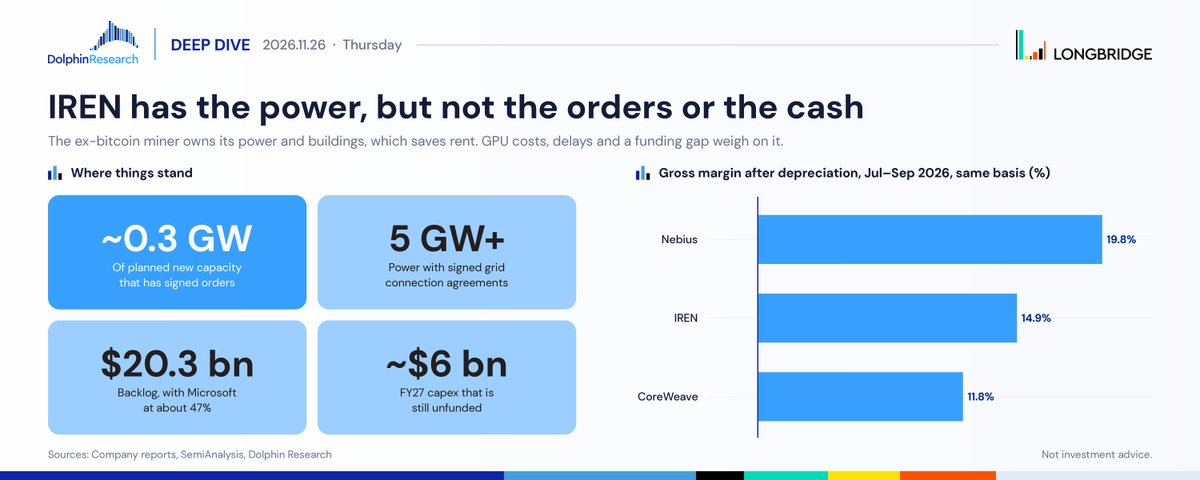
$IREN holds 5 GW+ of grid-approved power and its own land, yet only ~0.3 GW of its planned capacity has orders. Our read: owning power saves rent, but GPUs are the real cost, and IREN trails CoreWeave and Nebius on orders, chips, delivery and funding.
Dolphin Sonar #3 · Asia AI: chips & models · Thu, Nov 26
Six things from Asia's AI chain today.
1. China's data centers get signed faster than they fill
$GDS cut its 2026 capex guide to RMB 8.5 bn from 10 bn with its 3Q results on Wednesday. Customers keep signing: about 154,000 sqm of new commitments in the first nine months, about 2.7 times the 56,000 sqm they moved into. Management says it now only takes orders that run on domestic chips and come with take-or-pay terms. A global bank reading the call puts the slower move-ins on customers' GPU supply. VNET said much the same on Monday.
2. Southeast Asia's GPU clouds get a shorter customer list
Since $NVDA set up a customer whitelist, the number of Asian buyers cleared for its AI chips has fallen by more than half. Its sales staff have told some customers, verbally and with nothing in writing, that at least 51% of services in future contracts must go to non-Chinese clients. Megaspeed, now on the US entity list, has a Malaysian sister company that bought at least $4.8 bn of Nvidia gear between mid-2024 and February. Singapore said this week it will not enforce US export rules for Washington, so the checking falls on Nvidia's own sales desk.
3. Cooling orders keep growing
GOOGL's plans for coolant distribution units over the next 24 months are now about 33,000, up 80% on earlier forecasts, with about 18,000 in 2027 alone. In China, BIDU, BABA and Tencent are expected to double their data center capacity to about 5GW in 2027, with liquid cooling demand up 150–200%. Cooling gets ordered with the building, before the chips show up.
4. China's chip design tools start working as a chain
At a Huawei forum on Tuesday, Huawei and Xingxin showed Tau EDA, which they call the first time Chinese EDA tools have been chained together on a real project, with a chip designer, several fabs and a packaging house involved. The tools named cover back-end signoff, so it is still short of a full design flow, and no node or chip was disclosed. On the research side, mainland institutions have 105 papers at ISSCC 2027, a record, up from 81.
China models
5. ByteDance's agent push meets the app wall
ByteDance opened an invite-only beta of Xiaodou on Tuesday, a standalone assistant built on Doubao with long-term memory and 40+ connectors, from Douyin and Feishu to calendar and health. It can draft and send a Feishu message almost instantly. Ordering and paying stay with the user. Access is the limit: 151 apps, mostly from Tencent, BABA, Meituan and Kuaishou, have refused screen automation. Phone makers keep control too. Honor's new 700 series, on sale Friday, ships "YOYO Doubao" but keeps on-device control and gives Doubao only the cloud side.
6. Tencent fits three model jobs into 8GB
WeChat's team open-sourced WePocketModel (WePM), a 4B model that handles retrieval, generation and simple decisions with one set of weights, about 8GB. It says that is 61.9% less memory than three specialist models at about the same average score, and it runs fully on a Mac. On devices, memory is the expensive part: one third-party count puts DRAM plus NAND at about 43% of a phone's bill of materials now. Tencent's Hunyuan keeps hiring too: people in the industry say Wang Ruochen, who demoed ChatGPT Voice at the GPT-5 launch, has joined its Hong Kong team for multimodal work.
Dolphin's read: China's AI build is paced by chips now. Into 1H27, data center operators keep signing space faster than they fill it and keep trimming capex, while cooling and power orders keep growing. Southeast Asia stops being an easy way around the rules. In models, the contest moves to who owns the phone screen and how little memory a model needs.
Watching:
- Feb 14–18: ISSCC 2027, where Huawei details its custom HBM
- Early March: GDS's 4Q results, and whether move-ins start catching up with bookings
— Dolphin Research · Sonar runs every US trading day before the open


Partly played out.
Sonar #1 (Nov 24): after the export rule, a bank cut its 2028 SE Asia data center forecast 15%. FT today: Nvidia told Dell and Supermicro to halt AI server shipments to Malaysia, Singapore, Thailand, Indonesia.
Our read: SE Asia's 2027 build lands below plan.

Dolphin Sonar #1 · Asia AI supply chain · Tue, Nov 24
Five things from Asia's AI supply chain today.
1. Half of Google's TPUs go to outside customers in 2027
Google ($GOOGL) keeps about 75–80% of its TPU output for itself this year and about 50% next year. CoWoS sets the ceiling: it's sold out through 1H28, mostly to NVIDIA ($NVDA), which already trimmed 2026 TPU shipments at Broadcom (AVGO). MediaTek (TW: 2454) is moving its next TPU design to EMIB packaging from Intel (INTC). The 2027 order from Anthropic (ANT), the biggest outside one, firms up by mid-December.
2. Tencent's 2027 AI capex comes in below 2026
The new US rules cut the overseas chip budget at Tencent (HK: 00700) roughly in half next year. Domestic chips from Huawei, Kunlunxin and Enflame cover inference; for training, Huawei is the only option, and HBM is short. Domestic AI chip prices are set to rise in 2027.
3. The PCB squeeze moves to looms and drill bits
From a global bank's visits to Chinese PCB and laminate makers: electronic glass cloth went from about 5 to 21 yuan per meter since last December. Kingboard Laminates (HK: 01888) has locked up half of Toyota's new weaving looms through 2028. Drilling now takes 30–40% of PCB line capex, up from 20–25%. Nanya New Material (SH: 688519) runs at full capacity and aims to start shipping to NVIDIA in 1Q27.
4. ASMPT: photonics is the fast part
At an investor conference, ASMPT (HK: 00522) said logic chips drive most of its TCB bonding demand next year. Meaningful HBM volume is unlikely in 2027, though it is testing TCB for HBM5 with a Korean chipmaker. Photonics revenue in the second half could be 2–3x the first half's ~$75 mn.
5. SE Asia data centers: a bank cuts its 2028 build
After the US export rule, a global bank's Asia power team cut its 2028 SE Asia data center capacity forecast by 15% and 2028 data center power demand by a third. US hyperscaler spillover keeps the 2030 build-out going.
Dolphin's read: every layer of AI compute is being rationed. CoWoS decides how many TPUs exist, US rules cap China and SE Asia, and HBM caps China's domestic chips. Into 2027, the makers of the scarce inputs (packaging tools, laminates, glass cloth, drill bits) keep pricing power, and the buyers are the ones changing plans.
Watching:
- Mid-December: size of Anthropic's 2027 TPU order
- 1Q27: whether a mainland laminate maker ships to NVIDIA
— Dolphin Research · Sonar runs every US trading day before the open


2
4
191
CXMT's 4F² DRAM could lift bits per wafer by 30–50% without EUV. Samsung leads the Big Three on 4F², SK Hynix is a node behind and $MU is last. Our read: little impact before 2028, but a good CXMT ramp would put real pressure on DDR prices.

NVDA fell as much as 9.2% before closing -3.9%; the Nasdaq 100 cut a 4.7% drop to 0.64%. Credit didn't bounce: S&P put NVDA on negative watch and CoreWeave CDS jumped a record. Our read: the bounce is positioning; AI funding stress is still live. $NVDA

Dolphin Sonar #2 · Asia AI: chips & models · Wed, Nov 25
Six things from Asia's AI chain today.
1. Memory is trading as two markets
A day after a bank called memory the weakest link in the AI chain, the split is visible on the ground. An edge-chip industry expert describes panic selling in spot memory, with eMMC prices down 30–40%. Device makers there are hit twice, as lead times for high-end HDI boards went from under a month to two or three. The AI side reads differently. After a European roadshow, a global bank reports no sign of order cuts and no large cleanroom additions ready before 2028. It sees custom ASICs going from 31% of HBM demand last year to 57% in 2028.
2. A Chinese oilfield supplier is now a data center power vendor
From a global bank's note: Jereh has signed about 16.4 bn yuan of data center power equipment orders this year, its largest ever for one business line, at gross margins above 60%. Delivery lags orders by about two quarters, so most of the revenue lands in 2027. Relay maker Hongfa has 800V data center power moving from pilots to first small orders with global tech customers.
3. Huawei's hard-drive alternative goes into trial use
From a Chinese broker's note: Huawei Cloud has deployed its magneto-electric drives (MED) at its Ulanqab data center, with more than 30 customers in trial use and a wider China rollout for warm and cold data planned for 2027. One rack holds about 10PB at under 2kW, roughly a tenth of the power of a hard-drive array. Hard drives and tape both come from a handful of non-Chinese makers. This is a third option, built at home.
4. China's data centers wait on domestic chips
On its 3Q call this week, $VNET said visibility on domestic chip supply is low. It expects a bumpy 1H27, with most new deliveries coming online in 2H27. Its reasons: HBM supply, and foundry capacity that could shrink under tighter US export rules. No customer has formally asked for a delay, and capex is now tied to firm orders. Renting is getting dearer in the meantime: long-term contracts for H100s in China are up 18% since July.
China models
5. Tokens get cheaper, and Tencent jumps to #2
On OpenRouter, the usage-weighted token price fell about 20% in November while total spend kept rising. This week Tencent's Hy4 flash sits at #2 by tokens behind DeepSeek, and the top four models are all Chinese. The paid side is moving too: Tencent's WorkBuddy took in five times as much revenue in 3Q as in 2Q.
6. Zhipu's GLM-5.4 gets deeper without getting bigger
Zhipu shipped GLM-5.4 on Nov 23. It reuses a block of layers in a loop, keeping the parameter count flat, and says about 10% more training compute buys the depth of a model three to four times its size. In use it is still heavy: in one third-party end-to-end test it needed about 4x the time and about 15x the tokens of $GOOGL's Gemini 4 Neon for the same job. There is no API yet, so independent benchmarks have to wait.
Dolphin's read: China's token demand is running ahead of its compute. Into 1H27, token prices keep falling while GPU rents and domestic chip prices keep rising. The squeeze lands on model companies' margins, and pricing power sits with whoever holds powered capacity. In memory, the cracks stay in consumer-grade spot while AI-grade supply stays tight.
Watching:
- December: whether Zhipu opens GLM-5.4's API to outside testers
- January: 1Q27 DRAM contract prices, the first test of whether spot weakness reaches contracts
— Dolphin Research · Sonar runs every US trading day before the open


AI needs more memory and faster memory. HBM stacks dies vertically and sits beside the GPU on a silicon interposer, giving it 1,000–2,000-bit data paths. Our read: stacking and packaging now decide who wins, and $SKHY's MR-MUF bonding is its edge.

Dell's AI orders held at $60.2 bn and backlog rose to $132.3 bn, even as neocloud funding tightens. Revenue was $54.9 bn vs. $49.3 bn expected. Our read: the beat leans on traditional servers, and $DELL still won't say how much backlog is neocloud.

Dell's book says the same: a record $132.3B AI backlog at quarter end, and FY27 revenue guidance raised by $10B to $202B. Racks already booked for 2027 need memory that is already short, so the gap keeps widening into next year.

Best Buy: PC prices up ~25% on memory costs
HPE: memory shortage lasts "to at least the second half of calendar 2028"
Dell: gap between supply and demand "continues to widen"
Analog Devices: "it's tight everywhere"
1
1
224
The Jensen reinstatement rally lasted one day: SOX -7.88% and NVDA -5.9% as money rotated into healthcare. DELL says no customer has rescheduled. Our read: AI server demand still beats supply, but pricing power is moving away from box makers. $NVDA

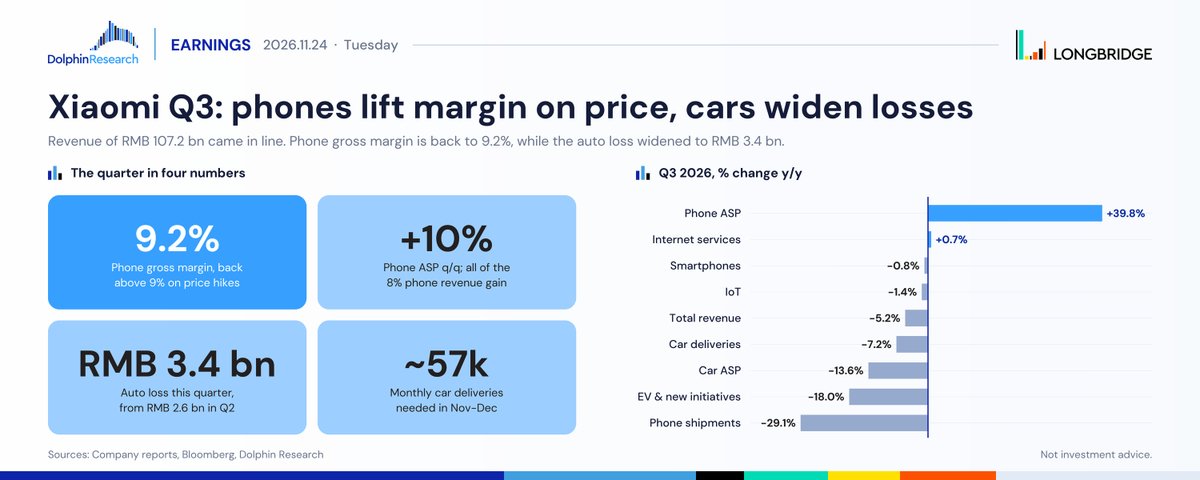
Xiaomi Q3: phones pulled gross margin back to 9.2% on a 10% q/q price rise. Cars went the other way: price per car down to RMB 225k, auto loss up to RMB 3.4 bn. Our read: phones and IoT have found a floor; cars still lack a hit. $XIACY
1
233
Dolphin Sonar #1 · Asia AI supply chain · Tue, Nov 24
Five things from Asia's AI supply chain today.
1. Half of Google's TPUs go to outside customers in 2027
Google ($GOOGL) keeps about 75–80% of its TPU output for itself this year and about 50% next year. CoWoS sets the ceiling: it's sold out through 1H28, mostly to NVIDIA ($NVDA), which already trimmed 2026 TPU shipments at Broadcom (AVGO). MediaTek (TW: 2454) is moving its next TPU design to EMIB packaging from Intel (INTC). The 2027 order from Anthropic (ANT), the biggest outside one, firms up by mid-December.
2. Tencent's 2027 AI capex comes in below 2026
The new US rules cut the overseas chip budget at Tencent (HK: 00700) roughly in half next year. Domestic chips from Huawei, Kunlunxin and Enflame cover inference; for training, Huawei is the only option, and HBM is short. Domestic AI chip prices are set to rise in 2027.
3. The PCB squeeze moves to looms and drill bits
From a global bank's visits to Chinese PCB and laminate makers: electronic glass cloth went from about 5 to 21 yuan per meter since last December. Kingboard Laminates (HK: 01888) has locked up half of Toyota's new weaving looms through 2028. Drilling now takes 30–40% of PCB line capex, up from 20–25%. Nanya New Material (SH: 688519) runs at full capacity and aims to start shipping to NVIDIA in 1Q27.
4. ASMPT: photonics is the fast part
At an investor conference, ASMPT (HK: 00522) said logic chips drive most of its TCB bonding demand next year. Meaningful HBM volume is unlikely in 2027, though it is testing TCB for HBM5 with a Korean chipmaker. Photonics revenue in the second half could be 2–3x the first half's ~$75 mn.
5. SE Asia data centers: a bank cuts its 2028 build
After the US export rule, a global bank's Asia power team cut its 2028 SE Asia data center capacity forecast by 15% and 2028 data center power demand by a third. US hyperscaler spillover keeps the 2030 build-out going.
Dolphin's read: every layer of AI compute is being rationed. CoWoS decides how many TPUs exist, US rules cap China and SE Asia, and HBM caps China's domestic chips. Into 2027, the makers of the scarce inputs (packaging tools, laminates, glass cloth, drill bits) keep pricing power, and the buyers are the ones changing plans.
Watching:
- Mid-December: size of Anthropic's 2027 TPU order
- 1Q27: whether a mainland laminate maker ships to NVIDIA
— Dolphin Research · Sonar runs every US trading day before the open
Partly played out. Sonar #1 (Nov 24): after the export rule, a bank cut its 2028 SE Asia data center forecast 15%. FT today: Nvidia told Dell and Supermicro to halt AI server shipments to Malaysia, Singapore, Thailand, Indonesia. Our read: SE Asia's 2027 build lands below plan.
69
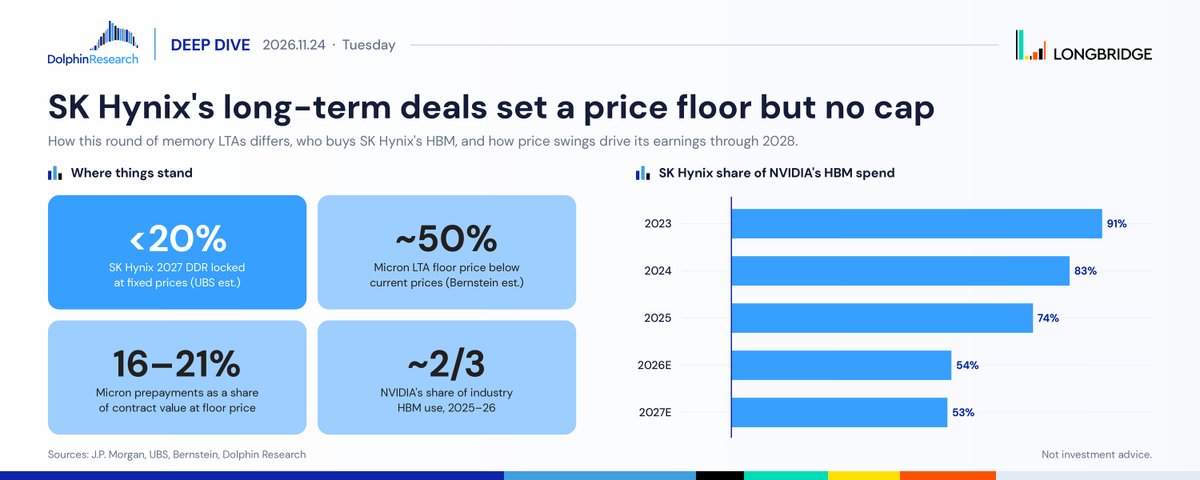
Memory LTAs now come with deposits, price floors and cloud-giant buyers. SK Hynix locks under 20% of 2027 DDR at fixed prices and sets no price cap. Our read: LTAs raise the floor under $SKHY's earnings, and the cycle stays.
Many new followers today came from @jiahanjimliu's repost for our HBM capacity work. The next memory supply question is China's CXMT, we did write a deep dive last month.
The article is about CXMT's first 4F² DRAM lands by year-end: up to ~50% more cells per area, no EUV.
Our call since October: a launch or samples this year, real volume around late 2028.

5
526
Thanks for Jim's recognition 🫡 Btw we will post out deep dive on $IREN soon this week

@dolphinR123 is a small and very underrated account in tracking HBM capacity.
There was a 13% shortage in 2026 but will balance out in 2027 but prices remain high because there’s no spare capacity.
1
14
2,742
DRAM demand, HBM included, tops supply by about 13% in 2026, then roughly balances in 2027. HBM tightens in 2027–28. Our read: SK Hynix's long-term deals set price floors with no caps, so $HXSCL has more upside while memory stays tight.
